
… demanded to know why she should waste her time studying three sciences to GCSE given that she did not wish to pursue a career in maths or science …a view her mother supported. It could be that, as a former editor of the Catholic Herald, Cristina Odone’s disengagement with science has deep roots. However, last time I looked on the Telegraph website there were over 500 comments on the article and those I sampled were not particularly sympathetic to her point of view, mostly making the obvious counter-arguments. I suggest mother and daughter have a day out at Compton Verney to see and reflect on, Periodic Tales: The Art of the Elements - perhaps Izzy will have second thoughts. At least, she might take a look at Compton Verney’s video on YouTube:
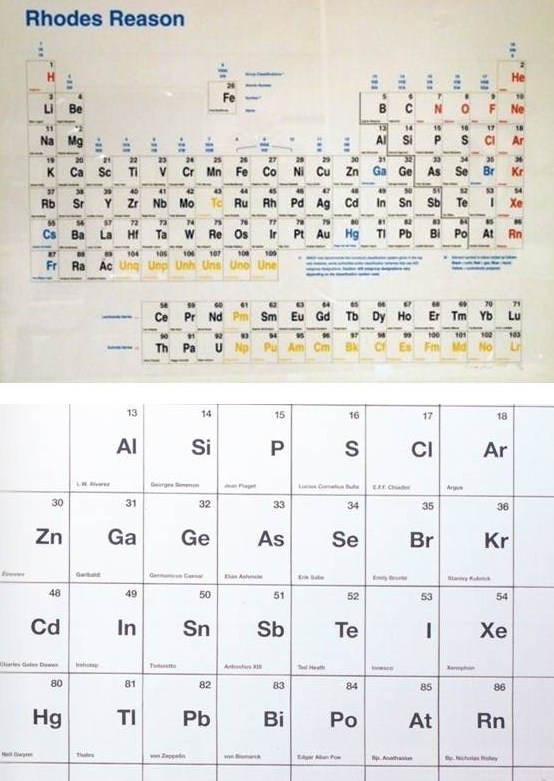
To be honest, this exhibition is rather more about British contemporary art than about science*. It draws on Hugh Aldersey-Williams's book, Periodic Tales, – he co-curated at Compton Verney – and aims in his words to provide a “cultural history of the elements”. The starting point, after a brief dabble with alchemy, is the periodic table of the 118 elements (at present, 24 of them man-made). After that, about 30 works are arranged around a succession of 15 of the elements, mostly metallic. The periodic table is, as they say, iconic and its appearance can be adapted for all sorts of purposes, as in the exhibition poster above. Simon Patterson is probably best-known for his lithographic take on the London Underground Tube map, The Great Bear. Another of his lithographs, Rhodes Reason (1995, below top), and his much larger assembly of ceramic tiles Quattro Formaggi II (1992, below lower), play with the appearance of the periodic table and its namings (for example, Br becomes Bertolt Brecht; Sn, Tintoretto) are among the first things a visitor encounters.
The next section is given over to Primo Levi’s short story collection, The Periodic Table, with accompanying linocuts from 1994 and of the same title by Bill Woodrow. The first element is Silver as in the crushed and suspended Thirty Pieces of Silver (Exhaled), Sugar Bowl** (2003, below), one of eight pieces in the show by Cornelia Parker.

Gold can, as it were compensating for its price, be hammered very thin as in John Newling’s Value; Coin, Note and Ellipse (2011, below), made with pressed and gilded Jersey kale.

Mercury is present in spirit rather than its tricky reality in Marc Quinn’s Etymology of Morphology (1996, below) made of silvered glass.

Antony Gormley’s Fuse (2011, below top) is made from cast Iron (well-rusted, so we are looking at ferric oxide) and Eduardo Paolozzi’s Tin Head –Mr Cruickshank (1950, below lower) explains itself:

Roger Hiorns’ Nunhead (2004, below top), with engines covered in Copper sulphate crystals, is dramatic but hardly elemental. Nor is Danny Lane’s Blue Moon (2015, below lower) made of glass with a Cobalt compound, also blue:

Heatherwick Studio’s Aluminium Billet 1: Extrusion 9, (2009, below top) comes with a video showing its fabrication in China, the country on whose nuclear power industry the UK will be increasingly reliant. Once we had our own, as Kate Williams’ and Keith Lloyd’s striking Uranium glass (well, uranium oxide probably) Nuclear Power Stations remind us; Springfield Nuclear Power Station (both 2006, left, below lower) and Dounreay Nuclear Power Station (right, below lower):

Whether David Nash was thinking about Carbon when he produced his charcoal Nature to Nature 4: pyramid, sphere, cube (1990/94, below top), we don’t know, but Tim Etchells was certainly thinking about Neon when he made something common in the universe but rare on earth (2015, below lower) for the show:

On the way in and out, you can hardly miss David Nash’s Big Black (2008-15, below) in carbonised California redwood:


Periodic Tales: The Art of the Elements ends on 13 December
* The exhibition catalogue in its Endnotes and elsewhere states that “The chemical elements are the fundamental building blocks of all matter”. “Up to a point, Lord Copper”, depending on what is meant by “fundamental” and “matter”. The chart below comes from Wikipedia:

The periodic table arranges the elements by their atomic number which is the number of protons in the nucleus. Protons and neutrons are the Nuclei in this chart above. An element has an equal number of protons and electrons. Protons are positively charged, electrons negatively. Electrons are a type of Lepton, see the chart. The periodic table groups the elements to reflect their electron configurations, when these are similar, the elements have similar properties, eg the noble gases, like neon. The same element can have different numbers of neutrons – isotopes of the same element. For example, most hydrogen on earth has just one proton and one electron, but it can have one neutron, when it is called deuterium, or two, tritium. Tritium, unlike deuterium, is unstable and decays to produce an isotope of helium – radioactivity.
** Or possibly Thirty Pieces of Silver (Exhaled) cake stand (2003).


