
The current Royal Academy Summer Exhibition in London is the best I can remember in over 20 years, most of it good, very little bad or ugly, and the most enjoyable one too, with virtually no photography restrictions and images of all the works available on line. The co-ordinator, Michael Craig-Martin RA, has made the gallery spaces more colourful and reallocated the architecture and other themes within the Academy galleries. At which point I suggest that anyone who reads this post as far as this would, instead of continuing here, probably gain more from exploring the RA Exhibition website pages which include a short introduction by Craig-Martin, behind-the-scenes videos and personal selections by Sebastian Faulks, Grayson Perry, Cath Kidston and others.

But for the record, here are a few items which registered with me out of more than 1100 on show in this slyly cerebral Summer Exhibition. Even before going in, I liked Jim Lambie’s treatment of the main staircase with ZOBOP (above). Craig-Martin chose magenta for Gallery III, enhancing all the work there, including his own Untitled (Watch) (below centre).

In that gallery I was also struck by Gillian Ayres' Tremenheere (below top left), Chantal Joffe’s Megan in Spotted Silk Blouse (below top right) and Mick Moon’s Noon Fishing and Dawn Fishing (below lower left and right respectively).

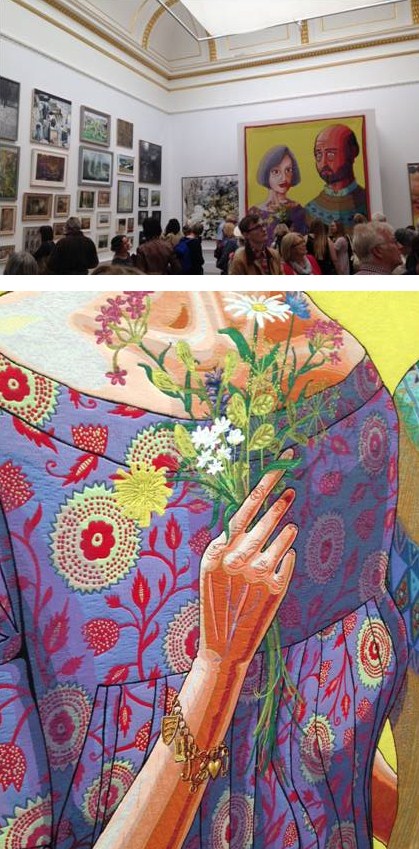
Gallery I this year is given over to small works with the exception of Grayson Perry’s tapestry, Julie and Rob, (below). As explained here in a post in May about A House for Essex, Julie Cope is a fictional “secular Essex everywoman”. Her charm bracelet includes that county’s shield, a cassette tape (a generational thing) and the cause of her untimely decease – was there a particular choice of wild flowers for the bouquet?
The Large Weston Room (below) now has the architectural models and drawings – I sometimes wonder whether the notions on show will ever be constructed but inspiration has to start somewhere, as with Gehry’s Fondation Louis Vuitton.

The Small Weston Room, no longer crammed with small works, is given over to some impressive drawings in ink on torn pages by William Kerridge, installed there by the artist, for example Untitled (The Periphery) (below):

There were two abstract pieces appealed to me in Gallery IV: Christine Stark’s When D'You Last Think You Saw It? (below upper) and Marion Jones’ Bars and Triangles (below lower):

Galleries V and VII are given over to prints, scores of them. So here are just a few; John Duffin’s etching Thames Bridges East (top left below) and Julian Opie’s Tourist with Beard (top right below); and two with South West scenes, Catherine Greenwood’s Silbury Treasure and Iona Howard’s Goonhilly Downs (below lower left and right respectively):

Between V and VII, Gallery VI is arranged by Craig-Martin with several interesting pieces including Lisa Milroy’s Black Dress (below left) and Gary Hume’s The Blue Ground (below right):

which is in the background to this photograph of Anish Kapoor’s study of refraction, Untitled (below):

Gallery VIII provided many fine things, including another South West scene, Cyril Croucher’s PZ101 at Mousehole (below left, PZ indicates a fishing boat registered at Penzance, Cornwall) and two contrasting bronzes by James Butler, Soldier and In the Sun (below right, upper and lower respectively):

Gallery IX, arranged by Alison Wilding and Bill Woodrow around Michael Sandle’s monumental bronze, As Ye Sow So Shall Ye Reap: An Allegory (Acknowledgements to Holman Hunt) (below left), included some interesting political pieces like Bob and Roberta Smith’s Sir Peter Bazalgette's P45, positioned just below Allen Jones’ Salome, (below right):

and Emily Allchurch’s Babel London (After Bruegel) (below) with its warning signs:

The Lecture Room is given over to things sculptural, for example Antony Gormley’s series of six “Small” below:

Nicola Hicks’ Relic (below top) and Dido Crosby's 5 Sheep and a Goat (below lower) seem particularly flattered by the sky blue walls:

More challenging are Eva Rothschild’s What the Eye Wants (below top) and Phillip King’s The Unpainted Gum Tree (below lower):

Geoffrey Clarke’s Taunton Deane Crematorium Test Panel was at Crucible2 in November.
Finally, Gallery X is exclusive to Tom Philips’ A Humement (1966-2015), a page-by-page artistic reworking of an old book (below):

The RA Summer Exhibition 2015 ends on 16 August.


