Showing posts with label Dulwich Picture Gallery. Show all posts

21 September 2015

Canaletto at the Holburne, Bath

It is difficult to imagine anyone taking a strong dislike to the art of Canaletto (Giovanni Antonio Canal, 1697-1768). Representational certainly, camera obscura produced even, nonetheless it provides an invaluable, almost photographic, record of the Europe of nearly 300 years ago. From 1746, when he was invited by the Duke of Northumberland to record the construction of the new Westminster Bridge, to 1755, Canaletto painted English scenes, mostly in London. Canaletto Celebrating Britain, now at the Holburne Museum, Bath after a first showing at Compton Verney, brings together major works from his time here.


The son of the painter Bernardo Canal, and hence known as Canaletto, was born into a townscape shaped by architects like Andrea Palladio (1508-80). So starting the show with a reminder of Canaletto's Venice and two fine canvases from Manchester of about 1740, Church of the Redentore (below) and Church of San Giorgio Maggiore, seems wholly appropriate.


Canaletto's Britain then follows, starting with two of Compton Verney's own scenes of the London pleasure gardens of the day, The Interior of the Rotunda, Ranelagh, London (1754) and The Grand Walk, Vauxhall Gardens, London (c1751, below):


followed by Dulwich Picture Gallery's View of Walton Bridge (c1754, poster above) and the Royal Collection's two Views from the Terrace of Somerset House (1750-51) of the City and of Westminster (below):


The Old Horse Guards from St James' Park (c1749, below) is complemented by the rarely shown c1752 view of the New Horse Guards.


Canaletto's paintings are large so there is an inevitable loss of detail in small scale reproductions. A close look at the originals reveals some pleasing features, for example the coach and horses going over Walton Bridge and the carpet beaters at work near Horse Guards:


And they invariably flatter the English climate by making it resemble the Italian spring of an aristocrat's Grand Tour.

Finally, Canaletto's legacy is demonstrated in works by Samuel Scott - An Arch of Westminster Bridge (c1751, below):


 and William Marlow's dramatic and imaginary fusion of London and Venice, Capriccio: St Paul's Cathedral and a Venetian Canal (c1795, below):


Although the construction of Georgian Bath in the Palladian style had begun in the early 1700s and the Circus was under construction at the time he left England, sadly for us Canaletto does not seem to have had the opportunity to paint in the fashionable spa.

Canaletto Celebrating Britain ends in Bath on 4 October and will be at Abbot Hall, Kendal from 22 October to 13 February 2016.


24 April 2015

Ravilious at the Dulwich Picture Gallery

Possibly like others, I’m not sure when I first became aware of the work of Eric Ravilious (1903-1942). As late as 1982, Freda Constable commented in The England of Eric Ravilious that:
Despite three retrospective exhibitions [in1948, 1958 and 1972], Ravilious has been relatively neglected since the war. (page 35)
And again, perhaps like others, when I have seen his work it has been more by way of reproduction than on show. I missed the centenary exhibition, Imagined Realities, which was held at the Imperial War Museum in 2003 and is considered to have revived interest in his work, so I was keen to visit Ravilious, a major survey of his painting, mostly watercolours, currently at the Dulwich Picture Gallery.

Ravilious graduated from the Royal College of Art (RCA) in 1925 and died in 1942 in action as a war artist. A chronological survey spanning less than two decades would have been problematic in any circumstances and at Dulwich more than half of the works are 1938 or later, more than a quarter 1940 to 1942 (see Notes below). As an alternative the Curator has chosen six successive themes (matching the Gallery’s layout) for the artist’s work: Relics and Curiosities, Figures and Forms, Interiors, Place and Season, Changing Perspectives and Darkness and Light. Here are some of the items which I found particularly interesting within this sequence, but I could easily add more.

Relics and Curiosities

The Waterwheel (1938, below top) and Ship’s Screw on a Railway Truck (1940, below middle) are both juxtapositions of man-made objects seemingly out of place in the landscape. Submarines in Dry Dock (1940, below lower) are even more like fish out of water. On Bomb Defusing Equipment (c1940), see below.


Figures and Forms

Figures are distinctive in Ravilious’s work if only by being absent when they might be expected. His portrait of his close friend Edward Bawden Working in his Studio (1930, below top) is in tempera so doubly exceptional, as were the lithograph studies of submariners like Commander of a Submarine Looking Through a Periscope (1941, below lower).


Interiors

At the RCA Ravilious trained as a designer and few details seem to escape him, as, for example, in RNAS Sick Bay, Dundee (1941, below top) with its crested counterpain and Walrus aircraft, and in Train Landscape (1940, below middle), one of his most popular images and in marked contrast to the grim underground atmosphere of No 1 Map Corridor (1940, below lower).


Place and Season

There is a sense of loneliness conveyed in many of Ravilious’s works. The landscape of southern England, although shown as shaped by agriculture, is often unpeopled, as in Downs in Winter (1934, below top). There is only one sailor on deck on the Ship Leaving Scapa Flow (c1940, below lower).


Changing Perspectives

In 1939, Ravilious painted some of the chalk figures to be found on southern English hillsides, for example The Westbury Horse (in the poster and in Train Landscape above), which is in Wiltshire, South West England and the Wilmington Giant and The Cerne Abbas Giant (below), the latter in Dorset, South West England. 


Darkness and Light 

The fact that the majority of the pictures in this section, some of them particularly striking, are war art, adds to the appeal of the peacetime works, for example Bathing Machines, Aldeburgh (1938, below top). Ravilious witnessed the disastrous (for the British) Norwegian Campaign of 1940 and produced some remarkable images like Norway (below middle) and HMS Glorious in the Arctic (below lower). On this occasion his depiction of the monoplane aircraft (RAF Hurricanes) seems imprecise. The ship was lost with considerable loss of life the following day*.


A personal favourite of mine is Dangerous Work at Low Tide (1940, below top) portraying the disposal of a magnetic sea mine – note the non-magnetic wooden oars and barrels. Almost certainly Bomb Defusing Equipment (c1940, below lower) is a companion piece to this work. Sadly, if only from a technical rather than artistic point of view, this is not only hung back at the start of the show among the Relics and Curiosities but has been mis-titled at some stage in its life - it should be Mine Defusing Equipment. (One blogger recently called it Bomb Diffusing Equipment, even worse!).


Ravilious has shown a German magnetic mine in the background as in this contemporary (or more likely post-War) magazine illustration (below, from, but unattributed by, the World of Warships website).


Studying the list of items Ravilious included in his picture (below) makes it clear that the hoops on the barrels in both pictures are brass (11. Brassringed tub), another non-magnetic material, similarly some of the specialised tools (1. Copper Hammer”).  It looks as though the dangerous work started with the parachute case.


The Ravilious Catalogue by the Curator, James Russell, is well worth having and available on Amazon for those who can’t get to Dulwich. Ravilious continues until 31 August and is a must for anyone who likes his work, Bawden’s, the Nashs’, Rex Whistler’s … and the Romantic Moderns in general.

* See James Russell’s Ravilious in Pictures The War Paintings, page 20. His Ravilious Submarine is more wide-ranging than its title suggests but expensive.


NOTE

While statistics and charts feature sometimes in posts on this blog, this is the first (and possibly the last) on an art exhibition to include histograms. The first supports the point that a chronological show would have been dominated by Ravilious’s final work particularly that after 1939**:


The Catalogue (pages 156-157) also lists three pre-War exhibitions and identifies those works which are at Dulwich in 2015:


** Data from the Catalogue pages 22-154. Works dated circa a particular year (7 in all) eg c. 1937 are included in that year; works with date ranges (5) eg 1939-1942, are included in the later year. Lithographs - 1937 (1) and 1941 (7) – are excluded as was c. 1930s (1).


8 December 2014

Constable at the V&A

Constable: The Making of a Master at the Victoria and Albert Museum, London aims:
… to offer a new interpretation of Britain’s best-loved artist. ... For the first time, Constable is presented alongside the old masters of classical landscape whose formal values he studiously assimilated. By combining the authority of their compositional ideas with a breathtakingly naturalistic vision that was entirely his own, Constable would ultimately transform the genre of landscape painting, and in the process shape the enduring popular image of the English countryside.
I wonder how many visitors will be surprised to learn that Constable (1776-1837), like other artists of his day, studied and emulated works by his distinguished predecessors. In his case these included Claude Lorraine (who influenced Turner), Rubens, Titian, Jacob van Ruisdael and, closer to home, Gainsborough and Thomas Girlin (an artist unknown to Your Paintings, it seems). The argument is manifestly well-made, for example by putting Claude’s Landscape with Hagar and the Angel (1646 left), with Constable’s Dedham Vale (1802, right):


And from Dulwich Picture Gallery, Jacob van Ruisdael’s Landscape with Windmills near Haarlem (c.1650-2, left) and Constable’s Landscape with Windmills near Haarlem, after Jacob van Ruisdael (1830:, right)


The exhibition also provides a chance to see some of Constable’s masterpieces in their original form, images that sadly are dulled by over-reproduction, for example The Hay Wain 1821:


and Salisbury Cathedral from the Bishop’s Ground, 1823:


There is much else that is far less familiar, for example the oil sketches which seem so ahead of their time like Brighton Beach (1824, below top) and Rainstorm over the Sea (1824–8, below, lower):


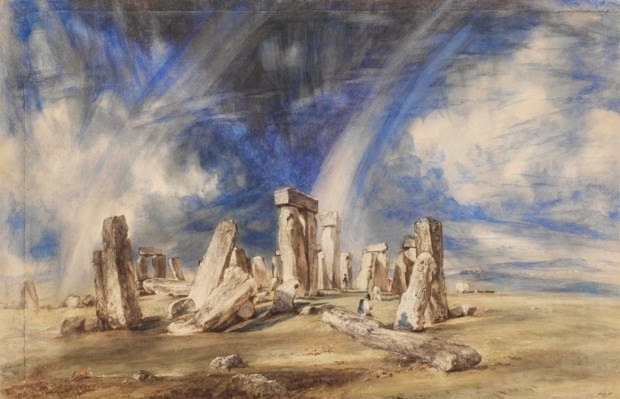
Constable tends to be associated with East Anglia (‘Constable country’), but, although he was not an adventurous traveller like Turner, he painted in the South West region beyond just Salisbury, for example nearby at Stonehenge, 1835:


and at Gillingham Mill, Dorset, (1827, below, top) and Weymouth Bay with Approaching Storm (1819, below, lower):


Constable: The Making of a Master ends on 11 January 2015. Although enjoyable and informative, a full ticket price of £14 seems high when so many of the works have come from public collections, particularly the V&A’s own.


18 August 2014

Rex Whistler and Laura Knight at Haddon Hall

Haddon Hall, near Bakewell in Derbyshire, is described in Pevsner’s Buildings of England for the county as:
… the English castle par excellence, not the forbidding fortress on an unassailable crag, but the large, rambling, safe, grey, lovable house of knights and their ladies, the unreasonable dream-castle of those who think of the Middle Ages as a time of chivalry and valour and noble feelings. None other in England is so complete and convincing.
Simon Jenkins, in his England's Thousand Best Houses, puts it in the top 20 with 5* (out of 5):
Haddon is the most perfect English house to survive from the Middle Ages. …. It has not changed because it never needed to change. … Those aristocratic curses of extravagance and infertility have not visted Haddon. The place is still owned by the Manners family, the Dukes of Rutland. To wander up the slope to the worn gatehouse steps and enter the ancient courtyard is as agreeable an experience as England can offer.
And he explains:
Through the 18th and 19th centuries, the Rutlands neglected Haddon in favour of the seat of Belvoir (Leics). This saved it from the drastic alterations that occurred to most houses over that period. Haddon’s restoration by the 9th Duke after 1912 and recently by his grandson have been deferential.
So it was a surprise during a recent visit to Haddon Hall to encounter work by two twentieth-century British artists, Rex Whistler and Laura Knight, and a reminder of the extent of aristocratic patronage, even in the 1930s.

The 70th anniversary last month of Rex Whistler’s death in combat during the Normandy campaign seemed to have passed without note. He was 39 and had had early success. Henry Tonks, his Professor at the Slade, remarked that he had only ever known three or four people with a natural gift for drawing, and Rex Whistler was one of them. Thanks to Tonks’ sponsorship, Whistler was able to produce one of his best known works, the mural The Expedition in Pursuit of Rare Meats, for the restaurant at Tate Britain when he was only 23. Various commissions followed from the wealthy and fashionable, so when in 1933 the 9th Duke of Rutland wanted to celebrate the end of his restoration work at Haddon he secured Whistler’s services to paint a landscape featuring the Hall to go over the fireplace in the Long Gallery. It shows the Duke and his son looking over their Arcadia:


Whistler completed his longest mural in 1937 for the Dining Room at Plas Newydd, A Capriccio (short title), commissioned by Charles, 6th Marquess of Anglesey. The Marquess’s wife was one of the daughters of Henry Manners, 8th Duke of Rutland. In 2013 a biography, In Search of Rex Whistler: His life and work by Hugh and Mirabel Cecil was reviewed admiringly and at length for The Times Literary Supplement by Matthew Sturgis. He points out:
The suggestion that Rex Whistler was the model for Charles Ryder in Evelyn Waugh’s Brideshead Revisited is properly dismissed here by the Guinnesses. Nevertheless, that sense – so well delineated in the novel – of a modest, conventional middle-class young man of talent and charm being drawn into an enchanted and perhaps emotionally dangerous aristocratic world does have strong echoes in the story of Whistler’s life.
Just after the Long Gallery, in the Great Chamber, is this ‘sketch’ by Laura Knight, seen a year ago at the National Portrait Gallery:


It was drawn in 1934 in preparation for an oil painting of Kathleen Manners, the 9th Duchess of Rutland. The painting is at Belvoir Castle, presumably on view to visitors. Although the NPG show made do with the sketch, perhaps the painting will be made available to the Dulwich Picture Gallery for the Laura Knight exhibition planned for the winter of 2015-16 and marking the 50th anniversary of her Royal Academy retrospective.

Footnote 

This Penguin Guide to Derbyshire and the Peak District, “Revised and Reprinted, 1949”, says about Haddon Hall that it “is considered by some to be the most lovely medieval house in England. The house is now open to the public daily 11 a.m. to 6 p.m, admission 2s”. For current opening times please consult the Haddon Hall website and also note that the basic admission price is now £10 (“2s” or Two Shillings is the pre-decimalisation equivalent of £0.10, so a 100-fold increase in 65 years ). Actually, £10 is good value, given the quality of the house and its contents and the gardens. On the other hand, the equivalent of £10 for a paperback of 169 pages, with maps but no illustrations, certainly was not!


28 July 2014

'Art and Life' at Dulwich

Art and Life: Ben Nicholson, Winifred Nicholson, Christopher Wood, Alfred Wallis, William Staite Murray, 1920 – 1931 is now at Dulwich Picture Gallery after spells at Leeds Museums and Galleries and Kettle’s Yard in Cambridge. Earlier posts here have covered shows at Compton Verney in 2011 which examined the impact on Ben Nicholson of encountering Alfred Wallis in 1928, and at the Courtauld in 2012 which examined Nicholson’s work in the 1930s after his encounter with Mondrian. The Dulwich show (Art and Life from now on) looks at an earlier period starting with Ben Nicholson’s marriage to Winifred in 1920, then the couple’s meeting Kit Wood in 1926, the three artists’ responses to Alfred Wallis in 1928 and ends with the Nicholson’s separation, de facto after 1931. Art and Life features more than 80 works, some 15 of which have been exhibited publicly for the first time and many are on loan from “Private Collection”. It includes items by the potter William Staite Murray who often exhibited with the Nicholsons. The show has been curated by the art historian Jovan Nicholson, Ben and Winifred’s grandson, who gave a very informative lecture, Art and Life: Ben and Winifred Nicholson, at this year’s Oxford Literary Festival.

Art and Life can be regarded primarily as a portrait of an artists’ marriage – for the years it lasted. Ben and Winifred both came from upper class backgrounds, his father being the painter Sir William Nicholson and her family being north of England aristocrats with unusually artistic inclinations. The exhibition starts early in their married life when they were painting together at Lugano, producing work like his Cortivallo Lugano 1921 (below, top) and her Window Sill Lugano (below, lower) and Cyclamen and Primula (poster above), both 1923, the year of their first joint exhibition:


They would often produce works on the same theme, thoughtfully juxtaposed like many of the exhibits, for example the moorland scenery in 1920 at Tippacott (Devon, SW England), her Watercolour below top, his Pencil Drawing below, lower:


The consensus seems to be that at this stage of their artistic lives, his work is more concerned with form, hers with colour. This is, of course, with the benefit of retrospect from the 1930s when he is clearly far more interested in form than colour. In 1923 the Nicholsons began to spend time at Bankshead in Cumbria near Hadrian’s Wall and the exhibition includes further examples of the same landscape being pictured by both. What is apparent is how anodyne their work seems in comparison with that of avant garde artists like Malevich a decade earlier. Soon three works by Ben Nicholson indicate an interest in something more unconventional: 1924 (First Abstract Painting, Chelsea) (below, top left), Jamaique, circa 1925 (below, top right) and Still Life with Jug Mugs Cup and Goblet, 1925 (below, lower):


In 1926 Ben met Christopher Wood who later took a painter’s holiday with the Nicholsons in Cornwall (SW England), before the area’s revival of interest to artists. Wood’s Pill Creek Eock Cornwall, 1928 (below top) and Winifred Nicholson’s Summer, 1928 (below, lower) are among the three’s responses:


Soon they met Alfred Wallis in St Ives. Wallis was a retired mariner and prolific painter of self-taught sea studies like The Schooner the Beata, Penzance, Mount’s Bay, and Newlyn Harbour, undated (below, left) and St Ives Harbour, circa 1932-34 (below, right):


which made a lasting impression on all three artists, particularly Ben, Cornish Port, circa 1930, (below, top) and Wood, Le Phare, 1929 (below middle), perhaps less so Winifred, Seascape with Two Boats, circa 1932 (below, lowest):


although her Autumn Flowers on a Mantelpiece shows a small Wallis. Then came the climactic events of 1930: Ben Nicholson’s meeting Barbara Hepworth and Christopher Wood’s suicide at Salisbury station. Wood’s influence on Ben is apparent later that year in 1930 (Christmas night):


By the end of 1931, the year Winifred gave birth to their third child, Andrew, the Nicholson’s relationship had sundered. The saddest pictures in the exhibition are Wood’s The Fisherman’s Farewell, 1928 (below, top) and her Jake and Kate on the Isle of Wight, 1931 (below, lower):


Art and Life provides a welcome opportunity to see several works by Wood, for example Blue Necklace, 1928 (his mistress, Frosca Munswer) and Zebra and Parachute, 1930. The final exhibits in the show go beyond its nominal dates, but are of considerable interest including Ben’s 1935 (White Relief) and an abstract by Winifred, White and Black Ellipse, Outwards, 1936. The Nicholsons did not divorce until 1938 when Ben married Barbara. The famous Hepworth triplets had been born in 1934.

Art and Life: Ben Nicholson, Winifred Nicholson, Christopher Wood, Alfred Wallis, William Staite Murray*, 1920 – 1931 ends at Dulwich on 21 September 2014, nearly a year after it began at Leeds.

*Ben Nicholson 1894 - 1982
Winifred Nicholson 1893 - 1981
Christopher Wood 1901 - 1930
Alfred Wallis 1855 - 1942
William Staite Murray 1881 - 1962


16 August 2013

Laura Knight at the NPG


This is Laura Knight’s third appearance in a post here within a year. A touring exhibition of her landscapes, in the open air, was followed by Summer in February, a film set in Cornwall (SW England) before the First World War among the Newlyn group of artists which included Laura and her husband. Now the National Portrait Gallery in London has put on a small show of her portraits.

Almost the first painting in the exhibition is from her Cornish period, Rose and Gold (1914, above). Unexpectedly it had links to the last exhibition posted about here, A Crisis of Brilliance at Dulwich. Firstly, the painting probably shows the extent of the influence on Knight’s style of the Roger Fry Post-Impressionist exhibitions whose impact is so evident in A Crisis of Brilliance. Secondly, the sitter for Rose and Gold was the artist’s model, Dolly Henry, who was shot dead shortly after the picture was finished by her lover, John Currie. He then committed suicide. A Slade student, one of his paintings, Some Later Primitives and Madame Tiscaron (1912), is in the Dulwich show. Fans of Summer in February will probably like Lamorna Birch and His Daughters (1916, finished in 1933, below).
 

After Cornwall, the exhibition is grouped into areas which reflect Knight’s inter-war interests: theatre and ballet, (the concert pianist, Ethel Bartlett (1926) in the poster above) and gypsies and circuses. Another pre-war section, Baltimore, consists of paintings and drawings of black Americans made in 1927, when she and her husband worked in the USA. Between 1942 and 1945 she worked on commissions for the War Artists Advisory Committee (see A Balloon Site, Coventry (1943) in the earlier post on the landscape exhibition). I was pleased to see RUSI’s Corporal Elspeth Henderson and Sergeant Helen Turner (1941, left) again. The Imperial War Museum’s The Nuremburg Trial (1946) is doubling as a portrait after its outing as a landscape (again, earlier post).

The exhibition ends with a selection of Knight’s portraits, often commissioned, which demonstrate her skill as a figurative painter (perhaps not at its best in the case of George Bernard Shaw (1933)). That facility was matched by her lack of interest in modernism and possibly helps explain the lack of interest in her work after her death in 1970. It is surprising, given her fight for recognition as a woman artist – the first modern woman RA – and her enthusiasm for portraying high-achieving women, that she never seems to have been regarded as an icon by feminists. Brian Sewell, who disliked this exhibition, calls her a “Very much the “anything you can do I can do better” sort of woman”, and describes at some length how little her work was fetching shortly after her death. Although he has little time for most of the works in the show, he ends:
That I quite liked Laura Knight seriously affects my view of this exhibition. I could have put together a show of paintings — her best in all her genres — that would not have disgraced her; it would not have been truthful, for it would have eliminated all the dross, but it would have been far more entertaining for the visitor to whom she is a stranger, and it would have honoured her. This shoddy little show is a disgrace.
He also comments:
Restricted to her portraits, this [exhibition] unwittingly demonstrates the damage that can be done to a forgotten painter’s reputation when only a single branch of a lifetime’s work is plucked from obscurity like this, and I am inclined to argue that the NPG has done Laura Knight a mortal damage, that no one to whom her name and work are new will ever want to see more of it.
Perhaps because of having seen the landscapes last year as well as these portraits, I am looking forward unreservedly to the Knight retrospective that Dulwich Picture Gallery are planning for 2015. Who knows, the curator may now be seeking Mr Sewell’s advice.

Laura Knight Portraits continues at the NPG until 13 October and will subsequently tour to the Laing Art Gallery, Newcastle (2 November 2013 – 16 February 2014) and Plymouth City Museum and Art Gallery (1 March – 10 May 2014) (SW England).

UPDATE 11 SEPTEMBER

Andrew Lambirth in the Spectator on 7 September took a much more sympathetic view of this exhibition than Sewell.


5 August 2013

'A Crisis of Brilliance' at the Dulwich Picture Gallery

When an exhibition gets good reviews from professional art critics, even I start to wonder why I bother with my tuppenceworth. So if you want to stop reading here about Nash, Nevinson, Spencer, Gertler, Carrington, Bomberg: A Crisis of Brilliance, 1908-1922 (its very full title) and instead find out what Brian Sewell or Andrew Lambirth had to say about it, I really won’t mind.


So what can I add? Having read the book and seen the exhibition, I can opine that if one was of interest, the other will be too. The book, David Haycock’s A Crisis of Brilliance Five Young British Artists and the Great War, came out in 2010. His five were Stanley Spencer, Paul Nash, Mark
Gertler, Richard Nevinson and Dora Carrington; the exhibition which Haycock has now curated includes David Bomberg as well. The notion of this group engendering a “crisis of brilliance” came from Henry Tonks, teacher and professor at the Slade from 1892 to 1930 (apart from war service), who had first applied it to a previous generation of his students there in the 1890s which had included Augustus and Gwen John and Percy Wyndham Lewis. Both his crises were the existence of a superfluity of talent in particular cohorts of students whereas Haycock’s crisis reveals itself as the one inflicted by the First World War on the six contemporaries in the Dulwich exhibition.

In the catalogue Haycock provides a very helpful description of the sequence of art exhibitions and of the groups of artists which were being formed in the years just before the War. The most important of the former were the 1910 Manet and the Post-Impressionists exhibition and the 1912 Second Post-Impressionist Exhibition, both organised by Roger Fry. It was the latter show which Tonks advised his students, all about 20 at the time, to avoid – what could have been more guaranteed to ensure their attendance? In1912 London was also introduced to Italian Futurism which would lead to the appearance of Wyndham Lewis’s Vorticism movement just a few months before the War began.
 

Although visitors encounter Bomberg’s In the Hold (1913-14) (above) juxtaposed with Dulwich’s old masters before entering, the exhibition adopts a chronological approach and starts with works showing the initial impact of exposure to modernism and futurism on a group of students originally preoccupied with early Renaissance Italian art (John Currie’s Some Later Primitives and Madame Tiscaron (1912) below).
 

Examples are Stanley Spencer’s Apple Gatherers 1912-13 and Paul Nash’s Apple Pickers (1914), both regarded as being influenced by Gauguin (below left and right) and Gertler’s The Fruit Sorters in the exhibition poster.
 

Subsequently the show makes clear how this exposure to modernism conditioned the group’s artistic response to the dislocations and innovations (eg Nevinson’s Futurist Spiral Descent 1916 left) of the First World War and the consequences for their work in the years after 1918. Two major works which were not made available to the exhibition were Gertler’s masterpiece, Merry-Go-Round (1916), which is a highlight of Tate Britain’s recent rehang, and Nash’s The Menin Road (1919) which is owned by the currently closed Imperial War Museum (below left and right). Hopefully the First World War centenary programme the UK government is running from 2014 to 2018 will include a major exhibition of art from the period to put the work of the Dulwich six in a wider context.


Does the Dulwich show work? On the whole exhibitions concentrate on one artist in retrospect or bring together artists who, if only for a period, embraced a similar artistic philosophy, be it Pre-Raphaelite or Bauhaus. Haycock’s book impressed by skilful intertwining of the biographies of his five subjects, but inevitably it is a different proposition for an exhibition to provide six retrospectives in parallel. The individuals concerned had the War in common, but had different experiences with varying effects on their art. Their lives would come to disparate ends, some distinguished, some tragic. Anyone interested in 20th century English art will find the Dulwich exhibition rewarding, but Haycock’s book or the exhibition catalogue are likely to prove very helpful in providing wider context to the works on display. Nash, Nevinson, Spencer, Gertler, Carrington, Bomberg: A Crisis of Brilliance, 1908-1922 closes on 22 September.


FOOTNOTE

Bomberg taught in one of London South Bank University ‘s predecessor organisations and its Borough Road Gallery is now providing opportunities to see his work.