Showing posts with label John Rentoul. Show all posts

16 June 2017

Doing it properly for JR

John Rentoul tweeted this on 15 January and commented on my reply:

I’m sure he knows what an x-axis is and the limitations in that respect of the chart he tweeted, especially for periods when elections are spaced other than 4/5 years apart – like now. Anyway, this is possibly a slightly better way of presenting the same data for the vote share of the two main parties:


Really, it should be a histogram for each election, the data having no meaning in the intervals between elections. But joining up the data points appears to reveal a cyclic pattern of several election intervals duration.


Superimposing the percentage of the total vote which goes to parties other than the Conservatives or Labour seems to indicate the end in 2017 of what had been a very long-term trend. It was in the 1970s when the non-Labour, non-Tory share of the vote was last as low as in 2017. There were five general elections in the ten years from October 1964 to October 1974 - if there were a cycle, it was a short one. But it might be unwise to rule out a revival in Liberal Democrat and UKIP fortunes in the next few years.


Note

This is the full link to Cowling's data: drive.google.com/file/d/0B5Ik-g


7 April 2016

Churchill and the Appeasers, Johnson and the Remainers

Would a Prime Minister Johnson "forgive and understand" their wrong-headedness?

Back in February, I remarked in a post here that:
There is even one school of thought that whether the result [of the Brexit referendum] is leave or remain, Boris Johnson will become the next leader of the Conservative party and therefore Prime Minister
and, if anything, this outcome seems more likely, not less. In fact, if being taken seriously is a measure, recent excoriating attacks on Johnson by, for instance, Matthew Parris on 26 March in The Times (Tories have got to end their affair with Boris, Charm can make us forget the dishonesty and recklessness that would be ruthlessly exposed if he became leader) and Nick Cohen in the Guardian a few days later (Boris Johnson. Liar, conman – and prime minister? The mayor of London has been treated with woozy indulgence by the media. But Britain may pay the price), suggest much more likely. Reacting to Parris, John Rentoul in the Independent was calm, It's time to get used to the idea of living under Prime Minister Boris Johnson, or perhaps just resigned.

Not long before, I had come across the biography which Johnson had written in 2014, The Churchill Factor: How One Man Made History. Reviewers tended to regard it as very readable in the style of Johnson’s Daily Telegraph opinion pieces which appear most Mondays (at £5000 a time they say), as not adding much to the huge amount of literature on his subject already available and as being as much about Johnson as Churchill.

It occurred to me that if Johnson were to become PM after a Brexit vote, he would be leading a Cabinet many of whom had been "remainers". How would he deal with them? Would his portrayal of Churchill who, after only three weeks as PM and in a much greater crisis in 1940, had to work with senior members of a Cabinet who had been advocates of appeasing Hitler, offer any insights?

Rather to my surprise, Chapter 1 plunges straight in at this point in Churchill’s life with The Offer from Hitler, made via Italy to negotiate an end to hostilities. This was put to the Cabinet in May 1940 by Lord Halifax, the Foreign Secretary and long-term appeaser of Hitler:
[Halifax] was tall, very tall; at 6 foot 5 he loomed about ten inches above Churchill – though I suppose advantage matters less around a table. (page 11)
Johnson is no more than 5 foot 10 by the way. Later after describing the Cabinet’s deliberations, Johnson comments:
It makes one cringe, now, to read poor Halifax’s defeatism; and we need to forgive and understand his wrong-headedness. (page 16)
and later:
All we are saying – in mitigation of Halifax – is that in seeking peace, he had the support of many British people, at all levels of society. (page 17)
Over 200 pages later (Johnson’s book is thematic in structure, not chronological) Halifax re-appears in 1941, prior to Pearl Harbor and the USA’s entry to WW2, as
… the British ambassador in Washington. This was none other than our old friend the Earl of Halifax: the beanpole-shaped appeaser - he who used to go hunting with Goering. Halifax was the British envoy charged with appealing to the finer feelings of the United States and he was having a terrible time. Shortly after arriving he is said to have sat down and wept - in despair at the culture clash. He couldn't understand the American informality, or their habit of talking on the telephone or popping round for unexpected meetings. In May 1941 the aristocratic old Etonian endured fresh torment when he was taken to a Chicago White Sox baseball game and invited to eat a hotdog. He refused. Then he was pelted with eggs and tomatoes by a group called the Mothers of America. Even for an appeaser, it seems a hell of a punishment. (page 247)
Johnson, if not inclined to vindictiveness, at least seems to have a taste for schadenfreude. He fingers a few other appeasers, for example:
Rab Butler, then a junior Foreign Office minister, was caught telling a Swedish diplomat that he thought Britain should do a deal – if Hitler offered the right terms (page 230)
returns to Johnson’s sights
… Tory drips such as Butler (the old appeaser) … (page 288)
So perhaps Tory remainers shouldn’t hold out too much hope of forgiveness and understanding from a Prime Minister Johnson.

There are some good things in The Churchill Factor. Johnson gives a whole chapter, An Icy Ruthlessness, to the decision to destroy the French fleet at Mers-el-Kébir, a tragedy which the British tend to overlook when revisiting the events of 1940. And another, The Ships that Walked, to Churchill’s sponsorship, when at the Admiralty during WW1, of the initial development of the tank by the Directorate of Naval Construction.

Unlike some celebrity writers, Johnson is happy to give credit to various helpers in the Acknowledgements, in particular Dr Warren Dockter, but my favourite is the one to a fellow Old Etonian:
David Cameron did some invaluable devilling into the exact locations of the pivotal meetings in May 1940 – not at all clear in Lukacs, for instance. (page 361/2)


UPDATE 24 APRIL 2016

Remarks by Johnson about President Obama at the time of the visit to London have led to Borises being sold heavily in the reputations market in the last few days – perhaps never to recover, although there are still 60 days to go before the Referendum.

Earlier in the month Johnson had published his tax return:


 - his earnings from the Daily Telegraph seem to match their reputation. In The Churchill Factor (pages 72 and 73), Johnson dismisses Evelyn Waugh’s criticisms of Churchill’s literary style:
Is it that Waugh was a teensy bit jealous? I think so; and the reason was not just that Churchill had become so much more famous than Waugh had been, by the time he was twenty-five, but that he had made such stupendous sums from writing. And that, for most journalists, alas, is the truly sensitive point of comparison. (page 73)

7 November 2015

Superforecasting

I’m going to assume that anyone who reads this post has almost certainly been landed here by Google, and therefore is likely to be familiar with the Good Judgement Project (GJP), the brainchild of Professor Philip Tetlock at the University of Pennsylvania and described in his and Dan Gardner's recently published book, Superforecasting: The Art and Science of Prediction. So I won’t provide a description of the GJP or the book.

Before going any further, I should say that I participated in the last GJP tournament and my score over some 135 questions was undistinguished – well below that of the top 2% who Tetlock defines as superforecasters (SFs). So you are welcome to dismiss anything that follows as sour grapes.

Undoubtedly, the book has been reviewed with enthusiasm in the UK by, among others , John Rentoul (not once, not twice “a terrific piece of work that deserves to be widely read”, but three times), Dominic Cummings (“Everybody reading this could do one simple thing: ask their MP whether they have done Tetlock’s training programme.”), Daniel Finkelstein (“This book shows that you can be better at forecasting. Superforecasting is an indispensable guide to this indispensable activity.”) and Dominic Lawson (“fascinating and breezily written”).

A key point to appreciate about individual SFs is that their capability as forecasters is based not so much on what they know - the forecasting questions range widely, so being a subject matter expert is not an advantage - as the way they set about it.. Nor are SFs mostly in the IQ top 1% (135+) of the population, although they are in the top 20% for intelligence and knowledge (Page 109). However, they “are almost uniformly highly numerate people” (Page 130) and “embrace[d] probabilistic thinking” (Page 152). The other factors in their success and how anyone could set about improving their own forecasting skills is the subject of the book.

SFs, being numerate, will have no problem with the Brier scoring system used by the GJP. Brier scoring may well be an eye-glazing subject for most people, but it is one that ought to be understood if an appreciation of superforecasting is to be more than superficial. Hence the Annex below for anyone interested.

Superforecasting, having more significant issues to address, does not bother the reader with much on the way the Brier score is calculated, but it does feature on pages 167/8 when the importance of objectively updating forecasts in the light of new information is being emphasised. A GJP question being asked in the first week of January 2014 was whether “the number of Syrian refugees reported by the UN Refugee Agency as of 1 April 2014” would be under 2.6 million. This chart* from page 167 shows successive forecasts made by one SF, Tim:


On page 168 the reader is told that “Tim’s final Brier score was an impressive 0.07.” The smaller the Brier Score, the better the forecast, of course. By my reckoning, that is the score which Tim would have received if he had made an initial forecast of 81% probability of the answer to the question being “Yes” and stuck with it. But, as is clear, he started with slightly better than evens in early January and then moved towards certainty in late March, thereby achieving SF status, on this as on many other questions.

But what if the UNRA had needed its forecast in January for planning purposes and a more accurate forecast in March would have been too late? The next chart attempts to break out Tim’s forecasts on a monthly basis. 


For January it looks as though Tim’s average probability was about 67% so the Brier Score for this month would have been a 0.22, rather poorer than the glittering 0.07. The GJP methodology is time-independent in the sense that it does not attach a greater value (weighting) to early forecasts as opposed to later ones. It might be interesting to see the effect of some discounting, as in (but opposite in time to) Discounted Cash Flow where early cash flows are valued more highly than late ones. This would seem appropriate if an important driver of a real-world forecast is someone’s need to make decisions well before outcomes are known.


Another time-related aspect of the GJP scoring is the termination date of the question. A scenario from the past might be helpful. On 30 September 1938 the leaders of Britain, France, Germany and Italy signed the Munich Pact allowing German occupation of the Sudetenland. The British Prime Minister, Neville Chamberlain, returned to London (above) where he was greeted by enthusiastic crowds and spoke of “peace for our time”. However, Churchill said that “England … has chosen shame, and will get war”. So a GJP question in October 1938 might well have asked “Will Britain and Germany be at war by 31 August 1939?”.

A Chamberlain supporter would have started his (or her) answer at a probability much less than 50%, a Churchill supporter at a substantially higher one. As the events of 1939 unfolded, both parties would probably have increased their estimates. However, when the question closed, the Chamberlain supporter would certainly have had the lower Brier Score. Of course, if the question had been “Will Britain and Germany be at war by 30 September 1939?”, their Brier Scores would have been reversed** and the Churchill supporter’s initial pessimism would have been vindicated. So, depending on the date of the question to within just a few days, a good (ie low) Brier Score can be obtained for questionable judgement in a broader sense. There were 135 questions in the recent GJP tournament, 23 of those ended on 31 May and another 39 between 1 and 10 June, dates which probably have more to do with Penn U’s academic year than geopolitics.

It is probably worth bearing in mind that SFs are people adept at minimising time-independent Brier Scores on questions which terminate on arbitrary dates and that is the basis on which their ability as forecasters has been assessed.

As pointed out earlier, the reviews of Superforecasting have been enthusiastic and keen to see its approach being adopted in business and government. I came across this interesting comment on Forbes/Pharma & Healthcare by an admiring reviewer, Frank David, who works in biomedical R&D:
So, companies may be able to nurture more “superforecasters” – but how can they maximize their impact within the organization? One logical strategy might be to assemble these lone-wolf prediction savants into “superteams” – and in fact, coalitions of the highest-performing predictors did outperform individual “superforecasters”. However, this was only true if the groups also had additional attributes, like a “culture of sharing” and diligent attention to avoiding “groupthink” among their members, none of which can be taken for granted, especially in a large organization.“ A busy executive might think “I want some of those” and imagine the recipe is straightforward,” Tetlock wryly observes about these “superteams”. “Sadly, it isn’t that simple.” 
A bigger question for companies is whether even individual “superforecasters” could survive the toxic trappings of modern corporate life. The GJP’s experimental bubble lacked the competitive promotion policies, dysfunctional managers, bonus-defining annual reviews and forced rankings that complicate the pure, single-minded quest for fact-based decision-making in many organizations. All too often, as Tetlock ruefully notes, “the goal of forecasting is not to see what’s coming. It is to advance the interest of the forecaster and the forecaster’s tribe,” [original emphasis] and it’s likely many would find it difficult to reconcile the key tenets of “superforecasting” with their personal and professional aspirations.
Very likely - “the toxic trappings of modern corporate life” - how true indeed.


* I may be taking the chart on page 167 too seriously, but a couple of points. The grey space above a probability of 1 is ,of course, just artistic licence. However, I don’t understand (apart from further artistic licence) why the successive forecasts have been joined by straight lines as shown. Surely a forecast remains extant until it is superseded by the next one, and the forecast line is a series of steps, as shown for January 2014 below?


** US readers, and this blog has a few, may need to be reminded that the UK declared war on Germany on 3 September 1939. Germany declared war on the USA on 11 December 1941.


Only superforecasters working in teams are likely to approach perfection - please let me know by commenting if you spot any mistakes in this post!


ANNEX


The red line is the Brier Score, S, as a function of (1-p), the dotted line for comparison is S = (1-p).


UPDATE 30 JUNE 2016

The Superforecasters' prediction for the UK "Brexit" referendum earlier this month was less than stellar - see this post.


29 September 2015

Jeremy Corbyn: Getting to 2020

I met Jeremy Corbyn back in 2003 when I was spending a day being educated on the ways of Parliament, which included discussions with MPs. Three of us, perhaps at the time not appreciating what would eventually become memorable, went for a cup of tea with Corbyn in Portcullis House. Casting about for a non-partisan topic, I asked him about ways to improve electoral turnout (it had been down to 59.4% in the 2001 general election). I remember the question but not the answer, so in retrospect it seems unlikely that anything particularly radical was suggested. Twelve years later Corbyn has emerged from relative obscurity and is Leader of the Labour Party and the Opposition and, although it seems unlikely, could become Prime Minister in 2020.

The commentariat are going flat out with Corbyn prognoses. Even before he was elected, Sebastian Payne asked on Spectator Coffee House
If Jeremy Corbyn is elected Labour leader, how long would he last?
and concluded that, if not challenged immediately,
Corbyn would be challenged a few months/years in his leadership. There is one particular flashpoint next year to watch: 5 May 2016. If Labour fails to win the Mayor of London race, loses Wales and fails to make any progress in Scotland, there will be calls for him to go.
Dan Hodges in the Daily Telegraph thought that the vote on Trident replacement in March 2016 would be a moment of reckoning (though Corbyn later told Andrew Marr that the vote would possibly be in June). On the other hand, John Rentoul in the Independent thought that the Labour Party
is so denuded of talent that it is hard to see where the succession to Corbyn will come from. Part of the reason for his success is the thinness of the field against him, but look beyond them and behold a wasteland.
Andrew Rawnsley in the Observer was full of misgivings:
For the moment, the spectacle of a leader and his top team agreeing to disagree on a host of critical issues at least has the merit of being unusual. It is the price Mr Corbyn is being forced to pay to avoid an immediate civil war with his MPs. It can’t be sustainable. There will be a crunch point between leader and parliamentary party. Then things will get really interesting.
but was not inclined to speculate about timescales:
Earlier foolish talk about a rapid attempt to unseat him has evaporated. The thumping scale of his victory means that his opponents within will have to tread very carefully for the moment. Yet the truth can’t be concealed. This leaves Labour MPs more divided than I have ever known them. Divided between those who are convinced that the Corbyn leadership will be an instant disaster and those who reckon it will be more of a slow-burning catastrophe for their party. Then there are those who candidly confess that they have no idea where their party is now going. “I think I know how this will end,” says one. “But I can’t say when.”
The Guardian made public Peter Mandelson’s private views that it would be “a long haul”:
Nobody will replace him, though, until he demonstrates to the party his unelectability at the polls. In this sense, the public will decide Labour’s future and it would be wrong to try and force this issue from within before the public have moved to a clear verdict.
In the FT Magazine, out just as the Labour party conference started, George Parker and Jim Packard had a long piece, Jeremy Corbyn: how long can he last?, but, not surprisingly, didn’t provide a specific answer. On the one hand:
“We have to give him time to fail and to make it clear to all his supporters that this cannot work,” says one moderate Labour MP. “There can’t be a coup now: we would have blood on our hands.” 
… “It’s going to go wrong,” says another senior Blairite former minister. “We just don’t know when.”
And on the other:
From David Cameron’s point of view, the longer Corbyn stays in the job the better. … “This is proof that God is a Conservative,” says one Cameron ally. The Cameron/Osborne strategy is to hope that Corbyn remains leader as long as possible and that years of leftwing-inspired chaos will cause irreparable damage to the Labour brand. 
… Cameron’s allies ponder whether Corbyn can hack the responsibility, the pressure and the mental strain of his new job and the need for constant accommodation and compromise with his party. “Cameron’s mentally extremely strong and even he can find it tough,” says one friend of the prime minister. “Corbyn’s 66. He’s never faced anything like this.” But Dave Prentis, head of the union Unison, says Corbyn has the stamina to survive the coming months. “He has done 100 rallies this summer. I have seen a man who, wherever he has gone, has shown commitment and fortitude,” he says. “Do I think he has the stamina for this? Yes.” 
On the totalpolitics website, James Skidmore explained Why Jeremy Corbyn will still be Labour leader in 2020, described the three hurdles any challenger would have to clear and concluded, fairly convincingly:
Essentially, the choice facing moderates now is how much rope do they give Corbyn? Until after the 2016 elections or until after 2020? Your correspondent reckons that when they sit down and think through the process they will leave it to 2020.
Given such uncertainty, I thought it might be interesting to look for any statistics which sum up the experiences of past Leaders of the Opposition (Leaders or LoOs hereon). To illuminate Corbyn’s position, comparisons should be made only with those individuals who have sought Leadership as a first step towards possible premiership. This rules out those who have had the office thrust upon them, that is those who have become Prime Minister (PM) by another route and then lost an election, most notably Churchill. Also excluded are interim, if recurrent, Leaders like Harriet Harman.

Initially the selection was confined to the last 80 years, beginning with George Lansbury who became Labour Leader in 1935 and, because of his pacifist views, is seen as having similarities to Corbyn. Over that period there were 14 men and one woman Leaders ab initio, nine Labour and six Conservative. Three of each party went on to win an election so the success rates are 33% for Labour and 50% for the Tories – success being defined as moving from LoO to PM. However, on examination Attlee’s position is exceptional. Lansbury resigned in October 1938, Attlee becoming Labour leader and losing the general election held a month later. Attlee eventually became PM in 1945 but had ceased to be Leader of the Opposition in February 1942 on appointment as Deputy PM in the wartime coalition.

Leader of the Opposition statistics
(notes at the end of the post)
So while it is useful for some purposes, like age on becoming Leader to include Lansbury and Attlee, comparisons with Corbyn for issues like age at the first subsequent general election are more appropriately made looking at the last 60 years. This is the period since Gaitskell became Labour Leader in 1955 and reduces the selection to 12 men and one woman. Seven of these were Labour and six Conservative with two Labour and three Conservative successes, 29% and 50% respectively.

Age 

Age is unarguable and Corbyn is certainly younger starting as LoO at 66 than Michael Foot or George Lansbury but at nearly 71 would be older at the time of the next election (7 May 2020) than any of the 11 of his 13 predecessors who survived to an election. Only two of them were over 60, neither man was successful. (In the last 80 years the only successful LoO older than Corbyn was Churchill at nearly 77 in 1951, but, as an ex-PM, and for other good reasons, there is no comparison).

Time in office

In May 2020, Corbyn would have been Leader longer than any of his predecessors except Heath who was successful. The five successful LoOs were in office slightly longer than the six unsuccessful ones but this masks an interesting difference between the two successful Labour LoOs who were in office for less than three years (2.2 average) and the three Conservatives, all more than four years (4.5 average). One could theorise that the UK media build up Tory LoOs, who thereby benefit from time in office, but conduct a war of attrition against Labour LoOs who do better the sooner they can get to Election day.

Health

Although correlated with age, health is always a matter of speculation. It seems reasonable to assume that if Corbyn has, or has had, any significant medical events and issues, they would have emerged in the media by now. To judge from his appearance, Corbyn does not look particularly young for his age. His not dowsing his hair in dye, like so many other politicians, if anything adds to his “authenticity” – perhaps it will encourage others to stop. He is long-sighted (presbyopia) to judge from the photograph of him looking over the top of his glasses at the TUC audience (below top left), as to be expected at 66. He looks slightly overweight to judge from the St Paul’s photograph of him not singing the National Anthem (below top right) – more than might be expected of a vegetarian, almost teetotal, cyclist. In future it can be assumed that he will be cycling less and making more use of the transport provided for LoOs (below lower) and gain weight.


When he was forming his Shadow cabinet in the House of Commons on 13 September, Corbyn was observed by Darren McCaffrey, Politics Reporter for Sky News:
… at the end of a bookshelf-lined corridor, opening up to the members’ lobby and behind a door grandly named Her Majesty’s Official Opposition Whips’ Office, Jeremy Corbyn was holed up. … And again Jeremy emerged, which he seemed to do once every hour, when a toilet break was needed.
Needing to urinate that frequently suggests that Corbyn has an enlarged prostate pressing on his bladder. If so, that would be a common condition (BPH) in a 66-year old male.

Corbyn is in the unusual position of a man having to give up his hobbies to work at an age when many others have already done the opposite. Should he become PM, he and a future King Charles could at least have that in common. Until now Corbyn has been doing what he enjoys with the salary and continuity of employment of an MP with a safe seat. His interests seem to revolve around the far left of politics and he has been able to spend his time engaged with like-minded people. As an MP answerable to no-one, certainly not his party’s whips, he has been able to avoid the stresses and conflicts of working life which he would have encountered in white collar employment. Men of his age at his salary level in the real world, if they haven’t already quit, will mostly be about to escape from having to meet the unrealistic aspirations of self-serving senior managers while overcoming the reluctance of subordinates to embark on anything but the mildest change.

It seems likely that nothing in Corbyn’s previous experience (apart from two divorces) will approach the stresses that he will encounter in The Worst Job in British Politics. So far he seems to be avoiding confrontation where possible, for example the first PMQs. If an interviewer, and there have been few so far, raises difficult issues, these are being deflected with vague promises of consultative forums and discussions which will arrive at agreements acceptable to all involved. That sort of obfuscation can only go on for so long. For Corbyn the stress of having to compromise sincere beliefs which have hardly ever been challenged, let alone had to be defended could eventually take its physical toll. Oddly enough, the two Labour predecessors to whom he is most often compared, Foot and Lansbury, lived on to the ages of 96 and 81 respectively. However, two Labour LoOs have died in office, Smith and Gaitskell, at 55 and 56.

Conclusion 
Leader of the Opposition
Month of taking office and outcome

As investment funds make clear, past performance is not necessarily indicative of future results – or words to
that effect. This is particularly so when the underlying statistics are so scant. But if Corbyn’s health holds out, and, in the hope that 70 is the new 60 I would not want otherwise, the statistics for previous LoOs in terms of age and time in office are not encouraging for him. Nor is the final table (right) which shows the outcomes for the 13 LoOs depending on their month of taking office, unfortunately September in Corbyn’s case.

On past performance Labour would do well to change Leader about two years before the next election – February 2018 looks a particularly auspicious time for a Corbyn successor, someone in their late 40s, to take office. In the unlikely event that anyone takes previous posts on this blog seriously, it would seem a good idea to select a second-born middle-born who went to Oxford!


Notes
(a) Died in office 12 May 1994
(b) Resigned 6 November 2003
(c) Died in office 18 January 1963


UPDATE 6 DECEMBER 2015

As far as I know, the first media report about Corbyn’s health which has appeared is the one in the Independent on Sunday (IoS) today, Jeremy Corbyn's allies accuse MPs of 'spreading lies' about Labour leader's health, an exclusive by Tom McTague. What I regard as the relevant extracts are below, but the original is easy to access.
Labour’s increasingly bitter civil war has deepened after allies of Jeremy Corbyn accused MPs of “spreading lies” about the 66-year-old’s health in an attempt to destabilise his leadership. Labour’s increasingly bitter civil war has deepened after allies of Jeremy Corbyn accused MPs of “spreading lies” about the 66-year-old’s health in an attempt to destabilise his leadership. … 
Sources close to the Labour leader have revealed that he has been forced to reassure MPs in private that he is not going to quit after being made aware of “smears” circulating Parliament about his fitness for the job – including the “categorically untrue” allegation that he briefly “passed out” under stress in his office last month. … 
One senior Labour source close to Mr Corbyn told The IoS that he had emerged from the past week strengthened – and demanded an end to personal insults and smears about his health. … 
A shadow minister, who did not want to be named, went further – accusing anti-Corbyn MPs of being “prepared to spread lies about Jeremy’s health in order to assist them in their aim” of destroying his leadership. He added: “You can’t get much lower than spreading lies about someone’s health to undermine them and their ideas.


UPDATE 7 FEBRUARY 2016

On 5 February Ken Livingstone appeared for about 15 minutes on RT News Thing. About four minutes in, being pressed as to whether he might become Labour leader after Corbyn, he said:
If Jeremy was pushed under a bus being driven by Boris Johnson, it would all rally behind John McDonnell.
Almost at the end of the session he reinforced the point, but less hypothetically:
I keep telling you, it’ll be John McDonnell. If Jeremy was to have a stroke or something like that, it will not be me.
For comparison with the table above, John McDonnell was born on 8 September 1951 and would be 68.7 on 7 May 2020.


1 January 2014

New Year Predictions 2014

At the start of the year I post about some of the predictions which people have come out with in the previous 12 months –for the record so far, see my post a year ago. This year I’ve picked three (and a half), mostly about the UK 2015 election, the outcome of which may well become apparent in the next 12 months. I’ve avoided the opinions of politicians – obviously Michael Gove is going to say he’s convinced that the Tories will get a majority in 2015, whether he believes it or not. Instead here are some opinions from observers, not players.

Firstly this from John Rentoul in his Independent Eagle Eye blog in July:
I suspect much of the Labour Party has lulled itself into a false sense of Swedenism* because some polls suggest that people think Osborne is an objectionable piece of work. Of course they do; he is a politician and he is currently in government. What this poll does, however, is to compare his policies with those of the other lot, had they been in the despised position of being in government. 
If Labour haven’t persuaded the voters that things would have been better under them by now (and I’m one of the 32 per cent in that last question, incidentally), they are unlikely to do so by the time of the election, now that the economy is picking up a little. And if Labour cannot do that, it cannot win. 
*Swedenism, n: The attribution to the electorate of generous social-democratic qualities.
Next an Oxford academic, Steve Fisher, in October, all very quantitative and objective at 559 days in advance, in a post on his Elections etc blog, pithily titled: A long-range forecast for a 2015 British General Election based on current polls and historical polls and votes:
Forecast Election Day Shares and 95% Prediction Intervals 
Con : 40.2 plus or minus 11.8 i.e. between 28 and 52 
Lab : 31.8 plus or minus 6.6 i.e. between 25 and 38 
LD : 11.8 plus or minus 14.5 i.e. between 0 and 26 
Forecast Election Day Seats 
Con : 337 
Lab : 265 
LD : 21 
Con majority of 24
Another quant with a high reputation is Nate Silver, “the man who knows everything” according to Will Pavia in The Times (£) in April:
What about Britain’s coalition government, I say. Will it survive? He thinks for a moment. “So, I’ve never quite understood,” he says. “What are the Liberal Democrats getting out of the coalition exactly?” He really does ask the most acute questions. As I struggle to supply an answer, he says: “And does Labour have a charismatic leader?” His prediction, based only on the fact that “you have had a rough several years economically”, is that David Cameron will not be re-elected. 
“He’s awfully unpopular right now,” he says. “Look, this is dangerous, because I can extrapolate from the political science literature in the US. In the US context, the economy is not everything, but it’s an awfully large factor and the personalities of the candidates don’t matter very much in nine out of ten cases. I’m not sure if that’s as true in the parliamentary system. I think the economy bit has generally been shown to be true across different parts of the world.” Cameron might as well call in the removal men.
The “half”? Later in the year, Silver also gave his opinion on the outcome of the 2014 Scottish independence referendum in the Scotsman:
... [he] said polling data was “pretty definitive”. “There’s virtually no chance that the Yes side will win”, he said. “If you look at the polls, it’s pretty definitive really where the No side is at 60-55 per cent and Yes side is about 40 or so. “Historically, in any Yes or No vote in a referendum, it’s actually the No side that tends to grow over time, people tend not to default to changing the status quo. 
… “If there was a major crisis in England – if the Eurozone split apart and there were ramifications economically (for the UK) – the maybe things would reconsidered a little bit. But he added: “For the most part it looks like it’s a question of how much the No side will win by, not what the outcome might be.”


17 November 2013

Presenting Poll Data

Back in August, Matthew Holehouse posted on his Telegraph blog a chart produced by Electoral Calculus. The following month John Rentoul was very taken with it, calling it the “Chart of the Year” (version below) in his Eagle Eye blog for the Independent on Sunday.


The chart presents what Holehouse called “the polling trajectories of the last seven general elections”. Perhaps not exactly a trajectory because each of the lines has only three points: the beginnings of the lines mark the polling forecast two years before the election, the dot in the middle marks one year before election day, and the dot at the end is the final outcome. The colour of the line is that of the party in power since the last election, and the colour of the end dot indicates the outcome.

Now, I realise that some people’s start to glaze over with this sort of stuff, so perhaps best for them not to read on. But here are some points which occurred to me:
The 1992 outcome (Con 41.9 %, Lab 34.4 %) seems to be wrongly plotted.
I’ve added the current (mid-November) UK Polling Report Average (Con 31 %, Lab 39 %).
I’ve turned the 2010 result into a purple dot to represent the Coalition.
The points labelled ‘a’ and ‘b’, I will come to later.
I don’t understand the “LIB DEM” area in the bottom left corner.

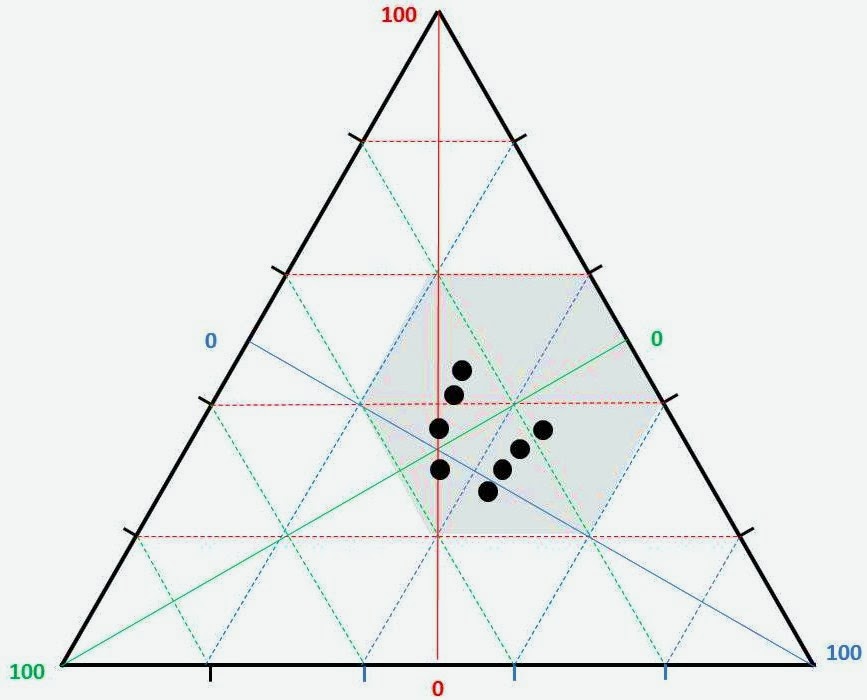
The last of these made me wonder whether a ternary plot (Wikipedia) might be of help in presenting polling results. This makes use of an equilateral triangle to locate data when three items have to add up in total to the same number (the scales run up the three vertices of the triangle). So Conservative %, Labour % and Other % have to add up to 100 % and the last eight election results can be plotted as in this chart:


All the results lie in the hexagon shown in grey and this can be used to plot the results and add in more detail: It shows the election results since 1970 in sequence, the majority boundaries which were provided by Electoral Calculus in their chart and the UKPR average as above. I’ve also added the 1945 election result for historical interest.


Does this form of presentation add any value? Possibly, (for those who can understand it and are not put off by the cluttered appearance) in terms of illuminating the consequences for the two main parties of votes being cast elsewhere.

For example, current Conservative support is back at the levels of the 1997 to 2005 elections. If Labour’s current support recedes to the level it was at in 2005, then, for the Tories to achieve a majority, the Other vote would have to drop to less than 25%. It hasn’t been so low in an election since 1979.

However, the Lib Dem level of support is currently at 10%, lower than at any election since 1970 and they are at present only one-third of the ‘Other’ vote. If they remain as unpopular but returned to being two-thirds of the ‘Other’ vote (as in elections from 1979 to 2005), the latter would drop to about 15%. The rest of current ‘Other’, (ie about 20%) could return to the two main parties rather than not vote at all. In the unlikely event of all these voters turning to the Tories in 2015, they would probably get a majority (‘a’, horizontally to the right from the November 2013 point). If as many as 5% transfer to Labour, even if 15% vote Tory, Labour has a majority (‘b’).

The poll data is in the Table below. To be honest, while the ternary plot is mathematically correct, I don’t think it adds much to Electoral Calculus’s more conventional form of plotting, which is probably quite enough for a lot of people.


18 October 2013

Norman Geras 1943 – 2013

I was very sorry to learn of the death of Norman Geras earlier today.

I first came across his normblog through John Rentoul who posted about Professor Geras on the Independent’s Eagle Eye this morning. Norman Geras was a far more sophisticated and knowledgeable blogger than I will ever be. I followed his posts with interest and learnt much.

I will add links to newspaper obituaries in due course, if they are not included in:

normfest   celebrating normblogging - a tribute to Norman Geras.


12 March 2013

Damian McBride’s “100 or so”

Damian McBride was a Whitehall civil servant who became Head of Communications at the UK Treasury and then, from 2005 until he resigned in April 2009, was special adviser to British Prime Minister Gordon Brown. He is now Head of Communications at the Catholic aid agency CAFOD and recently appeared as a witness before the House of Commons Public Administration Committee examining The Future of the Civil Service. McBride posts on his blog every few weeks on topics relating to his experience in government.

His most recent post, Going To The Mattresses: the art of surviving a coup, concerns the various ways a Prime Minister whose position is under threat can foil his colleagues’ attempts to oust him:
… if they [No10] want to know what it takes to get through an attemped coup, they could do worse than study the record of Gordon Brown – the Charles De Gaulle of Downing Street when it came to surviving assassination attempts. Based on the Brown survival manual, I would ask them the following five key questions …
For the full questions and answers see McBride’s post! But here is one gem:
With David Miliband’s various abortive coups, there was a certain crude art to inducing their failure. I was often personally criticised for over-reacting to some new Miliband manoeuvre, ‘ramping it up’ as people would say. But given David’s tendency to treat rebellion like a reluctant bather inching his way into the sea at Skegness, it made sense to push him right in at the outset, on the grounds that he’d run straight back to his towel, and not try again for at least six months.
I thought the answer to one question gives some insight into the way people at No10, at least in Brown’s day, see the world
4. How’s your relationship with the media these days?  
As I’ve said, momentum is everything in an attempted coup: to succeed, the plotters must keep pushing the leader towards the cliff. The media are crucial in determining that momentum: if they say it’s fizzled out, then it has; if they say one more bad day will make the leader’s position untenable, then it will. But, even for the BBC, this is not an objective, scientific process; it’s about 100 or so very influential people at different media outlets forming a view based on their conversations with each other and with key players on either side of the plot, as well as, to some extent, on public attitudes. That is why, no matter how bad the coverage of Gordon Brown’s Premiership became, it was still vital for us to maintain strong and friendly relationships with those 100 or so people.
So who are these “100 or so” (my emphases above)? I doubt if anyone, including McBride, has ever had a definitive list while at the same time there are probably a couple of hundred who would like to think themselves as being on one. As for the comment “even for the BBC”, here is an extract from the Pollard Review into the way BBC2 Newsnight handled the Savile story:
43. In addition to the overall structure of the BBC, it is also helpful to provide some background as to the structure of the BBC News Group, and the relevant reporting lines within this group.  
44. The head of the News Group is the Director of News. Throughout the period considered by this Review, this was Helen Boaden.  
45. … in November 2011 .... Ms Boaden’s reporting line was vertical – to the Director General. The Director General’s own reporting line is to the BBC Trust and its Chairman Lord Patten.  
46. Beneath the Director of News sits a Deputy Director of News. Throughout the period considered by this Review, this was Stephen Mitchell. Mr Mitchell is also Head of News Programmes. As Deputy Director of News, Mr Mitchell reports to Ms Boaden and is, in that role, involved in dealing with a range of strategic issues affecting the whole of BBC News. As Head of News Programmes, he is responsible for a wide range of national radio and television news and current affairs programmes, including Newsnight and Panorama.  
47. Beneath Mr Mitchell sit the editors of the news programmes. Thus Mr Mitchell is the line manager of Peter Rippon, the editor of Newsnight (who stepped aside from his post in October 2012). There was thus a direct reporting line from Mr Rippon to Mr Mitchell (and then in turn from Mr Mitchell to Ms Boaden).  
48. Beneath the editors are their deputy editors. Mr Rippon’s deputies in late 2011 were Liz Gibbons and Shaminder Nahal. They reported to Mr Rippon, whose own reporting line went to Mr Mitchell (and so on) as set out above.  
49. Beneath the deputy editors are the programme presenters, reporters, and journalists, such as Jeremy Paxman, Meirion Jones and Liz MacKean.
Leaving the BBC teams aside (11 in the above alone) it is possible to start guessing who some of the “100 or so” might be. A quick scan of the Labels used just on this blog since October 2010 comes up with:
Alice Thompson, Andrew Marr, Andrew Rawnsley, Benedict Brogan, Charles Moore, David Aaronovitch, Fraser Nelson, George Parker, Guido Fawkes (Paul Staines), Iain Martin, Isabel Oakeshott, Janan Ganesh, Jim Naughtie, John Rentoul, Lionel Barber, Mary Anne Sieghart, Patrick Wintour, Peter Oborne, Polly Toynbee, Rachel Sylvester, Sarah Sands, Simon Jenkins, Tim Montgomerie, Toby Young.
Another 76 or so to go then, and of course, not all the names would be common to Tory, Labour or Lib Dem lists of “100 or so”.

One of the above, Andrew Rawnsley, explains in Chapter 37 (Chamber of Horrors) of his The End of the Party the circumstances (the contents of some emails obtained by Guido Fawkes, also above) which led to McBride’s resignation from Brown’s team, and casts some light on his modus operandi:
… McBride had been Brown's chief propagandist for six years. He was also extremely tight with Ed Balls, closer some thought than he was to the Prime Minister. Balls, knowing that he would be spattered by association, raged at his friend: 'I can't believe you have been so f[xxx] stupid.  
The more scrupulous members of Brown's staff had long been horrified by what they saw of McBride at work. His modus operandi was to offer 'trades' to journalists who boosted Brown or killed stories that Number 10 didn't want published. Brown had ignored repeated warnings … to get rid of him. McBride was not a lone wolf; he was one razor-toothed but sloppy dog in the Brown pack with a licence from the Prime Minister.  
The e-mails were an extreme example of the macho and nasty tactics that had been employed on Brown's behalf by members of his cabal for many years. McBride operated in the dark side of Downing Street which was an expression of the dark side of Brown's personality. …(page 638)
Alistair Darling in Back from the Brink describes the aftermath of giving a bleak account of the UK’s economic prospects at odds with Brown’s views, to the Guardian:
… It was the briefing machine at No. 10 and Gordon's attack dogs, who fed the story and kept it running. I later described it as like 'the forces of hell' being unleashed on me. That's what it felt like. Damian McBride was no fan of mine - he clearly disapproved of Gordon's decision to appoint me as Chancellor. He used to look at me like the butler who resented the fact that his master had married someone he didn't approve of. I'm not sure that he ever spoke to me. He would give me a curt nod, nothing more. He had a group of journalists whom he briefed regularly, and when Catherine Mcleod [Darling’s Special Adviser] finally managed to meet with him, after repeated requests, he told her which journalists she should talk to and which not.  
… The attack dogs set about another colleague that summer. At the beginning of the summer recess, after the loss of the Glasgow East seat, David Miliband, then Foreign Secretary, had written an article for the Guardian in which he set out the need for a coherent political strategy to recover lost ground. It was a thoughtful piece, but it was interpreted by the inner circle as an attack on Gordon and a signal that David might launch a leadership attempt. Gordon was told by his team left behind at No. 10 that he should be relaxed about it. They were right. The article would have died a death had a cack-handed press operation not been mounted to trash David. (pages 106/7)
Darling also describes the emails which led to McBride’s resignation as:
… an all too predictable political catastrophe in No. 10, this time involving one of Gordon s spin doctors. Throughout his time in government, Gordon had relied heavily on these attack dogs, first Charlie Whelan, then Damian McBride. McBride had been caught out briefing against deputy leader Harriet Harman at party conference in October 2008 - by Harriet herself, who had overheard him. Rightly, she threatened to report him to the Cabinet Secretary unless Gordon did something about him. He promised to move McBride to where he could cause less trouble. It was to no avail. McBride's briefings against me to senior journalists and political editors were faithfully reported back. Gordon refused all entreaties by cabinet colleagues to let him go and tethered him instead in an office in No. 10. It was another flawed fix, and he continued to roam.  
Things finally came to a head when emails were published showing that McBride was involved in a shabby exercise to damage opposition figures and, in one case, the wife of a shadow minister. This time he had to go. Unfortunately, the disgrace did not leave with him. The repercussions for Gordon were disastrous. People had daily questioned our competence and our ability to control events. Now they had confirmation of what they suspected: we were a nasty party too. The perception was that our moral compass had irremediably lost its bearings. The McBride affair further destabilized the whole No. 10 operation.
In his post McBride mentions one of my Labels above:
If that instinct for survival – and everything that goes with it – is lacking in No10 at present, then it may point to a wider problem; with apologies to John Rentoul’s Banned List, something of an existential crisis.
who tweeted just after the post appeared:


I was surprised that the überpedant Rentoul should describe it as beautifully written. There were three howlers that even I could spot:

consiligieres instead of consiglieri
Charles De Gaulle instead of Charles de Gaulle
and “about 100 or so” is a redundancy.

But I may well make use of the “100 or so” label in future posts.