Showing posts with label 2015 general election. Show all posts

16 June 2017

Doing it properly for JR

John Rentoul tweeted this on 15 January and commented on my reply:

I’m sure he knows what an x-axis is and the limitations in that respect of the chart he tweeted, especially for periods when elections are spaced other than 4/5 years apart – like now. Anyway, this is possibly a slightly better way of presenting the same data for the vote share of the two main parties:


Really, it should be a histogram for each election, the data having no meaning in the intervals between elections. But joining up the data points appears to reveal a cyclic pattern of several election intervals duration.


Superimposing the percentage of the total vote which goes to parties other than the Conservatives or Labour seems to indicate the end in 2017 of what had been a very long-term trend. It was in the 1970s when the non-Labour, non-Tory share of the vote was last as low as in 2017. There were five general elections in the ten years from October 1964 to October 1974 - if there were a cycle, it was a short one. But it might be unwise to rule out a revival in Liberal Democrat and UKIP fortunes in the next few years.


Note

This is the full link to Cowling's data: drive.google.com/file/d/0B5Ik-g


15 February 2017

Brexit: London Boroughs and MPs

In a post here in January about the 2016 Richmond Park parliamentary by-election, I pointed out that “Anyone who attempts to look at [the relationship between the by-election and the 2016 EU Referendum] will encounter a problem: the Referendum results in London were reported at borough level, not by parliamentary constituency” and that I would “provide some further analysis of the London boroughs and the parliamentary constituencies within their boundaries” so here it is, for what it’s worth.

What constitutes London? Its orbital motorway, the M25, might provide a clear physical boundary but many people outside it earn their living in the city and its area assessed in terms of economic impact spreads a long way. For political purposes London is the combination of its 32 Boroughs with, at their centre, the City of London, both of these having Mayors. Within that London, there are 73 Parliamentary Constituencies (PCs). However, the City of London does not have its own MP, sharing one with next-door Westminster. So, for the purposes of most of what follows, I have combined the separate Referendum results for the Borough of Westminster and the City into “Westminster and City of London”.

A further complication is that 10 of the PCs straddle two LBs, Richmond Park being an example with its voters in Richmond upon Thames and in Kingston upon Thames. The table below shows how seats are distributed across the boroughs, 18 out of 32 sharing a PC with another. After the 2015 election the majority of London seats were Labour, and there was only one Liberal Democrat.


The 18 LBs and 10 PCs are shown below:


The 2016 EU Referendum introduced a new dimension into UK politics. The most pro-Remain area in the UK was Lambeth LB at 78.6%, 30.5% more than the UK average. But another London borough, Havering, at 30.3% was 17.8% below. 369th of the 380 UK reporting areas, Havering was almost as inclined to Leave as Boston in the East Midlands, the 380th at 24.4% Remain. The Remain and Turnout percentages for the LBs are shown in the chart below:

The chart shows that in London with exceptions (eg Richmond upon Thames) the relationship between Remain and Turnout was slightly inverse: that is to say, as the first went down, the second went up.

Across the UK, turnout for the Referendum in 2016 at 72.2% was higher than in the previous year’s general election at 66.4%. This was the case in most of the London PCs, but not all:


The LBs where turnout was less in 2016 than that of constituent constituencies in 2015 are shown below:


The Lewisham turnout reduction is unusual, involving all three of the PCs in the borough.

Finally, the chart below brings together the 2016 Remain results for the LBs (measured relative to the UK outcome – x-axis) and the majority in each of the PCs in 2015 (y-axis), both being percentages. PCs spread across two LBs are denoted with hollow bullets and linked with dotted lines. The outcomes of the two London by-elections in 2016 (Tooting just before the Referendum and Richmond Park nearly five months later) are indicated by the vertical arrows leading to stars.


The bullets with green shrouds indicate the PCs of MPs who voted against exercising Article 50 on 8 February. Not surprisingly, these represented constituents from LBs that had favoured Remain. The Lib Dem MP for Carshalton and Wallington is a notable exception. The MPs for the two PCs with voters in boroughs with marked differences in attitude to Remain (Erith and Thamesmead in both Bexley and Greenwich and Ruislip Northwood and Pinner in both Harrow and Hillingdon) did not vote against Article 50.


29 January 2017

The Richmond Park By-Election, 2016

The parliamentary by-election in the Richmond Park constituency held on 1 December 2016 was unusual, even for a by-election. It came about because the incumbent Conservative MP, Zac Goldsmith, had committed himself at the time of the 2015 general election, to resigning should a Tory government chose to proceed with a third runway at nearby London Heathrow. Earlier in 2016 Goldsmith had run for the Conservatives in the London Mayoral election – had he and not Sadiq Khan won, he would have resigned his seat then.

Because of the Conservative government’s Heathrow decision, in the December by-election Goldsmith stood as an Independent. Labour and the Liberal Democrats put up candidates against him but not UKIP, the Conservatives or the Green Party. In the June 2016 EU Referendum Goldsmith had supported Leave. The Liberal Democrat candidate in the by-election made it clear that she, like her party nationally post-Referendum, now supported Britain remaining in the Single Market. When the results came out, press coverage concentrated on Goldsmith’s losing his seat and the surge in the Liberal Democrat vote:


Much of the comment pointed to the high levels of Remain support locally in the Referendum earlier in the year. Anyone who attempts to look at this relationship more closely will encounter a problem: the Referendum results in London were reported at Borough level, not by parliamentary constituency. As the map below shows, the constituency (PC) of Richmond Park lies mostly in the London Borough of Richmond upon Thames (LB RuT) and partly in the Royal (London) Borough of Kingston upon Thames (RB KuT). The rest of LB RuT forms the PC of Twickenham. The RB KuT, except for the wards contributing to the Richmond Park PC, forms the PC of Kingston and Surbiton. 


The Referendum results for LB RuT and RB KuT are shown below in the context of other areas in London and the UK. Both were in the top 10% of Remain favouring areas across the country, but locally KuT was only just above the average for London and RuT was not one of the top 10 London boroughs.


The prevailing opinion was that the Liberal Democrat’s by-election success could be best explained in terms of a reaction to the Referendum. That is to say, local distaste for Brexit in 2016 had replaced local endorsement of Goldsmith’s anti-Heathrow stance in 2015. And there does seem to have been a differential effect in the turnout with the anyone-but-Goldsmith voting holding up quite well.

Perhaps some insight into Goldsmith’s fall from grace can be found in his original rise to favour revealed by comparing Richmond Park to the other two constituencies mentioned above in the three consecutive general elections of 2005, 2010 and 2015:


In 2005, all three were comfortably held by the Liberal Democrats, part of a cluster of seats in south west London which they had built up in previous elections. In 2010, the Tories improved their position moderately in Kingston and Surbiton and Twickenham but made a considerable improvement in Richmond Park where their candidate, Goldsmith, was elected. In 2015, all three seats became Tory-held, some of the former Liberal Democrat voters apparently preferring Labour or Green after five years of coalition. The Conservatives would probably have done better but for the rise of UKIP.

Does the 2016 by-election herald a return to favour for the Liberal Democrats and offer prospects of regaining the other two constituencies? If there were to be by-elections in either of them soon, the answer is probably yes, given the enthusiasm in the boroughs concerned for Remain and the small Conservative majorities by comparison with Goldsmith’s in2015. However, once the UK has exercised Article 50 in March 2017, events will move on and the key issues for voters at the next general election, quite possibly three years away, are not yet obvious.

After the 2015 election and until December 2016, there was only one Liberal Democrat MP in London, Tom Brake (a far from household name), in Carshalton and Wallington, the seat he has held since 1997. That constituency lies in the LB of Sutton together with the PC of Sutton and Cheam. In the Referendum LB Sutton was 28th among the London boroughs by pro-Remain ranking and one of only five of the 32 boroughs to be more pro-Leave than the UK as a whole (Table 2 above).


It seems obvious from the general election results 2005-2015 above and Brake's small majority in 2015 that the Tories would have added his scalp to their collection but for the votes taken by UKIP. If there were to be a by-election in Carshalton and Wallington in the near future, it could well be taken by the Tories. This raises the interesting point that the anti-Leave position currently adopted by the Liberal Democrats may not work for them everywhere as well as it did in Richmond Park – Labour’s problem writ small. 

A future post will look more closely at the national Liberal Democrat position post -Referendum in terms of the constituencies now held and those they might want to regain. Another will provide some further analysis of the London boroughs and the parliamentary constituencies within their boundaries.


31 December 2015

Andrew Marr’s ‘Head of State’

A disappointing first novel from a political insider, neither thriller nor satire 

At last I have got round to reading the paperback edition of Andrew Marr’s first novel, originally published in September 2014. At the time Head of State came out, I was intrigued by a piece in Private Eye (No 1376, 3 October, page 29 – familiarity with this magazine can only be helpful to readers of Marr’s book) which reported the launch in 10 Downing Street:


Head of State received faint praise from the critics then, and, when I looked recently on Amazon, it had acquired an oddly balanced set of Customer Review scores:


However, Marr, as well as having written other books about history, politics, poetry and the Queen, has been editor of a national newspaper (the Independent) and the BBC’s political editor and also, as the host of BBC1’s The Andrew Marr Show, has regularly interviewed top politicians for over 10 years. And his Author’s Note (dated April 2014), prefacing Head of State (which is subtitled A Political Entertainment - echoes of Graham Greene), seemed encouraging:
… I had long wanted to write a political satire that would help lift the lid on how aspects of government and the media really worked in a way that’s not possible in conventional journalism. 
… Some of the characters and stories in the novel are derived directly from my thirty years as a political reporter, though of course almost everything here is fictional.
I would guess that the bulk of the writing was done in 2013 when Marr was recovering from a stroke. At that time, well before the 2015 general election, a referendum on the UK’s leaving the EU (Brexit) set in September 2017, the motor of Head of State, must have seemed only a possibility and safely distant at that. By comparison, Michel Houellebecq, who must have been writing Submission at about the same time, was setting his novel in 2022. Now, Marr’s readers, less than 18 months after publication, are having to put to one side the facts that there will be an EU referendum this year or next and that David Cameron is still Prime Minister leading a Conservative government since May 2015. Fortunately in Marr’s 2017 the Tories are obviously in power, the Chancellor of the Exchequer being one Jo Johnson (Boris’s brother, currently Minister for Universities and Science (page 339).

Is Marr’s novel a roman à clef? Houellebecq mentions quite a few contemporary personalities in his future France but keeps them in the background, his main characters being plausible, but imaginary. Head of State mentions no end of real people, including, Marr himself (page 96), and Ian Hislop, the editor of Private Eye, (eating a cake on page 247). Moreover, while most of the foreground characters are fictional, readers of Private Eye’s Street of Shame column could make a guess at the inspirations, and there are several, for Ken Cooper, editor of the fictitious National Chronicle. However, one of the few admirable characters in the book, the modern historian, Lord Briskett, is surely without parallel in the real world:
Dressed in his trademark coarse green tweeds, with his halo of frizzy white hair and heavy horn-rimmed spectacles, part A.J.P. Taylor part Bamber Gascoigne, Trevor Briskett was famous enough from his TV performances to attract second glances from his fellow commuters. On the streets of Oxford that crowded, clucking duckpond of vanity and ruffled feathers - he was stopped-in-the-street famous. 
And rightly so. For Briskett was the finest political historian of the late twentieth and early twenty-first centuries. His early biographies - Blair, Thatcher, Johnson - were still in print, while the memoirs of scores of almost-forgotten politicians had long since vanished to charity shops and recycling dumps after selling only a few score copies. Briskett's account of the modern constitution had been compared to the works of that Victorian master-journalist Walter Bagehot. His history of British intelligence during the Cold War had been praised by all the right people. Emeritus professor at Wadham, winner of numerous literary prizes, elevated five years ago to the Lords as a crossbencher after chairing a royal commission on security lapses at the Ministry of Defence, Briskett was regularly tipped to be the next member of the Order of Merit. 
Yet somehow these decorative embellishments, which might have weighed him down and made him soft, slow and comfortable, had had little apparent effect on Trevor Briskett. At seventy he was as sharp, as boyishly enthusiastic, as wicked a gossip with as rasping a laugh, as he had been at thirty. The exact nature of the pornography discovered on the minister's lost laptop. The attempt to blackmail a senior minister over his wife's cocaine habit. Just who Olivia Kite was taking to her bed these days … If you really wanted to know you went to Briskett, and he would tap his nose, lean towards you, give a wolfish smile and a 'dear boy', and spill all the beans. (page 15/16)
Funnily enough, it was pointed out on the History Today website recently, when marking the 50th anniversary of the Journal of Contemporary History, that modern historians are dismissed as not dealing in real history, just gossip.

But without any attempt at disguise, a key role in Head of State is taken by Rory Bremner, a real British actor (and a Scot like Marr) who has made a career from comic impersonation of public figures. And what to make of a Scotsman called Nelson Fraser - did Martin Andrews have anyone particular in mind? Not to mention a female character described as whetstone-hard (page 285). Almost totally unambiguous is the King, for in Head of State the Queen has become “late” – presumably a few years after the publication of Marr’s The Diamond Queen: Elizabeth II and Her People in 2011. The characterisation of “Kingy”, as the staff of Marr’s Number 10 call him, owes rather too much to Silvie Krin’s Heir of Sorrows, as occasionally appearing in, yet again, Private Eye. By the way, in the United Kingdom the King or Queen is the Head of State, the Prime Minister is the Head of the Government. Marr is, of course, aware of this distinction and the title of the book is a pun on a particularly gruesome aspect of his tale.

Something similar happens with the locations: Gordon’s wine bar is real enough but Marr chose to put the “Universities and Constitutional Club” in the place of the Athenaeum – perhaps he’s a member.

If Head of State is too uneasily placed between imaginary and real worlds to be a satisfactory roman à clef, is it a thriller or a satire? In so far as the events being described are packed into eight days from 15 to 22 September 2017, the Brexit Referendum Day, surely the former. But Head of State is no Six Days of the Condor. There are 14 chapters, each titled with a date, and to explain the sequencing Marr chose rather than a normal narrative flow, a picture is worth thousand words:


The events in the eight days are too numerous, involve too many characters and mostly too far-fetched to yield a convincing thriller, and the leaping about in time reduces what suspense is mustered. On the other hand, there are too many attempts at wit which fall flat:
… ‘Fuzzy Blue oatcake’, the most influential right-wing blogger … (page342) 
Christ Almighty, a recent Hollywood adaptation of Evelyn Waugh’s biography of Ronald Knox (page 20)
to provide the entertainment of one of Waugh’s comic novels, and too much grotesque unreality (for example, the said head) to make for a thought-provoking satire. There is also some poor, or just careless, writing which the editors (described by Marr in his Note as “legend[s] in the trade”) should have picked up. Just a few examples:
… hair for whose colour there was no adequate description - corngold and copper, silver birch with licks of flame. (page 24 – is this a Clairol ad?) 
… a wooden cabinet whose numbered chambers were perfectly sized to hold Blackberries and iPhones (page 82 – “with numbered chambers for Blackberries and iPhones” - they can’t be perfect for both) 
… [he] felt himself a man brimming with talents in a world that no longer needed them; an itchy-palmed electrician, as it were, during the New Stone Age (page 247 – the New Stone Age ended almost 4000 years before the practical application of electricity!).
Marr’s dislike of bloggers (discussed here in 2010) comes up repeatedly and, no doubt for related reasons, in Head of State he makes frequent and disparaging references to “Witter”, right up to page 342. So why on page 358 does he relent and use “tweeting”?

Does Marr “help lift the lid on how aspects of government and the media really work[ed]”? Well, there are a few lines about Brexit, which might provide the flavour of arguments which will appear as the real Referendum Day draws near:
… A Europe that fragmented now would soon become a mere vacuum, a playground for American technology, Chinese money and Russian political ambition. And Britain? Britain would again find itself desperately trying to negotiate the balance of power between Berlin and Paris, from a position of no significance. It would be impossible. (page 104) 
… Increasingly excited, he and Charmian began to talk numbers. 'lf the UK does leave the EU - well, the dollar is 1.55 to the pound now. Sterling will no longer be a reserve currency, so it will fall to, say, 1.35. Probably lower than that. (page 204, Sterling is 4% of all currency reserves at present – so would this happen? I’ve no idea, like many other readers, I suspect)
And towards the end of the novel there is this intriguing passage:
The whole thing is simply incredible. Oh no, it couldn't happen here. It's as bonkers as - what? - two brothers fighting each other for the leadership of the Labour Party, or a husband and wife jailing each other. over a pretty minor traffic offence, or two eminent members of the Conservative Party being in a gay relationship even as they proclaim family values, or a prime minister having an. affair with one of his own ministers. Loopy. Loony. It's as bonkers as manufacturing the case for an entire war and thinking no one would notice. Mad as cheese. No, no, none of that could ever happen here. The great British public simply wouldn't let them get away with it. (page 327/8)
I would expect that some of these ‘incredible’ happenings are recognisable to most of the book’s likely readership, but are the others figments of Marr’s imagination or things he knows about and we don’t?

In a while I will post about Marr’s second attempt at a political novel, Children of the Master, published in September 2015 and again not enthusiastically reviewed. Both books will probably become available in an Oxfam near you before long.


5 December 2015

The Oldham West and Royton By-election

By-elections are probably over-analysed and over-interpreted but I thought this week’s at Oldham West and Royton was worth looking at. It took place on 3 December 2015 almost exactly seven months after the General Election on 7 May and three months after Jeremy Corbyn became Labour leader. I haven’t seen the results presented anywhere else as below, so offer them here.


The first column shows the Oldham West and Royton results in the General Election (GE) when over 43000 votes were cast. In the By-election (B-E) there were just under 28000 votes, as shown in the fourth column. If these had been cast in exactly the same proportions as at the GE (ie the same reduction in turnout had applied uniformly*) the parties would have had votes as in the second column.

The Green and Monster Raving Loony (MRL) votes can be ignored. What is striking is the consistency of the Liberal Democrat vote between columns two and four and the “poor” showing of the Conservatives. Where did those 2600 Conservative votes go? It seems like about 2000 to Labour and only 800 to UKIP.

Perhaps it’s fair to conclude that quite a few of the voters who are interested enough in politics to turn out for a by-election will vote tactically for whatever is in their own party’s long-term best interest.

Data from Wikipedia.


ADDENDUM 6 DECEMBER

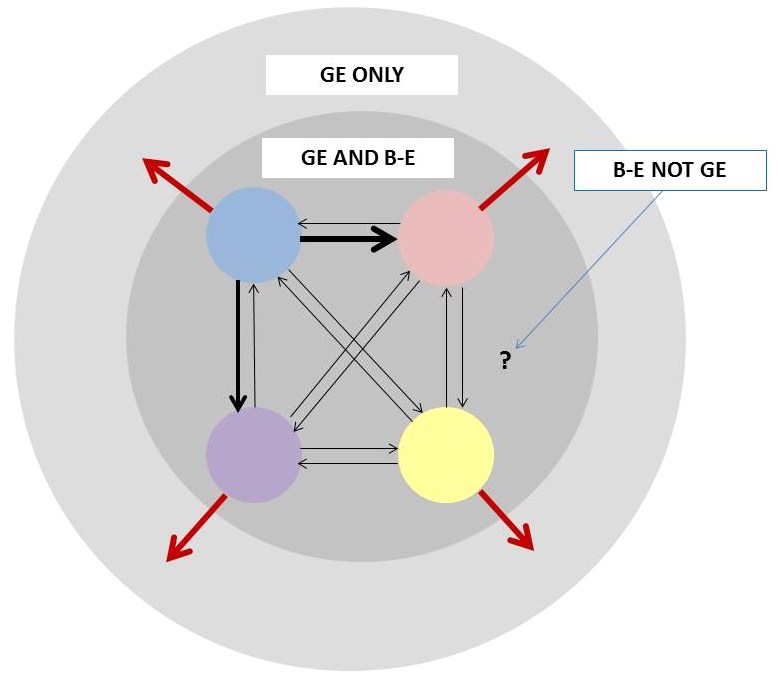
* This was not the only assumption as well as ignoring the Green and MRL. It is possible that some people who turned out for the by-election hadn’t voted in May. More significantly, voters who did turn out for both could have shifted their allegiances in seven months. This diagram indicates the possibilities:


However, I can’t imagine that many May Tories have gone to Labour or Lib Dem. In fact, it seems unlikely that votes would have moved to the Lib Dems in any number from either of the other parties. Hence only the heavy arrows in the diagram,seem to provide a plausible explanation for what happened.

I don't know if the data is available, but it would be very interesting to see the numbers of postal votes, GE and B-E, broken out by party.

14 May 2015

RN Trident after the UK General Election

During the election campaign Labour made it clear that they would continue with a UK nuclear deterrent and that it would by implication be in the form of SSBNs with Trident SLBMs:
Labour remains committed to a minimum, credible, independent nuclear capability, delivered through a Continuous At-Sea Deterrent. We will actively work to increase momentum on global multilateral disarmament efforts and negotiations, and look at further reductions in global stockpiles and the numbers of weapons. (page 78 and 79, Britain can be better, The Labour Party Manifesto 2015)
Elsewhere there were four mentions of NATO, none in the context of nuclear deterrence.

Almost as near to the end of their manifesto, the Conservatives were more specific about the number of submarines and the Trident system:
We will retain the Trident continuous at sea nuclear deterrent to provide the ultimate guarantee of our safety and build the new fleet of four Successor Ballistic Missile Submarines – securing thousands of highly-skilled engineering jobs in the UK. We will work closely with our allies to continue to strengthen NATO – supporting its new multi-national rapid response force. We will maintain our global presence, strengthening our defence partnerships in the Gulf and Asia. Later this year, we will hold a National Security Strategy and Strategic Defence and Security Review to plan for the future. (page 77, The Conservative Party Manifesto 2015)
There were six other mentions of NATO, again none were in the context of nuclear deterrence.

By comparison, the SNP seemed mildly obsessed with Trident and nuclear weapons, a subject which appeared six times in their manifesto spread from pages 3 to 38 (see Annex below). However, there was no mention of NATO at all, even though the “High North and Arctic are a key priority for Scotland”. Of course, this avoided any need to address the problem of pursuing unilateral disarmament and in so doing destabilising a nuclear alliance, as had been apparent in the 2013 white paper, Scotland’s Future Your Guide to an Independent Scotland (discussed here last year).

SNP leader Nicola Sturgeon at a CND rally in April 2015
But the election of a Conservative government seems to have given a green light (if not a blue one) to four new SSBNs with Trident missiles. The bloc of 56 SNP MPs at Westminster could not win a vote against it, even with the support of left-wing Labour and Liberal (Democrat) members. But this ignores the new reality of Scottish politics with the SNP seeking to make any suitable issue – the repeal of the Human Rights Act, for example – into one of Westminster dominating Scotland and so bolstering the case for another independence referendum.

In terms of defence planning, with its timescales of years or even decades at the level of the “National Security Strategy and Strategic Defence and Security Review”, endorsement of the future of the deterrent can hardly avoid addressing the contingency of another independence referendum in which the No/Yes vote of 45/55% in 2014 might be reversed. So adamant are the views of the SNP on the subject in their manifesto that it seems unlikely that any compromise would be forthcoming in any independence negotiations. The relocation of the deterrent from Scotland to SW England has been the subject of more than one post on this blog. Most recently, last October, I concluded:
Following the referendum result, the problems that might have arisen after independence, of which Trident’s future was just one, have moved off the political agenda. Although the possibility of Scottish independence cannot be ruled out for all time, it seems most unlikely that resourcing submarine relocation would be recommended in the UK’s Strategic Defence and Security Review (SDSR) due in 2015.
Now I’m not so sure – and having taken so many Lib Dem seats in SW England, the Conservatives will doubtless want to hold on to them. An article in the Financial Times on 14 May, Conservative vote rose in seats receiving extra government money, drawing on Social Market Foundation research, makes the point nicely.


Annex Stronger for Scotland 

And we want the precious resources of our country to be invested in building a better future for our children, not on a new generation of nuclear weapons. (page 3, Stronger for Scotland, SNP Manifesto 2015)

• For no new nuclear weapons – we continue to oppose nuclear weapons and will seek to block a new generation of nuclear weapons, saving as much as £4 billion a year in the mid-2020s. (page 5)

We will invest in our economy to create more and better paid jobs. And we will oppose a new generation of nuclear weapons. (page 7)

We will oppose plans for a new generation of Trident nuclear weapons and seek to build an alliance in the House of Commons against Trident renewal. We will vote for the £100 billion that the Westminster parties plan to spend on Trident renewal to be invested instead in better childcare, education and the NHS. (page 8)

We also propose different spending and taxation priorities. At a time when thousands of our citizens are forced to use food banks, there can be no doubt that spending billions on a new generation of nuclear weapons is unjustifiable. A vote for the SNP is a vote to halt progress on Trident renewal, delivering a saving of £100 billion over the next 35 years. (page 14)

And in a lengthy section on Defence that works for the people of Scotland:

As a northern European nation, our near neighbourhood including the High North and Arctic are a key priority for Scotland. The forthcoming UK Strategic Defence and Security Review (SDSR) must take full account of the particular challenges and opportunities of the northern regional dimension, and of the need to be more effective at combatting cyber-terrorism where the SDSR must lay out a clear strategy, including continued engagement with the Scottish Government.

The SDSR must review the current Ministry of Defence record, which includes falsely inflating spending commitments, mismanaging Army personnel reforms and creating dangerous capability gaps.

In particular, we believe there should be ocean going conventional patrol vessels based permanently in Scotland and will seek the early procurement of multirole Maritime Patrol Aircraft purchased ‘off the shelf’ by the end of this parliament and operating from Scotland. The SDSR must also fully consider the advantages of a defence policy without weapons of mass destruction and wasting £100bn renewing Trident. We will continue in our principled opposition to nuclear weapons and believe that the UK should abandon plans to renew the Trident nuclear missile system. In addition, the MoD should also publish in full current and projected annual costs of the Trident system and its proposed successor programme, including nuclear weapons through-life costs. (pages 19 and 20)

The SNP goes into this election with a clear message - none of us can afford more austerity. Our NHS, our economy and our children can't afford the billions of pounds of additional cuts that the Tories, Labour and Liberals have signed up to. And none of us can afford the £100 billion they plan to spend on new nuclear weapons. (page 38)


12 May 2015

UK General Election 2015

Back in March I was foolish enough to post about forecasting the outcome of the UK election on 7 May:
My hunch is that the LibDems will do better in their established areas than the national polling would suggest, and also that Labour will do better in Scotland than some of the forecasts are indicating.
Oh dear, my hunch was way wrong – so were other people’s forecasts, all based on opinion polling which turned out in retrospect, almost without exception (Survation and internal Labour party polling, both revealed after the event), to have been near useless until the exit poll. This chart updates one in the earlier post to show the final forecasts and the actual outcome:


That post had another chart, also updated below, which showed the relationship between the votes cast for Conservatives and Labour and the seats the parties obtained, both expressed as percentages. The first-past-the-post voting system tends to reward parties in that as they get more votes, they get even more seats (otherwise the dotted grey line would apply). However Labour does better than the Conservatives (the thin red line through their recent election results as opposed to the thin blue one). The dotted lines seem as good a guide as most of the more sophisticated forecasting models – assuming the forecast percentages of votes are correct.

Finally, will it be 1992 all over again in terms of the number of MPs? In the UK as a whole and looking at the two main parties, far worse for Labour alone, but in terms of Conservatives vs a Labour/Lib Dem/SNP bloc, remarkably similar. In England and Wales terms, Northern Ireland and Scotland both now being insignificant for the three main parties, Labour are slightly better placed than in 1992, but again in terms of Conservatives vs a Labour/Lib Dem bloc very similar:


30 March 2015

Forecasting GE2015

It isn’t necessary to go into the detail of this chart from the Economist to see how the two main parties’ market share of the UK electorate has declined since 1945:


This has meant that forecasting the outcome of UK general elections has become more difficult although the tools for doing so have become more powerful. Various academic political scientists have constructed models making use of polling, census and past election data to forecast voting at constituency level and then the number of seats each party might win. On 27 March the forecasters met in London and shared their current estimates as to how the 650 UK parliamentary seats might be distributed, as tweeted the following day by Matthew Goodwin:


At first sight, there is quite a large spread in these figures but the chart below might put it into context. The number of Conservative (blue) and Labour (red) seats for the last five general elections is shown and then the forecasts (and spread thereof) taken from three sources. I have chosen electionforecast.co.uk because it is the UK partner for FiveThirtyEight (the Editor-in-Chief of FiveThirtyEight is Nate Silver, author of The Signal and the Noise). The other two appear to me to be the most credible as they are attempting to address the number of seats for all the parties and are avoiding obvious outliers like the SNP with only nine seats. As in 2010, a hung parliament looks likely and there is currently much discussion of various coalition-type arrangements and combinations.


Outside the UK (and quite possibly inside), not everyone may be aware that the four “nations” of the United Kingdom are disparate in terms of the Westminster parliamentary seats they have currently (there were more Scottish seats before the Scottish Parliament was established):


(England, Scotland, Wales, Northern Ireland; Conservative, Labour Liberal Democrat, Others includes the Speaker). 

The Conservatives are almost confined to England and Wales and, if they are to form a single-party majority at Westminster, that is where they have to secure the seats to do so. If the Scottish Nationalists (SNP) do as well as is expected (see the second chart above) they will have about 2/3 of the Scottish seats and Labour will be in a similar situation. The next chart shows the relationship in England and Wales for the last five general elections between the votes cast for Conservatives and Labour and the seats the parties obtained, both expressed as percentages.


The first-past-the-post voting system tends to reward parties in that as their share of the vote increases they gain disproportionately more seats (otherwise the dotted grey line would apply). However Labour does even better than the Conservatives (the thin red line through their recent election results as opposed to the thin blue one) because of the distribution of the electorate across constituencies.

As long as the two main parties have similar low 30% voting support in polls, it suggests that Labour will be the largest party in E&W although probably not achieving an overall Westminster majority. Because the five Sinn Fein MPs do not attend Westminster, the theoretical minimum for an overall majority is 323. Labour would also have support on from the remaining Scottish Labour MPs, on many issues from the SNP, and, as the largest party, on many issues the LibDems.

If the Conservatives break through to the upper 30% level – this would require squeezing UKIP, there are only hard-core LibDems left to squeeze – leaving Labour behind, they become the largest party, and as such may turn again to the LibDems for support. Whether they would get more seats together than Labour and SNP combined is difficult to say and best left to FiveThirtyEight & Co. 

My hunch is that the LibDems will do better in their established areas than the national polling would suggest, and also that Labour will do better in Scotland than some of the forecasts are indicating.


23 March 2015

It’s the David Miliband wagon again

Just my conjecture of course, but could it have been that it seemed a good idea last Monday. On the Wednesday (18 March) Osborne’s Budget - bribing taxpayers with borrowed money - was bound to go down well and Ed Miliband’s response to go down badly; the YouGov opinion poll to be conducted on 19-20 March was certain to show that the Conservatives had opened up a significant lead over Labour; then on 22 March the poll results could lead on the front page, the Sunday Times magazine having been given over to a cover feature trailed all week: Celebrity big brother How David Miliband conquered New York. Anonymous Labour MPs and shadow cabinet members would provide quotes which evinced a bad attack of the heebie-jeebies, and the ditch Ed bandwagon would be shown to be rolling.

Only it didn’t quite work out like that. The poll showed a two point Labour lead and accordingly was relegated to page 16, leaving Iain Day’s David Milband article, THE OTHER MILIBAND Yo bro, I’m the talk of the town, somewhat high and dry in the magazine, as was the companion puff piece, No 1 Miliband still wants No 10, on page 8 of the main paper. Never mind, it still left some grist for the mill of this blog which has been following the periodic revivals of media interest in David Miliband since last August (and December and January).

So what was different about this one? There was certainly stock material about their Marxist dad, which brother got the first in PPE, and how upset their mum was and how the two younger Mrs Milibands had fallen out when Ed stymied David’s bid for the Labour leadership. But Day’s article seemed to have some new material from New York sources in and around the International Rescue Organization (IRC) where David now works as its president and CEO, at a salary of £300,000 ($450,000 presumably). As always, these things are best taken with a pinch of salt, for instance, early on we are told:
Miliband, astonishingly, has become the toast of the Manhattan elite.
and three sentences later:
… they have become minor celebrities among über-rich New Yorkers.
Not quite the same thing, surely? Anyway, towards the end there is a health warning:
David Miliband refused to be interviewed for this article.
Indeed, so we have:
According to some of his closest confidantes … 
… says one director of the IRC. 
Almost all of the IRC directors I spoke to … 
… a number of the charity’s directors confirmed to me … 
… says one IRC director … (five times)
and bizarrely:
Sir Patrick Stewart, the Star Trek and X-Men actor, is one of Miliband’s closest confidantes in New York, according to IRC sources …
Just how many directors are there? According to the relevant IRC webpage, 28, but the layout is unclear and I could have miscounted. There are also about 75 overseers (some may be directors as well) including, as the article explains, such eminences as Henry Kissinger, Madeleine Albright and Liv Ullman. Some of the overseers and directors are named as sources and their comments should interest anyone who wants to know how Miliband got the job and how he is operating and raising funds through his “relentless charm offensive around New York’s high society”. But this blog has been more interested in whether Miliband would “do a Boris” and return to Westminster politics. There are three passages in the article I thought worth noting:
"He wants to be prime minister," says one director of the IRC. "The typical term for the boss o this organisation is 10 years. He made a commitment to stay for seven, which takes him to 2020, but with, effectively, a break option at five. I don't think it's a coincidence that the dates align with the next election. He does not want to run against his brother. But if his brother gets chucked out I don't think he is at all averse to being the white knight."
and:
Should destiny come calling, Miliband has kept his designer kitchen cabinet of trusted advisers close to him. Madlin Sadler has long been the right hand of David Miliband, serving as his special adviser at the Foreign Office and as his agent in that fateful 2010 Labour leadership contest. The daughter of Labour MP Barry Sheerman, Sadler ditched a well-paid role with the law firm Mishcon de Reya to join her old boss in NewYork. Ravi Gurumurthy, a strategy expert who helped Miliband form British foreign-office policy, has also been hired. Gurumurthy is the brother of the Channel 4 newsreader Krishnan. Then there's Ollie Money, his Westminster public-relations handler, who is now the IRC's communications director. 
“David has a vision and a mission, Maddie [Sadler] just wants to get to Downing Street and to get there fast," says one IRC director. "When he brought her in, he called her his chief of staff, which was a big mistake. She's super-smart, young, really brassy, just killer. He needed that because he didn't have any experience managing big organisations, and there are 6,000 people in this organisation, spread all over the world. She just ripped the shit out of the place. There was a pretty strong reaction to her, but not to David. Being the great politician that he is, he made it good when it went too far."
and:
The IRC insists that Miliband's contract is not limited to just seven years. Yet a number of the charity's directors confirmed to me that Miliband made a commitment to the board to stay for a minimum period after they raised concerns about him being tempted to return home. Should the opportunity emerge to take the helm of Labour, Miliband would be a greyer, wiser, very electable 54 years old in 2020. He would be even better connected internationally. Unlike almost any other politician in Britain, Europe or the US, he would have experience of running something before attempting to lead the country. 
"We have our eyes wide open to the possibility that David could disappear," says one IRC director. "If Labour get trounced and they're looking for a new leader, and it doesn't look like he was the one who threw his brother out, would he consider it? Yes, I suppose. I still think he’d prefer that they threw in someone who would be cannon fodder for a period of time. Then, when there's a problem, David is the white knight. If David could write the script, that's what it looks like."
Day shared the by-line of the story in the main paper with Tim Shipman, who, to judge from this extract, had spent some of Saturday on the phone to his Labour contacts:
Labour MPs who supported David Miliband last night questioned whether he has a realistic chance of returning to replace his brother suggesting that rising stars such as Chuka Umunna, Tristram Hunt, Liz Kendall or even Dan Jarvis are better placed to carry the Blairite standard. A frontbencher who voted for David said: "He should have won the leadership and I think we'd be in better shape if he had. But the modernising wing of the party has moved on. "David's still young but he's part of a different political generation. We need to look forward, not back. There are a lot of talented people like Chuka, Tristram, Liz and even Dan Jarvis now coming through. David's had his time." Another prominent MP said: "If the public rejects one Miliband, the idea that they are going to race to embrace the other is fanciful." A spokesman for Miliband said: "David wants Ed to be prime minister. End of story."
“ … even Dan Jarvis” – an estimable character I always think, and well-equipped to “go on manoeuvres” as the Tories put it. Shipman’s view of politicians in general was revealed in a The Times Red Box email on 22 March while commenting on a Tory candidate currently in a spot of bother:
I am struck, not for the first time, that too many people engaged in frontline British politics believe they are living and working in House of Cards, with its labyrinthine Machiavellian scheming, when in fact they are straight out of The Thick of It, the ultimate modern incarnation of tragedy as farce. Politics attracts the talented and tormented, idealists and ideologues, the principled and the perverse. Most strikingly, it attracts more than its fair share of risk takers, gamblers, and fantasists; the kind of people who live their lives in a divinely ordained parallel universe of their own creation. Vetting can only show what skeletons candidates have in their cupboards. It cannot show the delusions in their own heads.
Interestingly on Monday 23 March, in the Sun (stablemate of the Sunday Times and The Times), Trevor Kavanagh, its veteran political journalist, has authored an opinion piece, Arrogant David is wrong to assume job’s his next time round. So, at least for the moment, the Miliband wagon is not just stalled, one of its wheels has come off. Disappointing for anyone at IRC who was hoping for a new CEO, perhaps one of those:
… long-standing staff members [who] did not take kindly to memos [from Gurumurthy] asking about their financial targets and questioning various projects in terms of cost benefit analyses and return on investment.