Showing posts with label inequality. Show all posts

26 February 2014

Carry on clinging on

A post earlier this month followed up a story in the Financial Times on 15 February about the division of the British middle-class into the 'über-middle' and the 'cling-ons'. Subsequently an article in The Times (£), Super-rich professions squeeze out traditional middle class, went over the same ground, quoting a little more data:


and the FT has returned to the subject, particularly the housing implications which I touched on in the last post. On 22 February (again a Saturday) the FT lead was High earners face London lockout, ‘Cling-ons’ priced out of homes by ‘uber-middle’, Camden and Hammersmith now unattainable. To help those who had missed the previous week’s story, it explained:
The purchasing power of a wealthy "über middle" is increasingly pushing the most desirable neighbourhoods out of the reach of "cling-ons" - the architects, engineers and academics whose salaries have failed to keep pace over the past 40 years. … People who could once have afforded Richmond, Wandsworth or Islington, are now buying homes in Barnet, Lambeth and Haringey, the data show.
“the data” came from Savills estate agency, as in my post. They were also one of the sources for a map on page 2 of the FT titled “Britain’s middle class has been forced out of “prime” neighbourhoods” showing how for various districts the percentage of electoral wards where average housing costs for a household with a net income of £58,000 are unaffordable (ie need more than 35%):


The accompanying article focussed on Oxford, quoting Savills’ man on the spot:
A lot of the families who lived in north Oxford up until the time that I started (in 1961) were academic families. A lot of those have sold and gone out. And the people coming in might have an academic background, in so far as they were undergraduates here, but they have gone off and made their fortune either in industry or in the City or as senior consultants or accountants and so on.
Another article described the difficulties faced by the cling-ons in affording private education, one of the attractions Oxford offers the übermenschen.  An FT video is available, British middle class splits in two, featuring St Albans as the context.

The FT offered an interesting point about London from Chris Hamnett, professor of geography at King's College, London, who has charted its "gentrification" over 50 years. He said that the capital was now "a global centre for the international rich whose desire to secure a home in the capital amounted to "a process of global asset diversification". Next month Evan Davies has a two-part series on BBC2, Mind The Gap: London Vs The Rest, which hopefully won’t be just a eulogy of Bojoburg and will be prepared to look at the strains the capital is starting to impose on the rest of the country.

Some interesting issues may emerge from this fission of the middle class into über and cling-on.

Firstly, the political implications. If the Conservatives start to be perceived as the party for of the über-middle and above in London and the south east, can they ever win a national election? The foreign owners of London properties don't even vote. Worse, many of the under-60 middle class, whose support the Tories need, will be increasingly aware of their precarious cling-on situation and may find Labour's concern for the squeezed middle appealing.

Secondly, for how much longer will the NHS be able to pay its medical staff über-middle rates of pay? 

Thirdly, are these stories underlain by an internal debate at the FT as to whether it should remain a national newspaper with declining print sales? Could it decide to push away the UK cling-ons? The FT could then concentrate its efforts on physical distribution only at the weekend and on-line subscription all week for the über middle and richer catchments, the dark bits in the map above and their equivalent across the Anglosphere? Much of the content of the FT’s How to Spend It supplements (see its “website of worldly pleasures”) concerns goods and services already clearly unaffordable by mere cling-ons. The weekend House and Home section is in a similar vein, Cheap as pommes frites*, being the headline of an article describing the cheapness of the French property market – from €4.5 million upwards.
*UK chips, US French fries.

 
UPDATE 6 MARCH

Tyler Brülé is the editor-in-chief of Monocle magazine and he also writes a weekly column, The Fast Lane, for the Weekend Financial Times. On 1 March, a few days after this post appeared with its concluding bit of speculation, Brülé chose to write about a new Australian newspaper appearing for the first time that day, The Saturday Paper:
It comes at a time when many of the world's big news groups are considering what to do with their print editions from Monday to Friday (go exclusively on-line? Drop home delivery? Limit distribution to big cities only?) while placing more emphasis on their weekend editions (The FT, for example, has a big global campaign to bolster its weekend offering).  
The Saturday Paper cuts out the cost that comes with running a newspaper throughout the week and is building on a readership base from an established sister magazine, The Monthly. Publisher Morry Schwartz's move to shake up weekend reading should be monitored closely by press barons, both established and emerging.
The FT on 1 March seemed to be giving the über-middle/cling-on thing a bit of a rest.

18 February 2014

The view from the unter-middle*

On 15 February the Financial Times lead was one of those designed to sell copies of Saturday’s paper: Über-middle' pulls ahead' on pay:
In this tale of two middle classes, doctors, barristers and London's financial services workers emerge as the big winners. But this "über-middle" is dwarfed by a much larger group of "cling-ons" who have seen their relative position dramatically worsen even during the years of economic boom. The data, prepared for the FT by two of the nation's foremost labour market economists, Professors Brian Bell and Stephen Machin, shines a light on the shifting fortunes of the professional middle class.
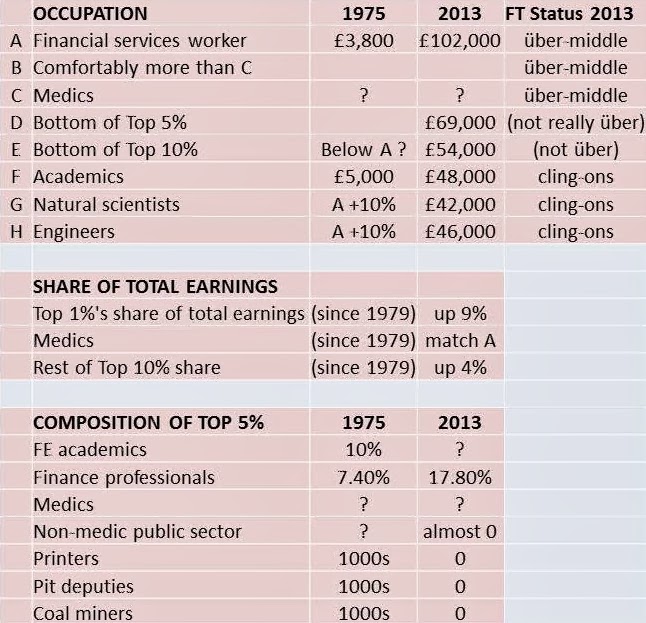
Actually, there wasn’t that much data. From page 1 and supplementary material on page 2 under the heading The fractured middle, the reader can pull together the following:


There was also a graphic, Winners and losers: how professional salaries have changed over the decades, adding data for 1994 and for more occupations but using the somewhat opaque statistic of ‘Ratio of mean earnings for each profession compared with the top 10% of earners’:


The only two occupations which have pulled ahead are London finance and Medical practitioners. I was not surprised to read that:
Underpinning this shake-up in the top tier of society is a severing of the bond that for decades tied the top 1 per cent of earners to the 1 per cent below them. Since 1979, the very highest earners have increased their share of total earnings by almost nine percentage points while the rest of the top 10 per cent have captured only an extra four percentage points.
- hardly a revelation. In 2011 Will Hutton’s final report of the Review of Fair Pay in the public sector was published and it showed that the top 1% had been moving ahead since 1980:


in the UK and US that is. And from everybody else in the UK:


But I was surprised to read in the FT:
Doctors, Prof Bell pointed out, were the only group of public sector workers to have done well" "Public sector workers have almost disappeared from the top of the income distribution,"…
because Hutton’s Review had stated that
… public sector employees represent around seven per cent of the highest one per cent of earners [although] those seven per cent only receive one per cent of top earnings. Approximately one in 85 workers in the private sector earn over £150,000 a year, compared to just one in 280 public sector workers. (pages 17/18, 2009 figures)
Top civil servants had certainly done less well than local authority chief executives who, in turn, had failed to keep up with private sector chief executives:


 Hutton thought that when comparing budgets in the public sector and turnover in the private, together with “analyses of job size and complexity [it was still consistently found] that public sector roles pay considerably less than equivalent roles in the private sector” and produced a chart to back that up:


Hutton admitted that:
Simple comparisons of organisation size of course mask very real differences in the size of the role of the leader in what are very different types of organisation; and it may be objected that any private sector CEO can only be paid if his or her organisation is profitable - a crucial test that does not apply to the public sector.
Not the only objection I would have thought. Take the position of university vice-chancellors as reported in the Times Higher Education Supplement last year:
The vice-chancellor with the highest salary in 2011-12 was the University of Birmingham’s David Eastwood, who took home £372,000 in basic pay; he also collected £34,000 in pension contributions. (However, the highest remuneration package overall went to the University of Oxford’s Andrew Hamilton – [£371,000 salary, unknown expenses, £53,000 pension]. That is dwarfed by the remuneration awarded to Mark Allan, chief executive of student housing company Unite Group. According to Unite’s accounts, he received not only £393,000 in basic pay but also a £428,370 performance- related bonus and £78,600 in pension contributions for the year ended February 2012 - a total package of almost £900,000, not including long-term share options. The FTSE 250 company’s annual income of £219.5 million is less than half of Birmingham’s £472 million income in 2011-12 and only about a fifth of the University of Oxford’s £1 billion income over the same period. Oxford’s Hamilton received £371,000 in basic pay and £53,000 in pension contributions in 2011-12, less than half Allan’s income. 
But is the comparison with the private sector reasonable? While vice-chancellors might increasingly need to act like CEOs, captains of industry would surely claim that their business models - and levels of risk - are nothing like the work of politically protected institutions largely reliant on public funds (regardless of whether that money flows through research and teaching grants or state-subsidised student loans).
To appreciate what might be meant by "levels of risk", consider the Bath/Bristol area of SW England where there are four universities within a 12km radius:


and whose vice-chancellors were rewarded as in the table below in 2011-2012:


In similar geographical circumstances in the private sector, one can’t help thinking that the vice-chancellor equivalents would be under pressure from institutional shareholders and, more scarily, private equity to rationalise to reduce overheads in what are very similar areas of business and increase profitability. This table certainly brings out the FT’s point that the average academic is now what they charmingly describe as a cling-on. Professors are hardly in the über-middle. The FT also pointed out the concentration of the best paid jobs of all kinds in London and the southeast. The further the cling-ons are from that region, the better off they probably feel. However, housing costs across a large part of southern England are driven by a London effect extending into the South West , as shown by this map produced by Neil Hudson of Savills Research last year:


*Why the FT chose “cling-on”, as opposed to “unter-middle” (or unter-Mitte even), wasn’t explained – perhaps too close to Untermenschen. Anyway that’s where I put myself, for sure!


UPDATE 18 APRIL

Some data from Bell and Machin here.