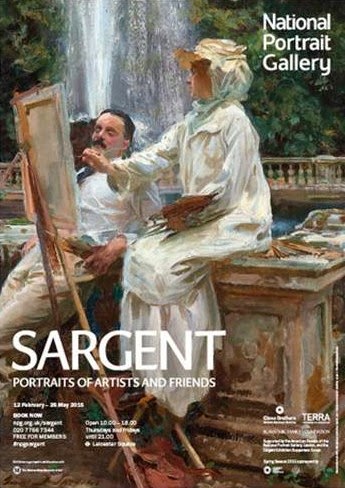
I missed the Sargent exhibition at the Tate in 1998 (in Washington and Boston the following year), which I regretted, having been impressed in 1979 by the London National Portrait Gallery’s John Singer Sargent and the Edwardian Age (which went on to Detroit). So I was looking forward to Sargent: Portraits of Artists and Friends, again at the National Portrait Gallery, and I was not disappointed.
Sargent (1856-1925) certainly was the leading portrait painter of the Edwardian age (circa 1900-1910), much sought after to produce impressive portraits of the top “1%” at a time when the disparity between the wealthiest and the poorest was as great as it is today. But Sargent also painted portraits of his friends, often men and women who were of distinction in the artistic world and who he could portray in a less mannered style of his own choosing. Ideally I would post all the pictures in this exhibition, the ones which follow are those I found particularly striking.
The NPG show is chronological, starting with the artist’s early years spent in Paris (1874-85), initially as a pupil of Carolus-Duran (1879, below left). Sargent’s first exhibit at the Royal Academy was Dr Pozzi at Home (1881, below right), the founder of modern French gynaecology, looking just as Central Casting would have offered for the part.
Sargent, although never married, obviously enjoyed female company and revealing depth of character in the women who sat for him. As soon as you see them, you want to know more about them, for example the Italian Renaissance intellectual, Vernon Lee (1881, below left) and the habituée of Parisian artistic and political circles, Madame Allouard-Jouan (c1882, below right):
Particularly impressive is the double portrait of the children of one of Sargent’s earliest patrons, Edouard Pailleron, Portraits de M.E.P. … et de Mlle E.P. (1881, below); the brushwork of the detail in Marie-Louise’s costume is fascinating.
The next section of the exhibition, Broadway (Worcestershire, England not New York), covers the years 1885-89 and various paintings Sargent made in southern England. There was a community of artists and writers at Broadway where one Tate Britain’s most popular works, Carnation, Lily, Lily, Rose (below) was painted in 1885-86, the subjects being the daughters of Sargent’s artist friend, Frederick Barnard.
The following section is the largest and covers the years Sargent was dividing his time between Boston and New York (1888-1912) and London (1889-1913). There are only five pictures to cover the former, one of interest being Edwin Booth (1890, below left) - he was an actor, like his brother John Wilkes Booth, Lincoln’s assassin, and distantly related to Cherie Booth, wife of former Prime Minister, Tony Blair. In the London selection, W. Graham Robertson (1894, below right) has elements of the society “swagger” portraits for which Sargent was celebrated.
Again, some strong female portraiture: Ellen Terry as Lady Macbeth (1889, below left) and Mrs George Batten Singing (1897, below right):
The exhibition ends with Europe (1899-1914) with paintings Sargent made on painting holidays with friends, many in Italy. The poster above is of The Fountain, Villa Torlonia, Frascati, Italy (1907) with Wilfrid and Jane de Glehn. The same couple are in the watercolour, Sketching on the Giudecca, Venice (c1904, below top) while other friends are captured on holiday in the Alps in Group with Parasols (c 1904/5, below lower):
Within a few years the cataclysm of World War 1 would engulf Europe. Nothing could be further from the paintings at the end of this exhibition than the massive work recently on show at the Imperial War Museum which Sargent would undertake in 1918, Gassed. Within a few years of his death Sargent’s reputation was in decline, undermined by Roger Fry on the grounds of its having been overtaken by modernism in much the same way as his successor as the UK’s leading society portrait painter, William Orpen, was done for by John Rothenstein. Sargent and Orpen had much in common artistically, in particular a facility to produce portraiture that was pleasing to its subject while being more revealing of character than the sitter would realise. An ability that must have been very irksome to fellow artists who lacked it.
Sargent: Portraits of Artists and Friends ends on 25 May.
UPDATE 23 MARCH
Christopher Snowdon (@cjsnowdon) tweeted this last week. The opening lines of AJP Taylor's English History (1914-1945) seem to sum up the world that people in the privileged position of Sargent and his friends lost at the outbreak of WW1:
Showing posts with label John Singer Sargent. Show all posts
16 March 2015
16 February 2015
WW1 British Art at the IWM
2014’s being the centennial of the outbreak of the First World War (WW1), was an opportunity with obvious appeal for the Political-Media Complex. The BBC even appointed a “centenary controller” in 2013 to oversee the "biggest and most ambitious pan-BBC project ever commissioned". As might be expected, the warning on an archived BBC History webpage, no doubt relegated early on in this grand projet, that “The war that 'would be over by Christmas' dragged on for four long years of bloody stalemate” went unnoticed. But the BBC’s coverage of WW1, once the “1914 Christmas Truce” was over, has turned out to be minimal, although we are promised a return to the Somme and Jutland in 2016. It is, of course, unfair to single out the BBC because most of the media seem to have lost interest in the centennial, although The Times is continuing to draw a 100 year-old item from its archive every day. The politicians are, of course, focussed on the 2015 election and the media has moved on to the 70th anniversary of the ending of WW2.
Most of the big art-related WW1 guns were fired off early too. The popular installation by Paul Cummins and Tom Piper, Blood Swept Lands and Seas of Red, in the Tower of London moat (above) ended in November 2014, although some of its 888,246 ceramic poppies will go on a UK tour. 888,246 is officially the number of British military fatalities in the war, a number which, by definition, couldn’t have been arrived at before November 1918, so the installation might have been more appropriate for the centennial of the Armistice in 2018. The Great War in Portraits at the National Portrait Gallery ran from 27 February to 15 June, ending well before the centenary of the assassination of Archduke Franz Ferdinand, let alone hostilities. But one exhibition, and probably the most significant art offering of the WW1 centennial, did manage to see out the first winter of the hostilities (a harsh one as shown in Eric Kennington’s oil on glass, The Kensingtons at Laventie, (1915 below), the London Imperial War Museum’s Truth and Memory: British Art of the First World War.
The exhibition was part of the reopening of the IWM last year after refurbishment and is the largest show of British First World War art for almost 100 years. Most of the 120 works come from the museum’s own holdings or Tate Britain’s. The division into Truth and Memory - two slippery entities in any context, let alone war art - was certainly expedient given that the two exhibition areas on the third floor of IWM are separated by the landing. On top of this distinction there is another theme: that the initial artistic response to the war may have been expressed in classical and heroic terms but that modernism turned out to be the more appropriate style for the emerging horrors of trench and aerial warfare. An added complexity in curation was the convoluted nature of the government’s sponsorship of war artists. As recorders their images didn’t always suit the government’s wish to maintain wartime morale, and as memorialists their works turned out to be too large for the accommodation post-War governments were prepared to finance. To quote Waldemar Januszczak (his review of Truth and Memory is the best I’ve seen):
Works by Nevinson and Orpen, for example his Dead Germans in A Trench (1918 below left) and The Mad Woman of Douai (1918 below right) dominate the Truth side of the exhibition. Most of Orpen’s work here is in marked contrast with his portraits at the NPG. He gifted his WW1 works to the nation (in 2005 the IWM’s William Orpen Politics Sex and Death provided an opportunity to see these works in the context of his whole career).
The Memory section of the IWM show seemed to attract fewer visitors when I was there, oddly given that there are major works on show, exciting to see as large originals. Both Nash brothers are well-represented: John Nash’s Oppy Wood, 1917: Evening (1918) and 'Over The Top'. 1st Artists' Rifles at Marcoing, 30th December 1917 (1918, below):
and Paul Nash’s We Are Making a New World (1918 below top) and The Menin Road (1919 below lower):
There are also a major works by the Vorticist, Percy Wyndham Lewis, A Battery Shelled (1919, below top) and by Stanley Spencer, Travoys Arriving with Wounded at a Dressing Station at Smol, Macedonia, September 1916 (1919, below lower):
And there are some interesting pictures of life on the home front in hospitals and munitions production. Anna Airey’s Shop for Machining 15-inch Shells: Singer Manufacturing Company, Clydebank, Glasgow, (1918 below) is a remarkable picture of arduous work by women:
Memory concludes with some very large pieces including Charles Sergeant Jagger’s plaster relief of The Battle of Ypres: The Worcesters at Gheluvelt (1919, below top), Orpen’s controversial To the Unknown British Soldier in France (1921) and, of course, John Singer Sargent’s 2.3 metre-wide Gassed (1919 below lower):
Truth and Memory ends on 8 March, so the opportunity to see some of the finest British 20th century art will be over by Easter, you might say.
Most of the big art-related WW1 guns were fired off early too. The popular installation by Paul Cummins and Tom Piper, Blood Swept Lands and Seas of Red, in the Tower of London moat (above) ended in November 2014, although some of its 888,246 ceramic poppies will go on a UK tour. 888,246 is officially the number of British military fatalities in the war, a number which, by definition, couldn’t have been arrived at before November 1918, so the installation might have been more appropriate for the centennial of the Armistice in 2018. The Great War in Portraits at the National Portrait Gallery ran from 27 February to 15 June, ending well before the centenary of the assassination of Archduke Franz Ferdinand, let alone hostilities. But one exhibition, and probably the most significant art offering of the WW1 centennial, did manage to see out the first winter of the hostilities (a harsh one as shown in Eric Kennington’s oil on glass, The Kensingtons at Laventie, (1915 below), the London Imperial War Museum’s Truth and Memory: British Art of the First World War.
The exhibition was part of the reopening of the IWM last year after refurbishment and is the largest show of British First World War art for almost 100 years. Most of the 120 works come from the museum’s own holdings or Tate Britain’s. The division into Truth and Memory - two slippery entities in any context, let alone war art - was certainly expedient given that the two exhibition areas on the third floor of IWM are separated by the landing. On top of this distinction there is another theme: that the initial artistic response to the war may have been expressed in classical and heroic terms but that modernism turned out to be the more appropriate style for the emerging horrors of trench and aerial warfare. An added complexity in curation was the convoluted nature of the government’s sponsorship of war artists. As recorders their images didn’t always suit the government’s wish to maintain wartime morale, and as memorialists their works turned out to be too large for the accommodation post-War governments were prepared to finance. To quote Waldemar Januszczak (his review of Truth and Memory is the best I’ve seen):
No one was sure where to place it [the IWM], or what to do with the art that might go in it. The original idea was to build a new museum commemorating the war in Whitehall, but that proved too expensive. The art was initially put on show in the Crystal Palace, in Sydenham, where the glass walls proved thunderously inappropriate for the showing of pictures. Next, they took it to South Kensington, to galleries adjoining the Imperial Institute, which stood where Imperial College stands now. Finally, after a further decade of muddling, the Imperial War Museum and its great collection of First World War art was installed in its present home, in the building that used to house the most notorious madhouse in the world, Bethlem Royal Hospital — “Bedlam”.Some of the war artists’ works were passed on to the Tate Gallery, for example CRW Nevinson’s La Mitrailleuse (1915 below left) and Bursting Shell (1915 below right):
Works by Nevinson and Orpen, for example his Dead Germans in A Trench (1918 below left) and The Mad Woman of Douai (1918 below right) dominate the Truth side of the exhibition. Most of Orpen’s work here is in marked contrast with his portraits at the NPG. He gifted his WW1 works to the nation (in 2005 the IWM’s William Orpen Politics Sex and Death provided an opportunity to see these works in the context of his whole career).
The Memory section of the IWM show seemed to attract fewer visitors when I was there, oddly given that there are major works on show, exciting to see as large originals. Both Nash brothers are well-represented: John Nash’s Oppy Wood, 1917: Evening (1918) and 'Over The Top'. 1st Artists' Rifles at Marcoing, 30th December 1917 (1918, below):
and Paul Nash’s We Are Making a New World (1918 below top) and The Menin Road (1919 below lower):
There are also a major works by the Vorticist, Percy Wyndham Lewis, A Battery Shelled (1919, below top) and by Stanley Spencer, Travoys Arriving with Wounded at a Dressing Station at Smol, Macedonia, September 1916 (1919, below lower):
And there are some interesting pictures of life on the home front in hospitals and munitions production. Anna Airey’s Shop for Machining 15-inch Shells: Singer Manufacturing Company, Clydebank, Glasgow, (1918 below) is a remarkable picture of arduous work by women:
Memory concludes with some very large pieces including Charles Sergeant Jagger’s plaster relief of The Battle of Ypres: The Worcesters at Gheluvelt (1919, below top), Orpen’s controversial To the Unknown British Soldier in France (1921) and, of course, John Singer Sargent’s 2.3 metre-wide Gassed (1919 below lower):
Truth and Memory ends on 8 March, so the opportunity to see some of the finest British 20th century art will be over by Easter, you might say.
Subscribe to:
Posts (Atom)


