Showing posts with label blogging. Show all posts

2 September 2014

An elegantly written tweet

Anne Elizabeth Moutet (@moutet), who I follow on Twitter, retweeted this from the UK’s ambassador in France (@HMARicketts):


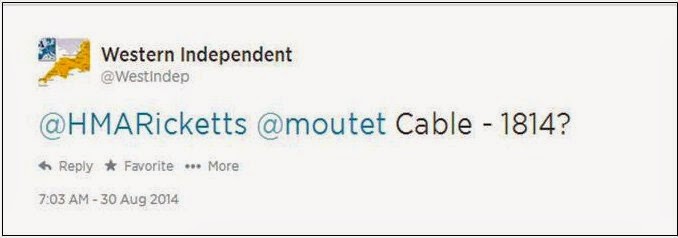
The first successful cross-Channel telegraph cable began operation in 1851, the year before Wellington’s death, so I couldn’t help but respond the next morning with:


and received a prompt response, nominally from Our Man in Paris:


Well I wonder if it was. But whether he does his own social media (“#digital diplomacy”) or not, his Twitter timeline since 21 August is an interesting read, much of it marking the 200th anniversary of the British Residence in France, the first permanent residence abroad apparently. Today we learnt where Wellington’s ‘elegantly written despatch’ got him:


No doubt not the last time that Whitehall would be unenthusiastic about requests concerning foreign allowances.

I'm now following @HMARicketts and I've discovered that HM Ambassadors blog too!


27 June 2014

But a whimper

Not many people appear twice in the same issue of Private Eye but Dominic Cummings, a former special adviser (spad) for Michael Gove has managed it this week (No 1369 27 June – 10 July), under The New Coalition Academy (page 23) and Me and My Spoon (page 26):


This feat stems from an interview he gave Alice Thomson and Rachel Sylvester which made the front page of The Times on 16 June. He is quoted as saying:
As Bismarck said about Napoleon III, Cameron is a sphinx without a riddle – he bumbles from one shambles to another without the slightest sense of purpose. … Everyone is trying to find the secret of David Cameron, but he is what he appears to be. He had a picture of Macmillan on his wall – that’s all you need to know.
Subsequently he posted on his Wordpress blog A few responses to comments, misconceptions etc about my Times interview, referring in passing to an earlier post The Hollow Men (Part 1). This starts with a selection from TS Eliot’s poem:

Close up:

On Wordpress blogs the readers’ comments are called “thoughts”, and I offered one, a very short one: “Eliot”. This wasn’t allowed through. On this blog, when I’m offered an acceptable correction I not only let it stand but respond with “Thanks, corrected” or some such. Cummings’ blog is a much grander affair than mine, and he might well have regarded Western Independent’s input as a trivial attempt at attention-seeking off his back. So, if he’d not published but had corrected his misspelling of Eliot’s name, I really wouldn’t have minded.

But at the time of this post, it’s still “Elliot”. Readers can draw their own conclusions, particularly when he and Mr G have such a reputation as advocates for academic rigour.


5 June 2014

Panda Slapped

Bloggers who use Google as their platform have access to what are described as ‘Stats’. There are a variety of these and they are not always consistent. For example, the totals for a day’s Pageviews by country, browser and operating system are usually close, but rarely identical. In turn the Overview figure for ‘Pageviews today’ may be different again.

But all these discrepancies are small. What is really alarming are the 'Stats' of trends over time – look below at the Pageviews for this blog over the last month: from over 100 a day a month ago to less than half that now. Admittedly there has been only a marginal increase in content – the usual 6 or 7 posts added in the last month - but nothing has been removed from or altered in the 350-plus older posts, some of which are viewed every day.


So what has happened? My guess is that it’s to do with the Panda algorithm which underpins Google searches. Funny old thing, but a Google search doesn’t throw up much information about Panda; Google, it seems, also have a related algorithm called Hummingbird. From what I can make out from the Search Engine Watch website, Panda 4.0 was launched around 20 May:
The Panda algorithm, which was designed to help boost great-quality content sites while pushing down thin or low-quality content sites in the search results, has always targeted scraper sites and low-quality content sites in order to provide searchers with the best search results possible.
Well, this isn’t a scraper site so I guess it’s the low quality content! That, and the fact that I don’t make any money for Google through, for example, Google Play, although this blog is consuming a tiny amount of their resources.

Something similar has happened before after a tweak to Panda, or maybe Hummingbird, and then the Pageviews slowly climb again, but I’ve not seen such a marked drop off before. As I blog primarily for my own amusement, I’m irritated, but not deterred from continuing as before, after being “Panda Slapped”. Read what this blogger felt he had to do after he had taken a far more severe hit from a previous change to Panda.


UPDATE 6 JULY

As predicted, there are signs of a slow recovery, particularly in the last week or so:


12 January 2014

Should a blogger be anonymous?

Last November a well-known journalist and commentator, after writing about the occurrence of racism on Twitter and elsewhere, concluded by calling for “the end of anonymity on social networks". This made me ask myself why I have chosen to appear here as Western Independent and not by the name on my birth certificate. I'm assuming that I haven't revealed so much about myself up to now as to be easily identifiable among male adults in my (apparent) age group living in (presumably) SW England - several hundred thousand of us.

I certainly agree that there is no justification for using anonymity on the internet or anywhere else to conceal an identity with intent to abuse or harass for racialist or other deviant purposes. However, in reality for most paid journalists (admittedly not those at The Economist) their non-anonymity, that is to say their byline, is a key part of their being able to make a living. Many have embraced social networks like Twitter with enthusiasm, and seem pleased to have as many followers as possible who will dutifully click on the links they provide to their latest pieces. Of course, the more hits the better for both William Boot and BeastOnline.co.uk, and today’s Lord Coppers will probably be taking an interest in the amount of traffic generated.

For even a moderately successful professional journalist, the existence of an established byline will affect their self-presentation in everyday life. Family, friends and the people they encounter from their GP to the technician who comes to mend the central heating, depending on their place in the market know what they do and why, and may even choose to engage them about it. This might be a little tedious at times, but is surely an acceptable price to pay for even a small degree of public recognition and being one of the relatively few who are famous for more than fifteen minutes.

For an ordinary Joe Blogger like me life is different. For a start, should I tell people about this blog? Almost certainly this would risk my being regarded as a bore or eccentric, and immodest to boot. On the other hand, what if my blogging existence is uncovered indirectly in the course of a search by someone I know? What benefit would come from being known to offer the world gratuitous opinions about "Art, politics, cinema, France and other things" (my pretentious Twitter self-description)? At best I might be regarded as a clever dick with a high opinion of himself, at worst more than a bit odd. After all, most people choose to confine expression of opinions to the weather or the English cricket team's deplorable performance, and don't offer inexpert views on the balance of power in the Western Pacific or the works of Paul Klee.

I do what I do here to amuse myself while avoiding disruption of normal relationships with people who know me. If a few of these posts are of interest to anyone out there, so much the better. A cynic might say that a blogger is someone who is indulging in vanity publishing but is too mean to pay for it. On the other hand, I earn nothing from writing this blog and I don’t think it unreasonable to want to retain some of the privacy which a paid journalist inevitably foregoes.

(Above: Man Writing by Jacobus Josefus Eeckhout undated, Southampton City Art Gallery)


21 March 2013

Private Eye, Guido Fawkes and blogging

I have read Private Eye off and on for most of its existence. So perhaps it’s not surprising that criticism of the Eye from Guido Fawkes’ “blog of plots, rumours and conspiracies”, Order-Order, has seemed to me a bit like the sort of obstreperousness to be expected from a new-kid-on-the-block. In particular, Guido has repeatedly chided the Eye for being behind with the news, playing to the advantage that his website-based product has over a fortnightly magazine. Furthermore, the Eye seems to see the internet primarily as a means of selling merchandise and subscriptions.


But the juxtaposition of two stories (above) on page 5 of the new Private Eye (Issue No. 1336, 22 March 2013) suggests that it needs to try a bit harder sometimes. I can understand why Ian Hislop, Private Eye’s editor, is exercised about the post-Leveson arrangements for press regulation. But Grant’s tweet was about a rumour that he had heard. Is the Eye’s point that because rumours can’t be fact-checked, none should never be reported? If so, it seems like an oblique way of criticising a blog of rumours. The Eye argument went uneasily with the other story just 8cm away on the same page. On the other hand, the Eye’s Huhn-Pryce coverage on pages 5 and 7 of the same issue are worth the £1.50 alone and far better than a lot of the stuff on Order-Order.

By the way, as far as press regulation is concerned, the current New Statesman editorial contains this warning:
The definition of “publisher” covered by the new regulator was set out as not just either a newspaper or a political and cultural magazine, such as the New Statesman, but also “a website containing news-related material”. This threatened to drag in personal blogs and social media accounts; in effect, it would try to “regulate the internet”, a completely impossible task, and one not covered by Lord Justice Leveson’s inquiry or recommendations. Downing Street once again tried to brief that this was not the case but failed to explain exactly what was meant by “news-related material”. The danger is that bloggers will now find themselves subject to “exemplary damages”, imposed by a regulator that they were never originally supposed to join.
Not surprisingly, Guido Fawkes, despite Order-Order apparently being Ireland-based and with its servers in California, is watching this development closely and supports the Blog-off campaign. Whether I will be able to risk continuing with this little blog, given that its interest in current UK politics is by definition news-related, remains to be seen. Come to that, are my jejune, but possibly irritating to some, comments on current art exhibitions news-related?


12 November 2012

Stocktake

The first post on this blog was on 30 October 2010, just over two years ago. Since then I’ve averaged about two posts a week - this will be number 211. According to Google’s statistics, there have been nearly 17,500 page views, which averages out at about 80 views per post. The most popular post so far has been one about David Hockney with over 500 pageviews and there are another five with over 150. So a lot of posts are getting well below the average (ie the mean). These are small numbers by comparison with a lot of other bloggers (eg Thin Pinstriped Line who has had over 135,000 pageviews on 86 posts since starting a year ago, about 20 times as many pageviews per post).

What Google doesn’t tell me (or doesn’t actually know) is whether the postviewer finds what they were looking for, if they’ve arrived from a search. Or whether in reality the views are coming from automated ‘bots’ gathering data for search engine indexes. I wouldn’t be surprised if 80% of pageviews are unsatisfactory or spurious. I suppose that when a postview follows from a @WestIndep Tweet which has drawn attention to a post and indicated its subject, there is a better chance of satisfaction, albeit slight.

I have wondered whether some posts are too long. An article in The Times recently by Esther Walker, How to be a blogger, proposed 400 words per post, because:
Reading a lot of text on a screen isn’t practical, and any piece of writing is more interesting when it is short. It is so easy, with the unlimited space of the internet, to ramble on — but that is a turn-off for readers.
Someone commenting didn’t agree:
1000 word articles are not too long to read on a screen (the above article [Walker’s] is 852 words and I consider it bite-sized). Frankly, a blog post should be as long as it needs to be. If you have nothing much to say, then a short post is fine. Rambling is bad, but you are no longer constrained by column inches in a newspaper, and if a blog post needs 2,000 words, and those are 2,000 brilliant words, then people will read them.
Since a recent book review here was over 4,800 words and what I considered a short post was over 1,200 (again including quotes), I’m inclined to agree with the comment. My problem is lack of brilliance! But I set out as a blogger to amuse myself and stimulate the grey cells – anything’s better than Sudoku, surely. Also I’d like to think blogging has led to a little more discipline in assessing what I read and see than otherwise would have been the case. And some of the small number of comments I’ve had suggest that occasionally the blog provides something of interest.
 [473 words above, by the way!]


6 December 2011

Independent – Yes, really!

The main story in 6 December’s Independent newspaper (London) describes how:
An undercover investigation by the Bureau of Investigative Journalism, published in The Independent today, has taped senior executives at Bell Pottinger:
* Claiming they have used their access to Downing Street to get David Cameron to speak to the Chinese premier on behalf of one of their business clients within 24 hours of asking him to do so;
* Boasting about Bell Pottinger's access to the Foreign Secretary William Hague, to Mr Cameron's chief of staff Ed Llewellyn and to Mr Cameron's old friend and closest No 10 adviser Steve Hilton;
* Suggesting that the company could manipulate Google results to "drown" out negative coverage of human rights violations and child labour;
* Revealing that Bell Pottinger has a team which "sorts" negative Wikipedia coverage of clients;
Later in the article:
Joint events could be held with influential think tanks close to government, such as Policy Exchange, the firm suggested. Another strategy would include passing information to key academics "so that they are then blogging the right messages out there – so it's coming from an independent,"
and:
A presentation shown during the meeting said it could "create and maintain third-party blogs" – blogs that appeared to be independent. These would contain positive content and popular key words that would rank highly in Google searches.
I doubt whether Bell Pottinger’s false flags, if they exist, would be so daft as to call themselves ‘independent’, but just to reassure readers – this blog really is independent and I’m on my own with my own views. You may well think that is all too apparent, and also that nobody in their right mind would pay me for this stuff.

Though I wouldn’t mind knowing how to rank more highly on Google. A recent search for Sarah Helm Loyalty found my recent post ranked 142nd. The much respected Normblog’s contribution on the same subject was 50th, the highest for a private blogger as far as I could tell. So probably I should just learn to face up to my own intellectual shortcomings!

19 December 2010

Andrew Marr – a Bloggetariat response

The South West of England probably has more than its fair share of annual literary/literature festivals, held, for example, at Bath, Dartington and even Budleigh Salterton. It also hosts one of the country’s major festivals at Cheltenham. This year (8 October 2010) Andrew Marr, a leading BBC political presenter, gave a talk at Cheltenham: “exploring the impact of technology on our consumption of journalism, he joins us to consider the impact of the Internet on the reporting of current affairs and asks what is the future of news?” His comments on blogging in particular were picked up by the media, for example The Daily Telegraph and The Guardian, and were quoted thus:
"A lot of bloggers seem to be socially inadequate, pimpled, single, slightly seedy, bald, cauliflower-nosed, young men sitting in their mother's basements and ranting. They are very angry people. OK – the country is full of very angry people. Many of us are angry people at times. Some of us are angry and drunk. But the so-called citizen journalism is the spewings and rantings of very drunk people late at night. It is fantastic at times but it is not going to replace journalism."
Responding to a question from the audience he added:
"Most of the blogging is too angry and too abusive. It is vituperative. Terrible things are said on line because they are anonymous. People say things on line that they wouldn't dream of saying in person."
I only learnt about Marr’s views recently, and I don’t think they would have put me off starting Western Independent at the end of October. But to reassure anyone passing through: this blogger is not single, is too old to be pimply - at the price of a receding hairline, and hopefully less than slightly seedy. And we all have to live with the noses (or ears) we are given, don’t we? I don’t blog late at night, or very drunk, or in my mother’s basement. Surely these posts aren’t angry or ranting, though possibly I seem irked at times?  As far as appearances go, not long since I almost bumped into Marr in a London street. He’s on the short side in comparison to, say, the current and last three Prime Ministers, delicate rather than wiry, and could be considered unwise to raise the subject of baldness. He was well-groomed, but not exceptionally so for a prosperous London media type.  To judge from suits he wears on the BBC1 Andrew Marr Show, he likes to shoot a lot of cuff.

More seriously, Marr, a very talented man, has climbed high up the ladder of journalism and television, and may well take a dim view of clever arrivistes who seem to have discovered a short cut from mere blogging to mainstream media success and its rewards. Examples are Will Straw, formerly in command of Left Foot Forward, and Ian Dale of the Diary, who both, substantially on the strength of their blog reputations, were taken up by Any Questions on the BBC and the like, and are now giving up blogging for greater things. There are other bloggers who post thoughtful pieces which are well worth reading (eg Hopi Sen). But their presence, and the consequent claims they make on the finite resource which is readers’ time, can be seen as posing a threat to the existence of traditional journalists. Journalism, like acting, is an occupation which many people fancy as an option, and, unlike say the law, has always had a low entry threshold. Take this passage from the  Decline and Fall volume of Chris Mullin’s (a journalist turned MP) diaries (10 August 2005):
Ngoc [Mrs Mullin] drew my attention to the following passage in Andrew Marr's introduction to his book My Trade: 'Despite having a first class degree and reading an unfeasibly large number of books, it began to dawn on me that I couldn't actually do anything. I can't sing, act, tell jokes, play any musical instrument, hit, kick or catch a ball, run for more than a few yards without panting, speak another language or assemble things without them falling apart immediately ... journalism seemed the only option.'
'That's you,' she said.
And so it is, minus the first class degree.
It isn't too fanciful to wonder whether blogging is making the entrance level to a pretty marginal profession still lower, with the inevitable consequence of some real (ie non-citizen) journalism being displaced, contrary to Marr’s view.

Returning to Marr at Cheltenham: “People say things on line that they wouldn't dream of saying in person." So, would I have gone up and said all this to him in person? Yes, but that’s an academic question because I am a very ordinary “citizen blogger” ( a member of the bloggetariat – a word surely already coined) whose posts go unnoticed anyway. But, given the chance, I would have taken the opportunity to challenge his pretty harsh generalisations. I would also have said that his criticisms might have been better directed at the sort of comments that the web pages of serious newspapers permit to appear in their hundreds, attached to well-written pieces by quality journalists. Far too many of these contributions seem to come from the mentally disturbed, or just plain vicious, who must think their ramblings are given substance because they appear in font in a public space. Why the various Lord Coppers’ servers are ready to accommodate such ravings is unfathomable. There are, of course, honourable exceptions like The Economist and Financial Times websites (both protected to some extent by pay walls and registration), where, by contrast, the knowledgeable comments often add to the original offerings.