Showing posts with label Jean-Michel Basquiat. Show all posts

29 January 2016

Adam McKay’s ‘The Big Short’

After seeing JC Chandor’s A Most Violent Year a year ago, I sought out the same director’s impressive first feature from 2011, Margin Call. This was the story of how a Wall Street bank nearly crashed in a few days in 2008 told from the viewpoint of those on the inside. Adam McKay’s The Big Short is an account of some of the people, all distinctly unorthodox outsiders, who predicted the same crash well in advance and eventually profited from doing so. It draws on Michael Lewis’s nonfiction book, The Big Short: Inside the Doomsday Machine.

Because of the film’s subject, the director needed to provide explanations of sub-prime mortgages, collateralized debt obligations (CDOs) and the like and what shorting them on a large scale (the big short, indeed) involved. I had some idea of what had happened in 2008 (though, for example, the existence of CDOs-squared was new to me), so I can’t judge how enlightening metaphorical descriptions from actresses in bubble baths and celebrity cooks are to anyone coming to it all for the first time. (A much drier account can be found here - you might want to stop when you get to “The generational problem” - and there are some recommendations for further reading here). Alex von Tunzelmann, in an article in the Guardian, has looked at the historical accuracy of The Big Short and concluded that it provides “a solid historical explanation of the subprime crisis” though she also points out that most of the characters:
… have been semi-fictionalised and renamed. Michael Burry (Christian Bale) really was a stock market investor at Scion Capital; he wore no shoes and listened to thrash metal in the office. Mark Baum (Steve Carell) is based on hedge fund manager Steve Eisman; the movie keeps his Jewish background and straight talking. Jared Vennett (Ryan Gosling) is based on Deutsche Bank bond salesman Greg Lippmann: “He wore his hair slicked back, in the manner of Gordon Gekko,” wrote Lewis, “and the sideburns long, in the fashion of an 1820s Romantic composer or a 1970s porn star.” The film’s Vennett sports disappointingly inadequate sideburns but has a penchant for the same braggadocio as Lippmann. Ben Rickert (Brad Pitt) is based on Ben Hockett, and has a similar apocalyptic outlook.
Carell, Gosling and Pitt all play their parts to the full. Burry’s wacky character offers Bale the scope to impress at the time but Carrell’s Baum and Pitt’s Rickert, both difficult men with some moral scruples, will probably linger in one’s memory longer:
We live in an era of fraud in America. Not just in banking, but in government, education, religion, food. Even baseball... (Baum) 
If we're right, people lose homes. People lose jobs. People lose retirement savings, people lose pensions. You know what I hate about fucking banking? It reduces people to numbers. Here's a number - every 1% unemployment goes up, 40,000 people die, did you know that? (Rickert)
None of these characters are particularly admirable, and most of them could be regarded as being as greedy as the rest of the financial services industry, but they are possessed of a steely determination to be proved right and the majority wrong. I thought one of the best scenes was the meeting in the ratings agency. It’s a long film and frantic at times, presumably thought necessary to convey the atmosphere of Wall Street and New York – I’m sure a Basquiat appeared for a few seconds for no particular reason.

The pub in Exmouth (SW England) where Rickert sets up his laptop was unconvincing: wi-fi in 2007, the other customers spoke Estuary, not Devonshire, English and while they may well dislike bankers now, they probably would have been as blissfully ignorant as the rest of us then!


8 January 2016

Three Paris Exhibitions: (1) Picasso

Shows seen last month in a city subdued and uncrowded after les évènements of 13 December


While in Paris, I came across an article by Robin Pogrebin in the International New York Times about developments at the Museum of Modern Art (MoMA) in New York. Back in 2010, a NYT art critic had described MoMA’s conventional wisdom as “a reluctance to question the linear unspooling of art history according to designated styles that remains the Modern’s core value and its Achilles’ heel”. Now, MoMA’s chief curator of painting and sculpture was being quoted as saying that the museum was “reflecting a more widespread shift from thinking in categories – or thinking in so-called canonical narratives – to thinking about multiple histories. Having a sense of curiosity, rather than a desire for pronouncement.” Of the three exhibitions in Paris, the first two, Picasso.Mania at the Grand Palais (described below) and Splendeurs et Misères, can probably be regarded as concerned with multiple histories, the third, Villa Flora (to follow), probably not.

Shows at the Grand Palais aren’t what they used to be. By comparison with their major retrospectives, Georges Braque in 2013 and Edward Hopper in 2012, Picasso.Mania seemed thin stuff. Its thesis was apparently that
After World War II, Picasso became renowned as a modern artistic genius. This public recognition came at a time when contemporary art was once again moving towards “avant-gardism”. This movement’s values, as incarnated by Marcel Duchamp, were in contradiction with Pablo Picasso’s flamboyant subjectivity, media presence and commercial success. As a result, it was only in 1971 that a collective tribute by living artists from different disciplines was organised for the artist’s 90th birthday. In the 1980s, exhibitions showed a new generation of artists how Picasso’s later works were years ahead of his time.
A proposition which was not exactly supported by telling visitors that in the 1960s Roy Lichtenstein was inspired by Picasso and that David Hockney was a repeat visitor to the Picasso exhibition at the Tate in 1960. The show made a good initial impression with Sort of Fabulous (2015), a video installation of 18 artists talking about the impact of Picasso on their work, including Jeff Koons, Frank Gehry, Thomas Houseago and Cecily Brown. An unspooling of art history then followed, starting with All hail the artist!, the Self-Portrait of 1901 (below left), borrowed from the Picasso Museum, and some recent images of the artist including Van Pei Ming’s Portrait of Picasso (2009, below centre) and Rudolf Stingel’s Untitled (2012, below right):


and some of the 90th birthday lithographs from 1971:


The most successful of the exhibition themes which followed was probably that given over to cubism – a wall of Picassos:


and then a homage in the form of various works, many by David Hockney, beginning with his Artist and Model (1973/4, below left) and Harlequin (1975, below right):


From the 1980s onwards Hockney explored multiple viewpoints evoking cubism (“a kind of mechanical cubism”) in, for example, Paint Trolley, LA (1985, below top) and Place Ferstenberg, Paris, August 7, 8, 9 (1985, below lower):


More recent Hockney works were The Jugglers, June 24th 2012 (2012, below), 18 films on 18 screens shown over 22 minutes:


and A Bigger Card Players (2015), as at Annely Juda Fine Art, London last summer. After that, the show began to meander. Picasso on screen projected on three walls clips from a wide variety of films (below) in which either the painter or his works or both appear, ranging from Truffaut’s Jules et Jim to Jean-Luc Godard’s King Lear to Woody Allen’s Midnight in Paris.


Demoiselles from elsewhere and Guernica, a political icon were both Hamlet without the prince, the originals not being available. Various works inspired by Les Demoiselles d’Avignon (1907), included Untitled by Sigmar Polke (2006, below top) and Jeff Koons’ Antiquity (2011, below lower):


Of the works pertinent to Guernica, one of the most interesting to British eyes was Goshka Macuga’s construction, The Nature of the Beast (2009), commissioned by the Whitechapel Gallery in memory of their having exhibited Guernica in 1939 and now owned by the Castello di Rivoli (below left). Part of the work is a glazed circular table which exhibits documents relating to the Spanish civil war and more recent conflicts. I thought the photographs from the Whitechapel’s archive of Clement Attlee in 1939 were thought-provoking (below right) – there is a mention of the Major Attlee Company (sic) in his Wikipedia entry.


After this, a section, It’s a Picasso!, grouped his paintings and prints from the late 1930s and later:


and then some pieces relevant to Picasso and Pop art’s reaction to abstract expressionism including Andy Warhol’s Head (after Picasso) No III (1966, below right top) and Roy Lichtenstein’s Still Life after Picasso (1964, below right lower):


Out of what followed, the impact of Picasso on Jasper Johns’ The Seasons (1985 – 87, Summer below left) with, nearby, Picasso’s Minotaure à la carriole (1936, below right) was notable:


A section covering the media attention Picasso received in his later years was followed by a large display of his late works, some reminiscent of Japanese shunga, seen at Avignon in 1970 and 1973. The final theme was the impact on artists in New York of the Guggenheim’s 1984 Picasso show, for example Jean-Michel Basquiat’s Untitled (Pablo Picasso) (1984, below):


Picasso.Mania ends on 29 February 2016.


3 December 2015

A Visit to the Guggenheim Bilbao

A post here in May described A Visit to the Fondation Louis Vuitton in Paris. This is a companion piece following a visit during the summer of 2015 to the Guggenheim Museum in Bilbao, also designed by Frank Gehry. 


After the collapse of its industrial base in the 1980s, Bilbao was in desperate need of transformation. In 1991 the local administration and the Guggenheim Foundation reached an agreement to construct a contemporary art gallery on a derelict site next to the estuary and near the city centre. The Foundation had previously commissioned Frank Lloyd Wright for its museum in New York which had opened in 1959. Construction of Gehry’s design for Bilbao, which has become almost as well-known as Wright’s, began in 1993 and the museum opened in 1997. The structure is of steel, the surface being clad in titanium where not glazed and with limestone exposed on the exterior and the interior. The complex curving shapes were designed using computer applications originally developed for aerospace by Dassault in France in the 1970s. The exterior presents different forms at different viewpoints and references Bilbao’s maritime history of ships and fishing.


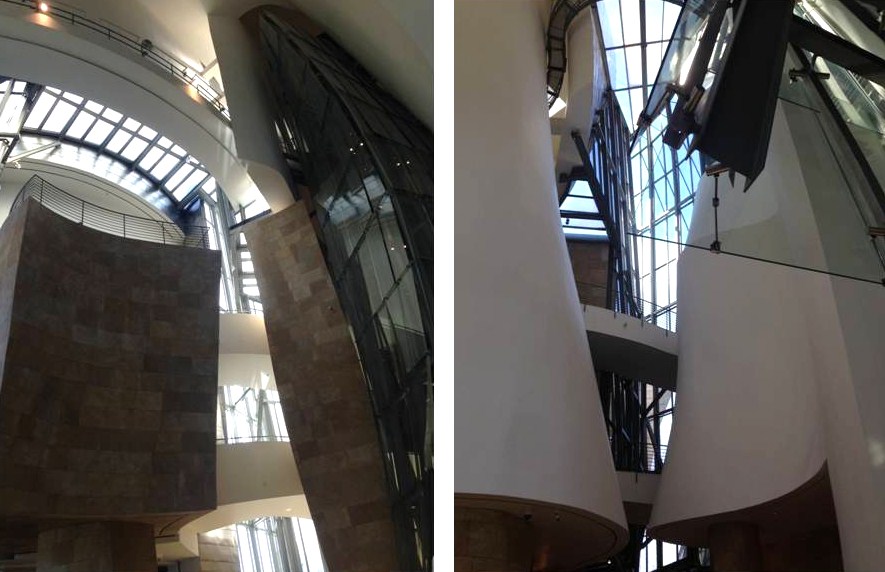
The interior is as just complex, as these views of the atrium reveal:


The Guggenheim Bilbao's permanent collection includes some major site-specific pieces on display externally including Anish Kapoor’s Tall Tree and the Eye (2009, below left) and Louise Bourgeois’ Maman (1999, below right):


and two works by Jeff Koons, Tulips (1995-2004, below top) and Puppy (1992, below lower):


Inside, in the ArcelorMittal gallery, are the seven massive pieces which constitute Richard Serra’s The Matter of Time (2005, below). Made of weathering steel and fabricated locally, they embody Bilbao’s industrial heritage.


At the time of this visit, most of the gallery space was given over to two exhibitions: Jeff Koons: A Retrospective (previously at the Centre Pompidou in Paris and the Whitney Museum of American Art, New York) and Jean-Michel Basquiat: Now’s the Time. People seem either to like Koon’s work or dislike it, not many are indifferent. Michel Houellebecq (quoted in a post here earlier this year) described Koons in unflattering terms as seen through the eyes of another imaginary artist. Julian Barnes at the Edinburgh book festival in August
… offered a text written by American artist Jeff Koons to accompany his work Puppy, a vast sculpture formed from flowering plants belonging to the Guggenheim Bilbao in northern Spain. Reading aloud from Koons’ text, he told the Edinburgh audience that Puppy “helps you have a dialogue about the organic and the inorganic. It’s really about the issue of the baroque, where everything is negotiated. The different aspects of the eternal through biology. Whether you want to serve or be served, love or be loved, all these types of polarities come into play because Puppy sets them up.” Barnes added: “To use the technical term of art criticism, it’s bollocks. I know it’s like shooting fish in a barrel but sometimes fish need to be shot.”
In October Barnes told a Cheltenham Literature Festival audience (including me) that Koons produced “machine-tooled whimsicality”. Jeff Koons: A Retrospective provided plenty of opportunity to make one’s own mind up and included examples of his work from The New Series in the early 1980s (vacuum cleaners in vitrines) to the recent Antiquity series.  I couldn’t help being impressed by the skill of Koons’ technicians in fabricating objects like Lobster (2003, below left), with the appearance of a PVC inflatable but made from “Polychromed aluminum”, and Large Vase of Flowers (1994, below right) made in polychromed wood.


Having seen this show, it may be a while before I feel the need to seek out any more Koons. I was more taken with Basquiat whose work I was seeing for the first time – if BBC Your Paintings is right, he is not represented in any UK public collection. Jean-Michel Basquiat was born in New York in 1960 and died of a heroin overdose in 1988, a year after Andy Warhol who had been his collaborator in the 1980s. Two works which epitomise Basquiat's style and preoccupations are Irony of a Negro Policeman (1981, below left) and Dark Race Horse—Jesse Owens (1983, below right):


Typical of Basquiat’s work with Warhol are Win $ 1,000,000 (below top) and Ailing Ali in Fight of Life (below lower), both 1984:


Man from Naples (1982, below), from Guggenheim Bilbao’s own collection, is a good example of Basquiat’s street graffiti work:


While the Guggenheim Bilbao is probably an even more impressive building than Gehry’s later Fondation Louis Vuitton, I thought it was less visitor-friendly.  The gallery space is less appropriate for exhibitions, particularly retrospectives. The Warhol show was spread over two floors while Basquiat required walking back through galleries 306 and 305 after reaching 307 and then down a corridor to 303 and 302 – not so good, at least on an initial visit. Also, to enter the Museum, visitors descend a flight of steps from street level to the level of the atrium floor level. Leaving is via another flight of steps down to river level. A third set of steps, the length of the other two combined, then has to be climbed to get back to street level. If you want to get back in to the Museum – allowed during the day of visiting – you then redescend the first flight … None of this should deter anyone from visiting in 2016 when Guggenheim Bilbao will be offering shows of works by Warhol and Bourgeois and Windows on the City: The School of Paris, 1900-1945.