Showing posts with label Julian Barnes. Show all posts

3 December 2015

A Visit to the Guggenheim Bilbao

A post here in May described A Visit to the Fondation Louis Vuitton in Paris. This is a companion piece following a visit during the summer of 2015 to the Guggenheim Museum in Bilbao, also designed by Frank Gehry. 


After the collapse of its industrial base in the 1980s, Bilbao was in desperate need of transformation. In 1991 the local administration and the Guggenheim Foundation reached an agreement to construct a contemporary art gallery on a derelict site next to the estuary and near the city centre. The Foundation had previously commissioned Frank Lloyd Wright for its museum in New York which had opened in 1959. Construction of Gehry’s design for Bilbao, which has become almost as well-known as Wright’s, began in 1993 and the museum opened in 1997. The structure is of steel, the surface being clad in titanium where not glazed and with limestone exposed on the exterior and the interior. The complex curving shapes were designed using computer applications originally developed for aerospace by Dassault in France in the 1970s. The exterior presents different forms at different viewpoints and references Bilbao’s maritime history of ships and fishing.


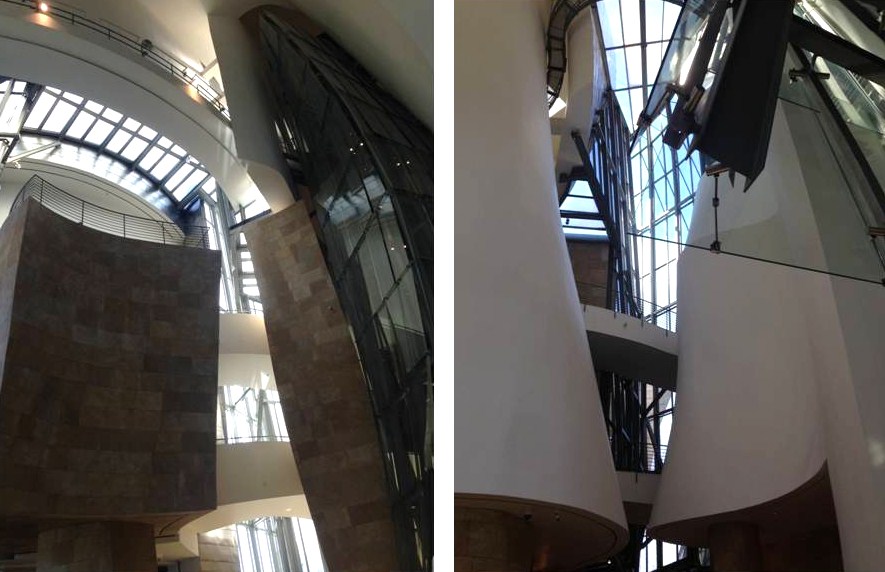
The interior is as just complex, as these views of the atrium reveal:

The Guggenheim Bilbao's permanent collection includes some major site-specific pieces on display externally including Anish Kapoor’s Tall Tree and the Eye (2009, below left) and Louise Bourgeois’ Maman (1999, below right):


and two works by Jeff Koons, Tulips (1995-2004, below top) and Puppy (1992, below lower):


Inside, in the ArcelorMittal gallery, are the seven massive pieces which constitute Richard Serra’s The Matter of Time (2005, below). Made of weathering steel and fabricated locally, they embody Bilbao’s industrial heritage.


At the time of this visit, most of the gallery space was given over to two exhibitions: Jeff Koons: A Retrospective (previously at the Centre Pompidou in Paris and the Whitney Museum of American Art, New York) and Jean-Michel Basquiat: Now’s the Time. People seem either to like Koon’s work or dislike it, not many are indifferent. Michel Houellebecq (quoted in a post here earlier this year) described Koons in unflattering terms as seen through the eyes of another imaginary artist. Julian Barnes at the Edinburgh book festival in August
… offered a text written by American artist Jeff Koons to accompany his work Puppy, a vast sculpture formed from flowering plants belonging to the Guggenheim Bilbao in northern Spain. Reading aloud from Koons’ text, he told the Edinburgh audience that Puppy “helps you have a dialogue about the organic and the inorganic. It’s really about the issue of the baroque, where everything is negotiated. The different aspects of the eternal through biology. Whether you want to serve or be served, love or be loved, all these types of polarities come into play because Puppy sets them up.” Barnes added: “To use the technical term of art criticism, it’s bollocks. I know it’s like shooting fish in a barrel but sometimes fish need to be shot.”
In October Barnes told a Cheltenham Literature Festival audience (including me) that Koons produced “machine-tooled whimsicality”. Jeff Koons: A Retrospective provided plenty of opportunity to make one’s own mind up and included examples of his work from The New Series in the early 1980s (vacuum cleaners in vitrines) to the recent Antiquity series.  I couldn’t help being impressed by the skill of Koons’ technicians in fabricating objects like Lobster (2003, below left), with the appearance of a PVC inflatable but made from “Polychromed aluminum”, and Large Vase of Flowers (1994, below right) made in polychromed wood.


Having seen this show, it may be a while before I feel the need to seek out any more Koons. I was more taken with Basquiat whose work I was seeing for the first time – if BBC Your Paintings is right, he is not represented in any UK public collection. Jean-Michel Basquiat was born in New York in 1960 and died of a heroin overdose in 1988, a year after Andy Warhol who had been his collaborator in the 1980s. Two works which epitomise Basquiat's style and preoccupations are Irony of a Negro Policeman (1981, below left) and Dark Race Horse—Jesse Owens (1983, below right):


Typical of Basquiat’s work with Warhol are Win $ 1,000,000 (below top) and Ailing Ali in Fight of Life (below lower), both 1984:


Man from Naples (1982, below), from Guggenheim Bilbao’s own collection, is a good example of Basquiat’s street graffiti work:


While the Guggenheim Bilbao is probably an even more impressive building than Gehry’s later Fondation Louis Vuitton, I thought it was less visitor-friendly.  The gallery space is less appropriate for exhibitions, particularly retrospectives. The Warhol show was spread over two floors while Basquiat required walking back through galleries 306 and 305 after reaching 307 and then down a corridor to 303 and 302 – not so good, at least on an initial visit. Also, to enter the Museum, visitors descend a flight of steps from street level to the level of the atrium floor level. Leaving is via another flight of steps down to river level. A third set of steps, the length of the other two combined, then has to be climbed to get back to street level. If you want to get back in to the Museum – allowed during the day of visiting – you then redescend the first flight … None of this should deter anyone from visiting in 2016 when Guggenheim Bilbao will be offering shows of works by Warhol and Bourgeois and Windows on the City: The School of Paris, 1900-1945.


4 May 2013

Julian Barnes’ ‘Levels of Life’

Levels of Life is the second book by Julian Barnes to appear in six months, Through the Window having been the subject of a post here as recently as January. His new book, only 118 pages long, is in three parts.


The first, The Sin of Height, is a series of vignettes about the history of ballooning in the years before the rise of heavier-than–air machines. By coincidence, a book devoted to the same subject, Richard Holmes’ Falling Upwards: How We Took to the Air, appeared within a few weeks of Levels of Life. As well as introducing the reader to Nadar’s The Giant (above), Fred Burnaby, an English military man and amateur balloonist, and the actress Sarah Bernhardt, Barnes establishes the perils as well as the pleasures of unnatural ascent. Anyone who has read Ian McEwan’s Enduring Love (or particularly if they saw the film) will need little reminder of the consequences of a fall from a great height. Any Francophile will enjoy the description of Burnaby’s supper when a rare northerly leads to an unplanned descent in Normandy:
omelette aux oignons, sautéed pigeon with chestnuts, vegetables, Neufchâtel cheese, cider, a bottle of Bordeaux and coffee. Afterwards, the village doctor arrived, and the butcher with a bottle of champagne. Burnaby lit a fireside cigar and reflected that ‘a balloon descent in Normandy was certainly preferable to one in Essex.’
The second part, On the Level, describes the 17-stone Burnaby’s pursuit of the five-foot Bernhardt in Paris in the 1870s.
You put together two people who have not been put together before; and sometimes the world is changed, sometimes not. They may crash and burn, or burn and crash. But sometimes something new is made, and then the world is changed.
But, despite their both being larger than life characters and his whetting her appetite for aeronautics, the Divine Sarah has no wish to settle down with Capitaine Fred.
Every love story is a potential grief story. If not at first, then later. If not for one, then for the other. Sometimes for both.
In the final and longest part, The Loss of Depth, Barnes describes the unleveling of his life after his wife of 30 years, Pat Kavanagh, succumbed in a matter of weeks in 2008 to an aggressive brain cancer. Its title derives from our modern lack of belief in an underworld where it might be possible to be reunited with the departed. Although Barnes writes unsparingly, it seems intrusive to quote from such a personal account. And the metaphors which run through Levels of Life don’t need labouring here either.

Barnes revisits certain themes throughout the book, one of them being Essex – not exotic, Burnaby tells Madame Sarah. Another is the symbolist painter Odilon Redon (1840-1916), who was born near Bordeaux in SW France, (Eye Balloon 1878 and Portrait of Mme Redon c 1911, below).
 

In the natural order of things, children expect to outlive their parents and perhaps evolution has left widows better equipped to cope with their state, just as it has given females greater life expectancy than males. But life expectancy is a statistic, not a guarantee to individuals. After I finished Levels of Life, Robert Peston’s account of his recently becoming a widower, also due to cancer, appeared in the Daily Telegraph. Any man or woman in a long-term relationship with a man or a woman should read both men’s stories. One can only hope that Peston and Barnes will, in time, both have the luck of a northerly wind.


6 January 2013

Julian Barnes’ ‘Through the Window’

I suppose it’s not surprising that some of the writers that I identify with most were born, like me, in Britain in the years after the Second World War – Ian McEwan (1948), Martin Amis (1949) and Christopher Hitchens (1949), for instance, and also Julian Barnes (1946). Barnes is the only one of the four I’ve set eyes on - at the National Portrait Gallery’s Wyndham Lewis exhibition a few years ago. A kind person recently gave me Barnes’ Through the Window: Seventeen Essays (and one short story) (to give it its full title), and thoughtfully chose the version of the paperback with the Dufy* cover (left).

The essays and the short story have all appeared elsewhere – in the Guardian and the New York Review of Books, particularly. The short story, Homage to Hemingway, possibly contains a warning for readers of the book. The narrator, a less than successful novelist tutoring a creative writing course, observes of his students that “some of them, it was true, enjoyed literature more than they understood it” which almost certainly applies to me. Some of the essays are about writers who Barnes regards highly, but whose works I have never read – Penelope Fitzgerald, Arthur Hugh Clough and Joyce Carol Oates - others about writers I like – Updike and Houellebecq ("a clever man who is a less than clever novelist") – and Barnes’ opinions of them can only widen the appreciation of an ordinary reader. I found some of the others fascinating because they involve France, a country which Barnes knows well and where he is much respected. In fact for me, Kipling’s France, France’s Kipling and the Orwell essay alone would be worth the price of the book. Three takes on Ford Madox Ford might be too many for some, however. The essay I enjoyed most was Translating Madame Bovary which spells out the problems and pitfalls of translation. Difficult enough when it’s the piece of department store puffery I attempted to translate here recently, let alone one of the classics of French literature.

The preface, A Life with Books, is a new piece in which Barnes recalls his years of book-collecting and visits to second-hand book dealers across the country. His attachment to the ‘physical book and physical bookshop’ as opposed to downloading to a Kindle (or other e-reader) is clear, as are his misgivings about the future of the printed book –he quotes Updike on the subject twice, in an essay and in the Preface:
For, who, in that unthinkable future  
When I am dead, will read? The printed page  
Was just a half-millennium's brief wonder…
But he concludes that books will survive although they might have to become more attractive in various ways. Moreover, “books look as if they contain knowledge while e-readers look as if they contain information”. There is another advantage to the physical book which James Panero points out in an article, The culture of the copy On the printing press, the Internet & the impact of duplication, in this month’s The New Criterion. After providing a useful succinct history of the internet (nice to see a US source giving Tim Berners-Lee his due), he compares printed and internet-based media and comments:
A published book is a fixed and polished record of a moment in time. The Internet always operates in the present. Aside from web portals like the “Wayback Machine,” which can provide historical snapshots of webpages, the Internet has no past. With “time stamps” and footnoted “corrections,” web culture has attempted to import the rules of fixed publication, but the Internet still treats all information the same. Any information on the Internet can be updated, changed, or erased at any moment.
The last point was underlined for me reading Barnes’ preface when he recalls his book-collecting habits forty years earlier:
Over the next decade or so-from the late Sixties to the late Seventies-I became a furious book-hunter, driving to the market towns and cathedral cities of England in my Morris Traveller and loading it with books bought at a rate which far exceeded any possible reading speed. This was a time when most towns of reasonable size had at least one large, long-established second hand bookshop, often found within the shadow of the cathedral or city church; as I remember, you could usually park right outside for as long as you wanted. …  
So I would drive to Salisbury, Petersfield, Aylesbury, Southport, Cheltenham, Guildford, getting into back rooms and locked warehouses and storesheds whenever I could. I was much less at ease in places which smelt of fine buildings, or which knew all too well the value of each item for sale. I preferred the democratic clutter of a shop, whose stock was roughly ordered and where bargains were possible.
I stumbled over “smelt of fine buildings” – what did Barnes mean? In his Man Booker prize-winning novella, The Sense of an Ending, there are some minor inexactitudes, “sperm” instead of “semen” and “server” instead of “internet service provider”, but these were, of course, not coming directly from Barnes. Instead they were words he had chosen for the book’s narrator, a character whose raison d’être was being almost, but not quite, right. So I admire Barnes, noting his having trained as a barrister and his The Pedant in the Kitchen reinforced now by Translating Madam Bovary, as a man of verbal precision. Could “buildings” just be a mistyping or a misprint, and the phrase possibly should have been “smelt of fine bindings”?

Well, on paper there may be some hope of finding out – if A Life with Books appears in, say, the Guardian, and if there had been a misprint, it might be corrected, which might also be the case if Through the Window were reprinted. But if the preface existed solely as an e-version it might be changed in an instant of “synching” without its purchaser ever knowing.


*Window on the Promenade des Anglais, Nice, 1938. A frequent subject of Dufy’s, more often with the window open.