Showing posts with label Sigmar Polke. Show all posts

8 January 2016

Three Paris Exhibitions: (1) Picasso

Shows seen last month in a city subdued and uncrowded after les évènements of 13 December


While in Paris, I came across an article by Robin Pogrebin in the International New York Times about developments at the Museum of Modern Art (MoMA) in New York. Back in 2010, a NYT art critic had described MoMA’s conventional wisdom as “a reluctance to question the linear unspooling of art history according to designated styles that remains the Modern’s core value and its Achilles’ heel”. Now, MoMA’s chief curator of painting and sculpture was being quoted as saying that the museum was “reflecting a more widespread shift from thinking in categories – or thinking in so-called canonical narratives – to thinking about multiple histories. Having a sense of curiosity, rather than a desire for pronouncement.” Of the three exhibitions in Paris, the first two, Picasso.Mania at the Grand Palais (described below) and Splendeurs et Misères, can probably be regarded as concerned with multiple histories, the third, Villa Flora (to follow), probably not.

Shows at the Grand Palais aren’t what they used to be. By comparison with their major retrospectives, Georges Braque in 2013 and Edward Hopper in 2012, Picasso.Mania seemed thin stuff. Its thesis was apparently that
After World War II, Picasso became renowned as a modern artistic genius. This public recognition came at a time when contemporary art was once again moving towards “avant-gardism”. This movement’s values, as incarnated by Marcel Duchamp, were in contradiction with Pablo Picasso’s flamboyant subjectivity, media presence and commercial success. As a result, it was only in 1971 that a collective tribute by living artists from different disciplines was organised for the artist’s 90th birthday. In the 1980s, exhibitions showed a new generation of artists how Picasso’s later works were years ahead of his time.
A proposition which was not exactly supported by telling visitors that in the 1960s Roy Lichtenstein was inspired by Picasso and that David Hockney was a repeat visitor to the Picasso exhibition at the Tate in 1960. The show made a good initial impression with Sort of Fabulous (2015), a video installation of 18 artists talking about the impact of Picasso on their work, including Jeff Koons, Frank Gehry, Thomas Houseago and Cecily Brown. An unspooling of art history then followed, starting with All hail the artist!, the Self-Portrait of 1901 (below left), borrowed from the Picasso Museum, and some recent images of the artist including Van Pei Ming’s Portrait of Picasso (2009, below centre) and Rudolf Stingel’s Untitled (2012, below right):


and some of the 90th birthday lithographs from 1971:


The most successful of the exhibition themes which followed was probably that given over to cubism – a wall of Picassos:


and then a homage in the form of various works, many by David Hockney, beginning with his Artist and Model (1973/4, below left) and Harlequin (1975, below right):


From the 1980s onwards Hockney explored multiple viewpoints evoking cubism (“a kind of mechanical cubism”) in, for example, Paint Trolley, LA (1985, below top) and Place Ferstenberg, Paris, August 7, 8, 9 (1985, below lower):


More recent Hockney works were The Jugglers, June 24th 2012 (2012, below), 18 films on 18 screens shown over 22 minutes:


and A Bigger Card Players (2015), as at Annely Juda Fine Art, London last summer. After that, the show began to meander. Picasso on screen projected on three walls clips from a wide variety of films (below) in which either the painter or his works or both appear, ranging from Truffaut’s Jules et Jim to Jean-Luc Godard’s King Lear to Woody Allen’s Midnight in Paris.


Demoiselles from elsewhere and Guernica, a political icon were both Hamlet without the prince, the originals not being available. Various works inspired by Les Demoiselles d’Avignon (1907), included Untitled by Sigmar Polke (2006, below top) and Jeff Koons’ Antiquity (2011, below lower):


Of the works pertinent to Guernica, one of the most interesting to British eyes was Goshka Macuga’s construction, The Nature of the Beast (2009), commissioned by the Whitechapel Gallery in memory of their having exhibited Guernica in 1939 and now owned by the Castello di Rivoli (below left). Part of the work is a glazed circular table which exhibits documents relating to the Spanish civil war and more recent conflicts. I thought the photographs from the Whitechapel’s archive of Clement Attlee in 1939 were thought-provoking (below right) – there is a mention of the Major Attlee Company (sic) in his Wikipedia entry.


After this, a section, It’s a Picasso!, grouped his paintings and prints from the late 1930s and later:


and then some pieces relevant to Picasso and Pop art’s reaction to abstract expressionism including Andy Warhol’s Head (after Picasso) No III (1966, below right top) and Roy Lichtenstein’s Still Life after Picasso (1964, below right lower):


Out of what followed, the impact of Picasso on Jasper Johns’ The Seasons (1985 – 87, Summer below left) with, nearby, Picasso’s Minotaure à la carriole (1936, below right) was notable:


A section covering the media attention Picasso received in his later years was followed by a large display of his late works, some reminiscent of Japanese shunga, seen at Avignon in 1970 and 1973. The final theme was the impact on artists in New York of the Guggenheim’s 1984 Picasso show, for example Jean-Michel Basquiat’s Untitled (Pablo Picasso) (1984, below):


Picasso.Mania ends on 29 February 2016.


29 May 2015

A Visit to the Fondation Louis Vuitton


Note: this post is based on a visit to the Fondation in early May 2105 

The Fondation Louis Vuitton in Paris was opened in October 2014 by Francois Hollande, President of France, and Bernard Arnault, President of LVMH - Moët Hennessy Louis Vuitton - and one of the wealthiest people in France. In 2001 he visited the Guggenheim Museum in Bilbao and met its architect, Frank Gehry. Five years later the Fondation was established as a private cultural initiative by LVMH to support contemporary artistic creation. Under a 55 year lease from the City of Paris, the Fondation’s building, designed by Gehry, is set in one hectare of land in the Bois de Boulogne next to the Jardin d’Acclimatation.

Like Gaul, a visit to the Fondation can be divided into three parts: the current exhibition, the display from the permanent collection and the building itself.

Keys to a Passion

In May 2015 the current exhibition is Les Clefs d’une passion (Keys to a Passion), “a selection of major works from the first half of the 20th century that established the foundations of modernity”. It is organised into four sequences: Subjective Expressionism, Contemplative, Popist (popiste) and Music which are in accord with the themes which structure the Fondation’s own collection (… en resonance avec les quatre axes structurant, de façon plastique et mouvante, la collection …).

Subjective Expressionism “evokes the questions each of us have about life, death, anguish, solitude and the desparate rage to live, despite oneself, despite others …”. It also provides a chance to see Munch’s The Scream (1893? 1910?, below left), a work normally confined to the Munch Museum in Oslo and not made available for the 2012 Pompidou Centre/Tate Modern Munch exhibition. That show was, of course, intended to have a post-1900 emphasis but so has Keys to a Passion!


A series of self-portraits (1934, above right) by Helene Schjerfbeck (1862-1946), a painter known best in her native Sweden, stand up to their proximity to The Scream. As well as a sculpture and two oils by Giacometti, this section includes two major 1949 works by Francis Bacon, Study from the Human Body (below left) and Study for Portrait (below right):


a Malevich not at Tate Modern in 2014, Complex Presentiment or Bust with a Yellow Shirt (c 1932, below left), and Otto Dix’s Portrait of the Dancer Anita Berber (1925, below right):


Contemplative occupies three rooms, the first dominated by two of Monet’s Water Lilies of 1916-19 borrowed from Paris museums. On one side of the room are four lake and mountain landscapes by the Swiss painter Ferdinand Hodler, on the other there are four studies of Lake Keitele from 1904-05 by the Finnish painter Aksell Gallen-Kalleila, one from the National Gallery in London. Complementing these are five seascapes, two by Emil Nolde and three from 1909 by Mondrian, the style of these being in marked contrast to some of his later works in the next room, for example Composition in line, second state (1916-17, below left) and Lozenge Composition with Yellow Lines (1933, below right):


However, this room is dominated by three of Malevich’s most significant works (again not at Tate Modern) lent from St Petersburg: Black Square, Black Cross and Black Circle, all c1923 and pointless to reproduce individually. They can be seen in the photograph (below top) with two of the Mondrians (including the one above left) and Brancusi’s Endless Column Version 1 from 1918. Opposite the Malevich’s, and to me as inducing of contemplation as the Monets, is a Rothko, No 46 (Black, Ochre, Red over Red) (1957, below lower):


In the next room an interesting Bonnard (Summer, 1917) is, to put it kindly, at a disadvantage near to a Picasso plaster sculpture (Head of a Woman with Large Eyes, 1931) and three of his Marie-Thérèse Walter paintings. One of these (Nude Woman in a Red Armchair, 1932) is familiar in London from Tate Modern, as Woman with Yellow Hair (1931, below left) and Reading (1932, below right), no doubt are in New York (Guggenheim) and Paris (Musée Picasso) respectively:


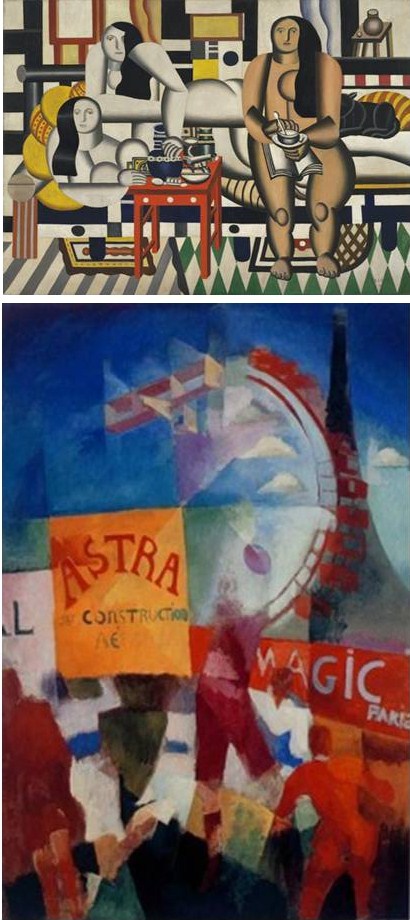
I found Popist the least successful of the four sequences. Picabia arguably anticipated Pop art and deserves a place in a section “resolutely engaged with the vitality, momentum and progress of modern life” but five large pictures, three of them nudes “veer[ing] between a joyous exaltation in nudity and a vaguely salacious eroticism”? Again three Legers, Three Women, (1921-22, below top), but the one other painting in the sequence, Robert Delaunay’s The Cardiff Team (1912-13, below lower) was new to me:


Music provides a triumphant conclusion to the exhibition, the four Kandinsky panels and works by Kupka and Severini being swept aside by two Matisse masterworks, The Dance (1909-10, below top) from St Petersburg and The Sorrow of the Kings (1952, below lower) from the Pompidou Centre in Paris (not lent to the Tate Modern/MoMA show last year):


Keys to a Passion certainly achieves its goal in bringing together some of the major art works of the 20th century. These include items which rarely travel, and for that as well as other reasons is worth making an effort to see before it ends on 6 July.


Items from the Permanent Collection 

Walking through these I was struck by Rachel Harrison’s Zombie Rothko (2011, below left) and Maurizio Cattalan’s Charlie don’t surf (1977 below right – the attendant and photographers are not part of the work). Harrison was awarded the Calder Prize in 2011 for exemplary work in the spirit of Alexander Calder.


It was pleasing to see works by UK artists including Ed Atkins’ video installations Us Dead Talk Love (2012) and Even Pricks (2013) and Tacita Dean, including her Lightning Series (2007) and Hünengrab (2008, below top). According to the caption it is one of a series depicting megalithic prehistoric stone formations in Cornwall (SW England). The series was inspired by Caspar David Friedrich’s Walk at Dusk (c1830-35, below lower), hence the title (Giant’s Tomb).


A large space is given to Sigmar Polke Cloud Paintings (1992-2009, below) – four paintings and a 4-billion-year-old meteorite, the third biggest discovered after a Siberian meteor shower in February 1947:


A small gallery is showing several works by Ellsworth Kelly, who was commissioned to provide works for the Auditorium (see below). These include Green Relief (2009, below left), Blue Diagonal (2008, below centre) and Purple Curve in Relief (2009, below right, lent by the artist):


There are also some fine Giacometti sculptures including Buste d’Homme assis (Lotar III), (1965, below left) and Grande femme II (1959-60, below right):


 THE GEHRY BUILDING 


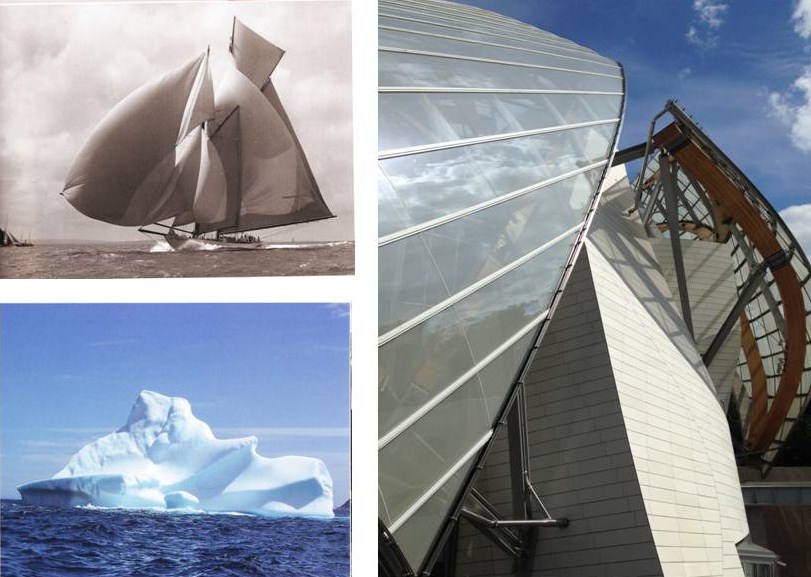
The interior of the Fondation building, containing the 11 gallery spaces (the underground ones vastly better than their equivalents at the National Gallery Sainsbury Wing in London), the Auditorium, shop and so on, is restrained and functional in contrast to the exterior. Some of the inspiration for Gehry’s design seems to have come from a yacht, the Susanne, built in 1911 and an iceberg (above), as well as from some of Paris’s famous metal and glass structures like the Grand Palais. The building is covered with over 19000 panels of white Ductal ® high performance cement (beton) and moving around the building and on the terraces provides a series of contrasts between the “iceberg” and the glass and steel “sails”. Its advanced design, fabrication and construction are a credit to French engineering.


There are some remarkable views over Paris and the Jardin, for example towards La Defense (below top). One of the terraces is displaying a living sculpture made of found objects by Adrian Villar Rojas, Where the Slaves Live (2014, below lower):


Inside are the Ellsworth Kelly works commissioned in 2014 for the Auditorium including Spectrum VIII (below right) and Color Panels Yellow and Red (below left).


Is the Fondation Louis Vuitton worth a visit? Definitely, but it may be a while before there is another show quite like Keys to a Passion.


UPDATE 3 JULY

Hopefully anyone in the UK interested in Frank Gehry will have been able to see Alan Yentob’s documentary, Frank Gehry: The Architect Says "Why Can't I?", in the BBC1 imagine strand before it disappears into iPlayer limbo.

Among the many points of interest are firstly that Gehry, when designing the Guggenheim Museum Bilbao in the mid-1990s, made use of what was at the time advanced software from France’s Dassault Group, aerospace being one of its main activities. Secondly he lived in Paris with his young family and the Jardin d’Acclimatation has very personal memories for him.


4 December 2014

Sigmar Polke at Tate Modern

Tate Modern is now showing the retrospective Alibis: Sigmar Polke 1963–2010, previously at MoMA, New York. Polke, who died in 2010, was born in Silesia in 1941, fleeing west with his family as the Red Army advanced in 1945. In 1953 they left East Germany and settled in Düsseldorf. By the time he was a student alongside Gerhard Richter and others, the German economic recovery (Wirtschaftswunder) was under way and he responded to the rise of they saw as an American-style consumer culture with pop art works like The Sausage Eater (1963, Der Wurstesser, below left) and “raster drawings” made up of dots like Portrait of Lee Harvey Oswald (1963, below right):


The dot drawings were far less mechanistic in appearance than Lichtenstein’s and part of a social commentary (Capitalist Realism) on German affluence and tourism, for example Girlfriends (1965-66, Freundinnen, below left), and fabric paintings like The Palm Painting (1964, Das Palmenbild, below right):


Also in the 1960s he took to criticising modern art in its various forms, whether abstract or conceptual – Solutions V (1967, Lösungen V, below left), even ridiculing artists in general - Polke as Astronaut (1968, Polke als Astronaut, below right):


During the 1970s Polke experimented with hallucinogenic drugs and went on the hippie trail through what is now called AfPak, and then further afield, making films (there are three at the Tate) and colouring in photographic images - Untitled (Quetta, Pakistan), (1974-1978 , below top)- but also painting works like Supermarkets (1976, below lower) which are a continuation of earlier preoccupations:


After the 1980s Polke began experimenting with unusual pigments – dye extracted from snails or heat and humidity sensitive substances as he used at the Venice Biennale in1986. A raster painting Police Pig (1986, Polizeischwein, below left), was hung outside the German pavilion. At that time he also made a series of Watchtower paintings which evoke both divided Germany and the Nazi camps, Watchtower (1984, Hochsitz, below right):


In the 1990s he experimented even more widely with soot paintings, distorted photocopying , resins, the effect of radiation on photographic materials, 3-D lenses and holograms, all explored in the Tate show. At the end of all this in 2007 he created The Illusionist (below), a work which I will not attempt to interpret but instead reproduce what Tate Modern had to say about it:


Alibis: Sigmar Polke 1963–2010 continues in London until 8 February 2015 and will be at Museum Ludwig in Cologne from 14 March to 5 July.

I have now posted here about all three of the most highly regarded German post-War painters, Gerhard Richter and Anselm Kiefer being the others.  For what it’s worth, my personal preference is for Richter.