12 June 2014

Lord Clark at Tate Britain


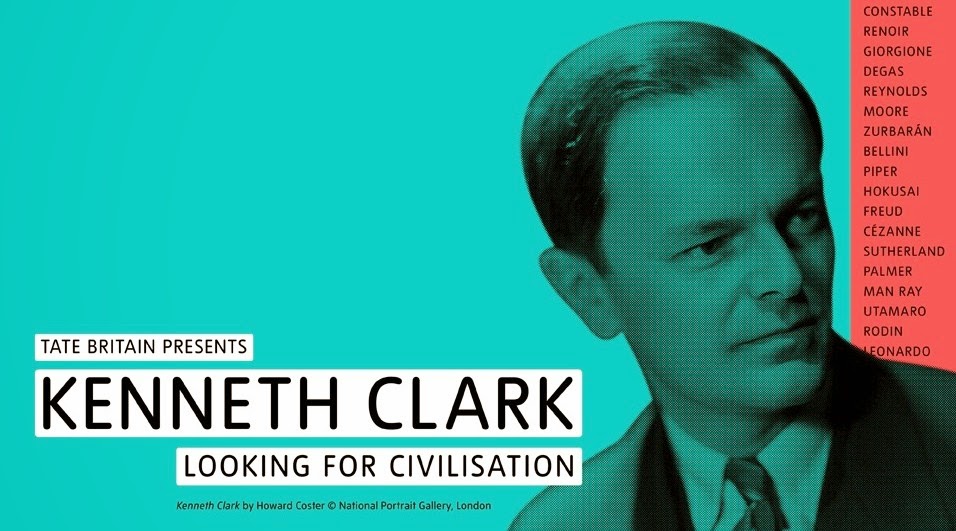
Kenneth Clark (1903-1983) was not only born in the same year as Evelyn Waugh, (mentioned in recent posts here), but also became well-known at a young age in the 1930s. Clark, unlike Waugh, was born into considerable wealth and, after studying the history of art at Oxford and coming under the influence of Roger Fry, was able to spend time in Italy with the American art historian Bernard Berenson, specialising in the Renaissance. On return to England he became Curator of the Ashmolean Museum in Oxford and then Director of the National Gallery from 1930 to 1946. His public service also included being Surveyor of the King’s Pictures, and chairmanships of the War Artists' Advisory Committee, the Arts Council of Great Britain and the Independent Television Authority. In 1969 Clark wrote and presented a celebrated TV series on the history of Western civilisation for BBC television, later shown in the US. When he subsequently received a life peerage, Private Eye dubbed him Lord Clark of Civilisation. The Tate Britain exhibition, Kenneth Clark - Looking for Civilisation, is a survey of his life’s work and brings together art that he had dealt with professionally, had benefitted from his patronage or that he had collected personally.

Not surprisingly, there is much to look at in this show. The 270 objects on display include some which are unfamiliar and may not be seen in public again for a while (one can hazard a guess as to which ‘Private Collection’ they come from). The first room is the most personal with Graham Sutherland’s portrait, Kenneth Clark (1963-64, left), and focusses on his early years. This is followed by works he collected for himself (Seurat’s The Forest at Pontaubert, (1881 below left) or, as Director of the National Gallery, for the nation, for example Constable’s Sketch for Hadleigh Castle (1828-9, below right), later transferred to the Tate. Some of the attributions he made when purchasing for the National Gallery do not seem to have stood the test of time particularly well. However, it was under his Directorship that the Gallery’s Scientific Department was formed, and the techniques which are now available to support judgements on authenticity began to be developed. In the 1930s Clark purchased for himself late works by Cézanne, as would Henry Pearlman a decade later and probably at a much higher price. A Cézanne pencil drawing, Still life, Pain sans mie, 1887-90, is particularly interesting in that its inclusion of commercial typography (“bread without crumbs”!) anticipates Picasso and Braque (but see the 1 July update below).


Clark not only collected but was an active patron looking favourably on Henry Moore (Recumbent Figure, 1938, right), Graham Sutherland, Paul Nash, and John Piper. He did not care much for abstraction (the Ben Nicholson on show seems to have been an exception), Francis Bacon or Lucien Freud’s later work. The fifth and largest space in the show is given over to the War Artists, most of whom worked in the Romantic style Clark liked, and is one of the most interesting. Although familiar in reproduction, the opportunity, during the Imperial War Museum’s closure, to see Paul Nash’s Battle of Britain (1942, below) and one of Moore’s shelter drawings (Tube 1941, below, lower) is welcome.


Among many impressive wartime pictures, ones which caught my eye were John Piper’s Somerset Place, Bath (1942, below,) and Albert Richards’ The Landing: H Hour minus 6. In the Distance Glow of the Lancasters Bombing Battery to be Attacked (1944, below, lower).


The final room concentrates on Clark’s activities after the war, particularly his involvement with television. The BBC are reportedly considering a new Civilisation series:
… "re-imagined … for the digital age". Unlike the original, it is likely to have a number of different presenters.
If so, I hope one of them will be Lisa Jardine, the daughter of Jacob Bronowski. His 1973 television series, The Ascent of Man, was complementary to Clark’s and looked at the rise of science as opposed to art, architecture and philosophy.

Just before leaving the exhibition, visitors can see two of the finest works acquired by Clark: a Francisco de Zurbarán still life, A Cup of Water and a Rose (c1630, below left), and Cézanne’s Le Château Noir (c 1904, below, right).


Kenneth Clark - Looking for Civilisation ends on 10 August and anyone with an interest in British art should try to get to Tate Britain before then. The most thought-provoking review I have come across is Kenneth Clark: arrogant snob or saviour of art? by James Hall in the Guardian.


A MINOR QUERY FOR THE CURATORS

In the first room there is a showcase (vitrine?) of Clark family photographs. One of these is of a villa owned by Clark’s father and (when I saw it) was labelled as being Clark’s childhood home in South West France at Cap Ferrat. I thought this unlikely. Although before the First World War Arcachon, on the Gironde department’s Atlantic Coast, was a fashionable resort, the village of Cap Ferret, nearby by sea but remote by land, was little more than a few oyster fishing huts (rather different now). However, Cap Ferrat (Saint-Jean-Cap-Ferrat) on the Mediterranean in the Alpes-Maritime department in South East France had become a magnet for the ultra-wealthy around 1900 and remained so. The Clark villa seems to be in the “Renaissance” style consistent with that location and, of course, Clark’s father was supposedly “the man who broke the bank at Monte Carlo”, not Biarritz. It might be worth checking.


UPDATE 1 JULY

A footnote to Cézanne’s use of commercial typography: I have recently come across this image of The Artist's Father, Reading "L'Événement", 1866, now in the National Gallery of Art, Washington DC. Apparently it wasn’t Louis-Auguste’s favourite paper but Cézanne’s old friend Emile Zola was L'Événement’s art critic.


9 June 2014

Here is not there

A post about Madresfield Court and how it was depicted in Evelyn Waugh’s Brideshead Revisited appeared here on 3 June. The day before, The Times had published a photograph (below) of the return to Castle Howard of a vintage Rolls Royce used in the filming there of the Brideshead Revisited TV series. (A more detailed story appeared in the Yorkshire Post.)


The day after (4 June), a letter from Professor Emeritus (of architecture) A Peter Fawcett was published in The Times (£):
Sir, Although Hawksmoor’s baroque Castle Howard (picture story, June 2) will be forever associated with Evelyn Waugh’s Brideshead Revisited, his real inspiration came from a building of a very different architectural persuasion: Madresfield Court in Worcestershire. The English Arts and Crafts designer CR Ashbee designed the library in 1902, and the chapel (which features prominently in the novel) is a fine assembly of artefacts from Birmingham’s Arts and Crafts workshops — a far cry from English baroque. Waugh visited Madresfield frequently, and members of its Lygon family owners also appear as prominent players in the narrative.
On 6 June, there were three more letters. Neville Peel thought that:
… Waugh, like other writers, had a variety of sources of inspiration. His description of Brideshead’s central rotunda reminds one of Ickworth and is very far from the Arts and Crafts of Madresfield.
David Bertram pointed out that:
Professor Fawcett deplores the use of the baroque Castle Howard as a visual shorthand for Brideshead, but there was good reason for its use in the TV film. In the novel Charles Ryder says staying at Brideshead signalled the end of his love for the medieval and his “conversion to the baroque”.
Nigel Thomas felt that:
A more obvious candidate is Wardour Castle in Wiltshire, which Waugh would have known through his friendship with Cecil Beaton and the Herberts. Waugh placed Brideshead in a Wiltshire park with a castle that gave its name to a Georgian successor. … Old Wardour Castle overlooks a lake that points to the new mansion on a nearby hill. The largest Georgian house in Wiltshire, Wardour Castle, has splendid interiors and a spectacular chapel. It too was the home to a Catholic dynasty, the Arundells.
which is a little ingenuous given that Sebastian Flyte tells Charles:
“… We had a castle a mile away, down by the village. Then we took a fancy to the valley and pulled the castle down, carted the stones up here, and built a new house.” (Book 1 Chapter 4)
and that New Wardour Castle is in the Palladian style (as is Ickworth), not baroque. On the other hand, a little later Charles remembers:
It was an aesthetic education to live within those walls, to wander from room to room, from the Soanesque library to the Chinese drawing room … from the Pompeian parlour to the great tapestry-hung hall, which stood unchanged as it had been designed two hundred and fifty years before; …
that would be circa 1675, which, while about a century before John Soane started work as an architect and James Paine’s designing New Wardour Castle, was only a few decades before Vanbrugh’s Castle Howard being built in a thoroughly baroque style.

At this point there is a danger of becoming one of those Sherlockians who argue about the exact location on Dartmoor of Baskerville Hall. Obviously it would be pleasing to think that Brideshead was in Wiltshire, South West England, but I suspect the region will just have to be satisfied with Waugh’s having spent much of his adult life there. Not only friendly with the Herberts, in 1937 he had married one, Laura, whose grandmother bought the couple Piers Court in Gloucestershire. In 1956 the family moved further west to Combe Florey in Somerset where Waugh died in 1966. He wrote Brideshead Revisited in Devon in 1944 while on unpaid leave from the Army.

Perhaps Waugh’s notion of baroque in the novel is more a metaphor for Catholicism than a Pevsner-like description of a particular building’s architectural style. His author’s note, "I am not I: thou art not he or she: they are not they” might be extended: “here is not there”.