In the previous post, I disagreed with Emmanuel Macron’s remark that “Europe is what has enabled us since 1945 to preserve peace … in our continent” rather than NATO. This view is not unique to the President of France, for example, as expressed in this tweet, much liked and retweeted, from Andrew Stroehlein* on Europe Day:
But if we zoom in on the period since the end of the Second World War in 1945, something is not quite right:
NATO was established in April 1949, the date apparently being staked out for the EU flag. The latter was designed in 1955 and adopted by the Council of Europe in December that year. In 1985 it was also taken up for the European Communities from which the EU inherited it in 1993.
The Council of Europe**, which like NATO was founded in 1949, is distinct from the EU and aims to uphold human rights, democracy, rule of law in Europe and promote European culture. No doubt it can be regarded in doing so as contributing to the preservation of peace, whether its existence is sufficient for it is another matter. Something similar could be said to apply to the first of the pan-European institutions which subsequently led to the EU, the European Steel and Coal Community, founded in 1951.
Meanwhile NATO, to quote, possibly apocryphally, its first Secretary General, General Ismay, got on with its job: "to keep the Russians out, the Americans in, and the Germans down".
*Stroehlein is European Media Director of Human Rights Watch, based in Brussels.
**Not the European Council which is part of the EU, as is yet another body, the Council of the European Union.
Showing posts with label Twitter. Show all posts
19 May 2017
2 September 2014
An elegantly written tweet
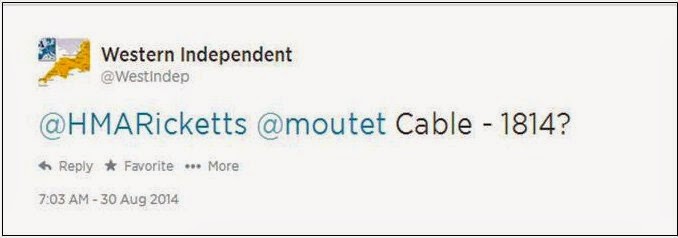
Anne Elizabeth Moutet (@moutet), who I follow on Twitter, retweeted this from the UK’s ambassador in France (@HMARicketts):
The first successful cross-Channel telegraph cable began operation in 1851, the year before Wellington’s death, so I couldn’t help but respond the next morning with:
and received a prompt response, nominally from Our Man in Paris:
Well I wonder if it was. But whether he does his own social media (“#digital diplomacy”) or not, his Twitter timeline since 21 August is an interesting read, much of it marking the 200th anniversary of the British Residence in France, the first permanent residence abroad apparently. Today we learnt where Wellington’s ‘elegantly written despatch’ got him:
No doubt not the last time that Whitehall would be unenthusiastic about requests concerning foreign allowances.
I'm now following @HMARicketts and I've discovered that HM Ambassadors blog too!
The first successful cross-Channel telegraph cable began operation in 1851, the year before Wellington’s death, so I couldn’t help but respond the next morning with:
and received a prompt response, nominally from Our Man in Paris:
Well I wonder if it was. But whether he does his own social media (“#digital diplomacy”) or not, his Twitter timeline since 21 August is an interesting read, much of it marking the 200th anniversary of the British Residence in France, the first permanent residence abroad apparently. Today we learnt where Wellington’s ‘elegantly written despatch’ got him:
No doubt not the last time that Whitehall would be unenthusiastic about requests concerning foreign allowances.
I'm now following @HMARicketts and I've discovered that HM Ambassadors blog too!
3 August 2014
By their tweets …
On 31 July the new UK Foreign Secretary, Philip Hammond gave his first newspaper interview to the Sunday Telegraph which reported his remarks on 3 August, concentrating on the situation in Gaza. Notably:
Two questions came into my mind reading this. Firstly, why “know” as opposed to “expect” or “suspect” or “wouldn’t be surprised if”? Secondly, why Shin Bet? This, as far as I understand, is Israel’s internal security service, as opposed to Mossad which operates externally.
Given its formidable reputation, I would be surprised if Mossad wasn’t aware of Mensch: a former Conservative MP retaining a keen interest in UK politics, living in New York with a Jewish husband, and writing a column for a Murdoch newspaper would seem to tick quite a few boxes as a person of interest.
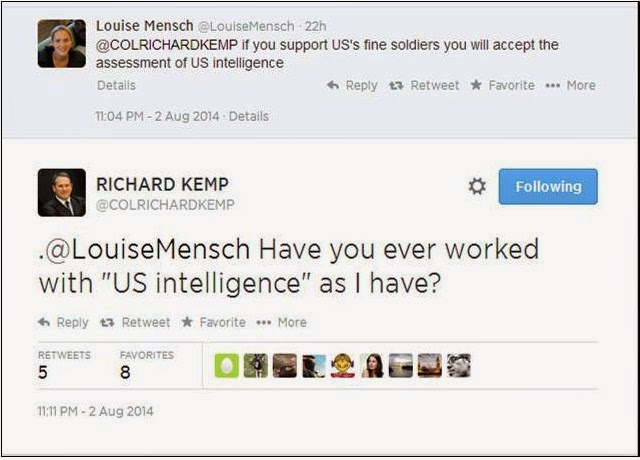
Her tweets often form part of a dialogue with others which can be combative at times. One of those with a different viewpoint from hers currently about Israel and Gaza is Richard Kemp (@COLRICHARDKEMP) who came up with these two among many others (2 August, 18:36 and 18:42):
“So-called” or “self-styled”? No matter. Kemp is a bit of an international man of mystery to judge from his single-page personal website:
but the website of his book, Attack State Red, is more informative and the description it provides would seem to support this particular point during a later exchange with Mensch:
but to be fair to both parties, their dialogue should be read in full.
“The British public has a strong sense that the situation of the civilian population in Gaza is intolerable and must be addressed — and we [the UK government] agree with them.”He was also quoted as saying that:
The British public is “deeply disturbed” by the suffering of the people of Gaza …Judging by some of the heated remarks on the normally calm parts of Twitter which I follow, he is probably right, and not just the British public. Perhaps people are being led into saying things they normally wouldn’t, or are just being careless about what they are saying. I couldn’t help being struck by this tweet (2 August, 16:02), one of many about Israel and Gaza from Louise Mensch (@LouiseMensch):
Two questions came into my mind reading this. Firstly, why “know” as opposed to “expect” or “suspect” or “wouldn’t be surprised if”? Secondly, why Shin Bet? This, as far as I understand, is Israel’s internal security service, as opposed to Mossad which operates externally.
Given its formidable reputation, I would be surprised if Mossad wasn’t aware of Mensch: a former Conservative MP retaining a keen interest in UK politics, living in New York with a Jewish husband, and writing a column for a Murdoch newspaper would seem to tick quite a few boxes as a person of interest.
Her tweets often form part of a dialogue with others which can be combative at times. One of those with a different viewpoint from hers currently about Israel and Gaza is Richard Kemp (@COLRICHARDKEMP) who came up with these two among many others (2 August, 18:36 and 18:42):
“So-called” or “self-styled”? No matter. Kemp is a bit of an international man of mystery to judge from his single-page personal website:
but the website of his book, Attack State Red, is more informative and the description it provides would seem to support this particular point during a later exchange with Mensch:
but to be fair to both parties, their dialogue should be read in full.
9 March 2014
Long distance information
It would be rash to predict the outcome of the current crisis over Russia, Ukraine and Crimea but no-one seems to be doubting its seriousness. Perhaps with an eye to reassuring the public that “To jaw-jaw is always better than to war-war”, photographs have been appearing of world leaders on the phone to each other discussing what should be done. The first seems to have been of Obama’s call from the Oval Office to Vladimir Putin:
Obviously the Russian equivalent of NSA and GCHQ wouldn’t be interested in listening to that one, but Obama’s call to David Cameron – well, they would if they could:
This was released via Twitter and subsequently generated numerous parodies with bananas and other surrealist substitutes. François Hollande was at work in the splendours of the Elysée when Obama rang:
who was on the line from Florida:
This is an interesting image - the others only show handsets whereas this shot includes the phone base station:
The LCD screen isn’t as easy to read as the coffee cup, but it also seems to carry the Presidential Seal. The base station and the handsets have some similarities to those of the Cisco VoIP (voice over internet protocol) phone which appears on Wikipedia:
Now, what at auction would be a really expensive phone, Salvador Dali’s Lobster Telephone, c 1938:
Obviously the Russian equivalent of NSA and GCHQ wouldn’t be interested in listening to that one, but Obama’s call to David Cameron – well, they would if they could:
This was released via Twitter and subsequently generated numerous parodies with bananas and other surrealist substitutes. François Hollande was at work in the splendours of the Elysée when Obama rang:
who was on the line from Florida:
This is an interesting image - the others only show handsets whereas this shot includes the phone base station:
The LCD screen isn’t as easy to read as the coffee cup, but it also seems to carry the Presidential Seal. The base station and the handsets have some similarities to those of the Cisco VoIP (voice over internet protocol) phone which appears on Wikipedia:
Now, what at auction would be a really expensive phone, Salvador Dali’s Lobster Telephone, c 1938:
12 March 2013
Damian McBride’s “100 or so”
Damian McBride was a Whitehall civil servant who became Head of Communications at the UK Treasury and then, from 2005 until he resigned in April 2009, was special adviser to British Prime Minister Gordon Brown. He is now Head of Communications at the Catholic aid agency CAFOD and recently appeared as a witness before the House of Commons Public Administration Committee examining The Future of the Civil Service. McBride posts on his blog every few weeks on topics relating to his experience in government.
His most recent post, Going To The Mattresses: the art of surviving a coup, concerns the various ways a Prime Minister whose position is under threat can foil his colleagues’ attempts to oust him:
Alice Thompson, Andrew Marr, Andrew Rawnsley, Benedict Brogan, Charles Moore, David Aaronovitch, Fraser Nelson, George Parker, Guido Fawkes (Paul Staines), Iain Martin, Isabel Oakeshott, Janan Ganesh, Jim Naughtie, John Rentoul, Lionel Barber, Mary Anne Sieghart, Patrick Wintour, Peter Oborne, Polly Toynbee, Rachel Sylvester, Sarah Sands, Simon Jenkins, Tim Montgomerie, Toby Young.
Another 76 or so to go then, and of course, not all the names would be common to Tory, Labour or Lib Dem lists of “100 or so”.
One of the above, Andrew Rawnsley, explains in Chapter 37 (Chamber of Horrors) of his The End of the Party the circumstances (the contents of some emails obtained by Guido Fawkes, also above) which led to McBride’s resignation from Brown’s team, and casts some light on his modus operandi:
I was surprised that the überpedant Rentoul should describe it as beautifully written. There were three howlers that even I could spot:
But I may well make use of the “100 or so” label in future posts.
His most recent post, Going To The Mattresses: the art of surviving a coup, concerns the various ways a Prime Minister whose position is under threat can foil his colleagues’ attempts to oust him:
… if they [No10] want to know what it takes to get through an attemped coup, they could do worse than study the record of Gordon Brown – the Charles De Gaulle of Downing Street when it came to surviving assassination attempts. Based on the Brown survival manual, I would ask them the following five key questions …For the full questions and answers see McBride’s post! But here is one gem:
With David Miliband’s various abortive coups, there was a certain crude art to inducing their failure. I was often personally criticised for over-reacting to some new Miliband manoeuvre, ‘ramping it up’ as people would say. But given David’s tendency to treat rebellion like a reluctant bather inching his way into the sea at Skegness, it made sense to push him right in at the outset, on the grounds that he’d run straight back to his towel, and not try again for at least six months.I thought the answer to one question gives some insight into the way people at No10, at least in Brown’s day, see the world
4. How’s your relationship with the media these days?
As I’ve said, momentum is everything in an attempted coup: to succeed, the plotters must keep pushing the leader towards the cliff. The media are crucial in determining that momentum: if they say it’s fizzled out, then it has; if they say one more bad day will make the leader’s position untenable, then it will. But, even for the BBC, this is not an objective, scientific process; it’s about 100 or so very influential people at different media outlets forming a view based on their conversations with each other and with key players on either side of the plot, as well as, to some extent, on public attitudes. That is why, no matter how bad the coverage of Gordon Brown’s Premiership became, it was still vital for us to maintain strong and friendly relationships with those 100 or so people.So who are these “100 or so” (my emphases above)? I doubt if anyone, including McBride, has ever had a definitive list while at the same time there are probably a couple of hundred who would like to think themselves as being on one. As for the comment “even for the BBC”, here is an extract from the Pollard Review into the way BBC2 Newsnight handled the Savile story:
43. In addition to the overall structure of the BBC, it is also helpful to provide some background as to the structure of the BBC News Group, and the relevant reporting lines within this group.
44. The head of the News Group is the Director of News. Throughout the period considered by this Review, this was Helen Boaden.
45. … in November 2011 .... Ms Boaden’s reporting line was vertical – to the Director General. The Director General’s own reporting line is to the BBC Trust and its Chairman Lord Patten.
46. Beneath the Director of News sits a Deputy Director of News. Throughout the period considered by this Review, this was Stephen Mitchell. Mr Mitchell is also Head of News Programmes. As Deputy Director of News, Mr Mitchell reports to Ms Boaden and is, in that role, involved in dealing with a range of strategic issues affecting the whole of BBC News. As Head of News Programmes, he is responsible for a wide range of national radio and television news and current affairs programmes, including Newsnight and Panorama.
47. Beneath Mr Mitchell sit the editors of the news programmes. Thus Mr Mitchell is the line manager of Peter Rippon, the editor of Newsnight (who stepped aside from his post in October 2012). There was thus a direct reporting line from Mr Rippon to Mr Mitchell (and then in turn from Mr Mitchell to Ms Boaden).
48. Beneath the editors are their deputy editors. Mr Rippon’s deputies in late 2011 were Liz Gibbons and Shaminder Nahal. They reported to Mr Rippon, whose own reporting line went to Mr Mitchell (and so on) as set out above.
49. Beneath the deputy editors are the programme presenters, reporters, and journalists, such as Jeremy Paxman, Meirion Jones and Liz MacKean.Leaving the BBC teams aside (11 in the above alone) it is possible to start guessing who some of the “100 or so” might be. A quick scan of the Labels used just on this blog since October 2010 comes up with:
Alice Thompson, Andrew Marr, Andrew Rawnsley, Benedict Brogan, Charles Moore, David Aaronovitch, Fraser Nelson, George Parker, Guido Fawkes (Paul Staines), Iain Martin, Isabel Oakeshott, Janan Ganesh, Jim Naughtie, John Rentoul, Lionel Barber, Mary Anne Sieghart, Patrick Wintour, Peter Oborne, Polly Toynbee, Rachel Sylvester, Sarah Sands, Simon Jenkins, Tim Montgomerie, Toby Young.
Another 76 or so to go then, and of course, not all the names would be common to Tory, Labour or Lib Dem lists of “100 or so”.
One of the above, Andrew Rawnsley, explains in Chapter 37 (Chamber of Horrors) of his The End of the Party the circumstances (the contents of some emails obtained by Guido Fawkes, also above) which led to McBride’s resignation from Brown’s team, and casts some light on his modus operandi:
… McBride had been Brown's chief propagandist for six years. He was also extremely tight with Ed Balls, closer some thought than he was to the Prime Minister. Balls, knowing that he would be spattered by association, raged at his friend: 'I can't believe you have been so f[xxx] stupid.
The more scrupulous members of Brown's staff had long been horrified by what they saw of McBride at work. His modus operandi was to offer 'trades' to journalists who boosted Brown or killed stories that Number 10 didn't want published. Brown had ignored repeated warnings … to get rid of him. McBride was not a lone wolf; he was one razor-toothed but sloppy dog in the Brown pack with a licence from the Prime Minister.
The e-mails were an extreme example of the macho and nasty tactics that had been employed on Brown's behalf by members of his cabal for many years. McBride operated in the dark side of Downing Street which was an expression of the dark side of Brown's personality. …(page 638)Alistair Darling in Back from the Brink describes the aftermath of giving a bleak account of the UK’s economic prospects at odds with Brown’s views, to the Guardian:
… It was the briefing machine at No. 10 and Gordon's attack dogs, who fed the story and kept it running. I later described it as like 'the forces of hell' being unleashed on me. That's what it felt like. Damian McBride was no fan of mine - he clearly disapproved of Gordon's decision to appoint me as Chancellor. He used to look at me like the butler who resented the fact that his master had married someone he didn't approve of. I'm not sure that he ever spoke to me. He would give me a curt nod, nothing more. He had a group of journalists whom he briefed regularly, and when Catherine Mcleod [Darling’s Special Adviser] finally managed to meet with him, after repeated requests, he told her which journalists she should talk to and which not.
… The attack dogs set about another colleague that summer. At the beginning of the summer recess, after the loss of the Glasgow East seat, David Miliband, then Foreign Secretary, had written an article for the Guardian in which he set out the need for a coherent political strategy to recover lost ground. It was a thoughtful piece, but it was interpreted by the inner circle as an attack on Gordon and a signal that David might launch a leadership attempt. Gordon was told by his team left behind at No. 10 that he should be relaxed about it. They were right. The article would have died a death had a cack-handed press operation not been mounted to trash David. (pages 106/7)Darling also describes the emails which led to McBride’s resignation as:
… an all too predictable political catastrophe in No. 10, this time involving one of Gordon s spin doctors. Throughout his time in government, Gordon had relied heavily on these attack dogs, first Charlie Whelan, then Damian McBride. McBride had been caught out briefing against deputy leader Harriet Harman at party conference in October 2008 - by Harriet herself, who had overheard him. Rightly, she threatened to report him to the Cabinet Secretary unless Gordon did something about him. He promised to move McBride to where he could cause less trouble. It was to no avail. McBride's briefings against me to senior journalists and political editors were faithfully reported back. Gordon refused all entreaties by cabinet colleagues to let him go and tethered him instead in an office in No. 10. It was another flawed fix, and he continued to roam.
Things finally came to a head when emails were published showing that McBride was involved in a shabby exercise to damage opposition figures and, in one case, the wife of a shadow minister. This time he had to go. Unfortunately, the disgrace did not leave with him. The repercussions for Gordon were disastrous. People had daily questioned our competence and our ability to control events. Now they had confirmation of what they suspected: we were a nasty party too. The perception was that our moral compass had irremediably lost its bearings. The McBride affair further destabilized the whole No. 10 operation.In his post McBride mentions one of my Labels above:
If that instinct for survival – and everything that goes with it – is lacking in No10 at present, then it may point to a wider problem; with apologies to John Rentoul’s Banned List, something of an existential crisis.who tweeted just after the post appeared:
I was surprised that the überpedant Rentoul should describe it as beautifully written. There were three howlers that even I could spot:
consiligieres instead of consiglieri
Charles De Gaulle instead of Charles de Gaulle
and “about 100 or so” is a redundancy.
But I may well make use of the “100 or so” label in future posts.
17 November 2011
Politicians and Twitter – “just like me” or you?
The Telegraph magazine on 12 November carried an article, Too Big to Fly?, by Joe Hagan:
Hagan’s article, which is well worth reading in full, doesn’t seem to be on telegraph.co.uk, but his similar piece published on 2 October, Tweet Science, is available on the New York magazine’s website.
While Twitter struggles to impose order on the 200 million messages a day that cascade through its servers, the battle to make the company profitable has become a race against time.The article concluded that the potential for profitability exists, but a way has to be found to introduce advertising without turning the tweeters and their readers off the whole thing. Hagan’s article contained a lot of interesting material, some of it particularly so:
To attract and hold the audience, and to attract the talent, Twitter needs the media as its accomplice. In 2008, Twitter hired Chloe Sladden, a former executive at Al Gore’s TV network, Current, to work with news agencies and cable networks. An attractive and animated speed-talker with bright, flashing eyes, Sladden was tasked with convincing old media that Twitter was the handmaiden to their future. …
The impact of all this hand-holding was not only to help the media but also to help the media help Twitter. To make Twitter seem inevitable, it got people with large organic followings, like newspeople and celebrities, to use it and draw in more users - what social-media investors call ‘viral looping’. Sladden is in charge of schooling these adoptees – television’s talking heads, reality television producers, newspaper columnists - in the ways of Twitter, which is, in essence, about giving followers that ‘magical feeling’ of being inside with the insiders. Sladden’s message is that to build an audience, you have to draw back the curtain on your life, or appear to. In Sladden’s view, this is perfectly in step with broader developments in the culture. ‘We’re changing to this more quote-unquote authentic media experience,’ she says, and everything is caught on tape. And that was a big part of the mission here, making it a two-way experience.
The key to this ‘authenticity’ is the use of the word ‘I’. The first rule of Twitter is that talking about yourself makes the tool work better. The upshot is a narcissism so democratized that users don’t have to feel guilty about it and, in fact, barely notice it.
In 2007 Twitter hired Adam Sharp, a former aide to Senator Mary Landrieu of Louisiana, to promote Twitter among the political class. Working closely with new-media staffers in the congressional caucuses, Sharp held private events to teach senators and congressmen why and how they should use Twitter, promising that they can ‘build a deep echo chamber to have a continuing dialogue with these people, who then go into their communities and they can say, “I was tweeting with Senator So-and-so last night.”’ Sharp figures three-quarters of Congress have signed on to Twitter. Sharp says, ‘If they can make that connection – “Oh, he’s a family man, he’s just like me,” or “She’s a working mother, just like me” - the candidates realise that the “just like me” is the most effective foundation for engaging in the political conversation.’So, when we read tweets from British politicians, like Ed Balls’ about his culinary achievements, or Louise Mensch’s on going to Asda, and if we experience a ‘magical feeling’ of being insiders in their lives, we should bear in mind that it’s just possible that they (or their staffers) have had private training in how to build ‘deep echo chambers’. Remember, politicians are by definition not “just like me”, or you, at all.
Hagan’s article, which is well worth reading in full, doesn’t seem to be on telegraph.co.uk, but his similar piece published on 2 October, Tweet Science, is available on the New York magazine’s website.
15 January 2011
Gratuitous tweets - 'gratweets'?
It’s probably a mistake to take Twitter too seriously. But this arrived early last Thursday from a high profile UK twitterer who has sent over 25000 tweets to over 7000 followers:
One of the meanings of ‘gratuitous’, according to the Oxford English Dictionary, is:
Sounds like Obama did well. Perfectly pitched speech apparently.. must listen. Can't imagine the contrast between him and Palin cld be starker.President Obama gave his speech (‘Remarks’ to use the White House description) in Tucson, Arizona at 18:43 MST on 12 January, which would have been 01:43 GMT on 13 January in the UK. Most people here learnt about the speech from radio and TV as they got up – so that particular tweet, however well meant, added nothing.
One of the meanings of ‘gratuitous’, according to the Oxford English Dictionary, is:
Done, made, adopted, or assumed without any good ground or reason; not required or warranted by the circumstances of the case; uncalled-for; unjustifiable.Perhaps we should start calling gratuitous tweets ‘gratweets’ in the hope it might discourage them!
Subscribe to:
Posts (Atom)