Showing posts with label Jeremy Corbyn. Show all posts

24 June 2017

On age advantage in general elections

There have been 20 elections in the UK since the end of the second world war. A recent post looked at the vote share of the two main parties (Conservative and Labour) in these elections. Another, perhaps less well-grounded, updated the remarkable record of graduates of Oxford university being the winners – now 18 times out of the 20.

Yet another, but not altogether serious, statistic about elections which is easily captured is the age difference between the contenders (Prime Minister and Leader of the Opposition), shown for the post-war period in the chart below.


The green shadow indicates where the election generated a change of governing party. 1945, following the wartime coalition led by Winston Churchill, and 2010, leading to a Conservative/Liberal Democrat coalition led by David Cameron, are assumed to be changes of party. Eight of the 20 elections were then of this kind. In the four elections from 1966 to 1974 the age difference between the contenders was insignificant, Harold Wilson being born in March and Edward Heath in July 1916. For this reason, no conclusions can be drawn about the 1970 and February 1974 changes of government. However, in five of the remaining six elections in which there was a change of party, the successful challenger was younger, on four occasions by 10 years or more. The only older successful challenger was in 1951, when, having failed to displace Clement Attlee in 1950, Churchill returned to the Prime Ministership.

In the 12 continuity elections (ie with no consequent change of governing party), Wilson’s successes against Heath in 1966 and October 1974 are as before insignificant as far as age differences are concerned. Cameron’s success in 2015 against Ed Miliband, who was three years younger, and John Major’s in 1992, when a year and a day older than Neil Kinnock, are probably best regarded as inconclusive as well. In the eight remaining continuity elections, three of the victors had an age advantage of more than 10 years and two were more than five years younger. Three were older, Margaret Thatcher’s defeat of Kinnock in 1987, when more than 15 years older, being easier to understand than Harold Macmillan’s of Hugh Gaitskell in 1959 when more than ten years older.

Is there any underlying significance to all this? It could be that for the electorate to move a party from opposition to government, there has to be an appetite for change and the case for fulfilling it can be made more convincingly by a younger person – Wilson in 1964, Margaret Thatcher in 1979, Tony Blair in 1997, Cameron in 2010.

And what should the two parties’ strategies be for the next election if they were to take age advantage seriously? Labour would, it seems, be more likely to succeed in selling change to the electorate with a much younger leader than Jeremy Corbyn, 68 but now not easily dislodged. It is worth noting that while Cameron at 43 in 2010 was the youngest PM since 1812, Justin Trudeau became Canadian Prime Minister in 2015 at the same age and Emmanuel Macron was elected president of France this year at 39. Labour might well want to wait for the Tories to move first but ought already to be considering that their man or woman should be much more than five years younger than Boris Johnson or Amber Rudd (both currently 53) and significantly younger than Michael Gove (49, going on 60) or Sajid David (47). The Conservatives (on the assumption that Theresa May is no longer PM by then) should aim to nullify any future Labour leader’s age advantage by choosing someone in their early forties. It would also be to the Tory’s advantage to play it long and keep Labour waiting.   Oh, and if they'd been to Oxford ...

Anyone thinking of starting up a new party under, say, David Miliband, should remember that he is 52 next month. How time passes.


Update 27 June 2017 

On 25 June, the Sunday Telegraph carried an article by Ben Riley-Smith, Tory plot to skip 'toxic' generation and install younger face as next leader.
Tory MPs and donors are plotting to “skip a generation” and install a younger MP as their next leader after concluding the front-runners to replace Theresa May are too toxic. A growing number of Conservatives believe that Boris Johnson and David Davis have “had their day” and only younger faces can revive the party’s fortunes.  
… Hopes are now turning to the “golden generation” of Tory MPs first elected in 2010 to win back younger voters who voted for Jeremy Corbyn en masse at the election.  Sajid Javid, the Business Secretary, Dominic Raab, the Eurosceptic justice minister, and Priti Patel, the International Development Secretary, are all being talked up by colleagues.  Other ministers from the 2010 intake such as Jesse Norman, Brandon Lewis and Jo Johnson - the brother of Boris - are also mentioned as possible contenders.  
Supporters of the plan point to how David Cameron, the last Tory to win the party a majority, was barely known when he joined the leadership race in 2005.  
“If and when this happens, we need Year Zero – a real radical revolution,” said one 2010 MP about a leadership switch.  “We need an equivalent to Ruth Davidson [the Scottish Tory leader] – someone completely counter-intuitive. She is a lesbian kick-boxer who doesn’t fit the mould. When she first got elected she didn’t have much cut through. But because they are new and different it will gather stream [sic].” 
One veteran MP warned that “all the front-runners are contaminated in one way or the other". Another younger MP said: “They’ve had their day and it hasn’t worked. For the current lot – Boris and the rest of them – their time is up.

Raab is 43; Patel, 45; Norman, 55; Lewis and Jo Johnson, both 46.


11 June 2017

The Oxford Incumbency continues (just)

It was back in October 2013 that I posted about the very high proportion of elected British Prime Ministers who were Oxford University graduates. The table I produced then is due for an update following the general election on 8 June 2017:


As are some the points which I made:

In 18 of the 20 general elections since 1945, the winning Prime Minister was educated at Oxford.

Of the 11 elected Prime Ministers since 1945, nine went to Oxford; of all 13 PMs since the war, ten went to Oxford.

On only one occasion, 1951, did an Oxford-educated incumbent, Clement Attlee, lose to a non-Oxford person –the “Former Naval Person”, Winston Churchill.

In only one election, 1992, had neither candidate been to Oxford.


Notes 

(1) Harold Macmillan did not graduate from Oxford, his studies having been interrupted by war service.

(2) Known as University College of South Wales and Monmouthshire in Neil Kinnock’s time there.

(3) Cameron, a Conservative, led a coalition from 2010 to 2015.

21 November 2016

Everything is possible, David Miliband

I last posted about David Miliband on 23 May 2015, 18 months ago. I was writing just after a Sunday Times magazine cover story had appeared, Celebrity big brother How David Miliband conquered New York, and was following up earlier posts on the theme of whether Miliband would “do a Boris” and return to Westminster politics. Now, after so many major and unexpected events, there seem to be good reasons to revisit the subject:

The UK general election in May 2015 was won by the Conservatives. Ed Miliband then resigned as leader of the Labour party to be replaced by Jeremy Corbyn who was re-endorsed by the party membership in 2016.

The EU referendum in June 2016 came down in favour of Leave. David Cameron resigned as Prime Minister and was replaced by Teresa May. She appointed Boris Johnson as Foreign Secretary.

In November Donald Trump was elected President of the United States defeating Hillary Clinton.

When in 2014 I reviewed Clinton’s book, Hard Choices, I noted that “On David Miliband the adjectives pile up:
David proved to be an invaluable partner. He was young, energetic, smart, creative and attractive with a ready smile. We found our views on how the world was changing remarkably similar.
As Donald Trump might tweet, Very nice! And it wasn’t surprising to read Tom Newton Dunn’s Sun story in April this year that
David Miliband is expecting to be given a top job in the US government by Hillary Clinton if she is elected president in November. The New York-based former Labour Foreign Secretary has told MP friends that the Democrat candidate for the White House wants to make him a foreign envoy. … Mr Miliband [may] have to take up US citizenship to accept the job offer. And it would mean he will have effectively ruled out a return to British politics for good.
So in September, when Miliband offered advice (writing in “a personal capacity”) in the New Statesman on the new challenges for the British left post-Brexit, it couldn’t have been difficult for him to muster the equanimity to observe that:
[Labour] have not been further from power since the 1930s.
and that:
The main charge against Jeremy Corbyn is not just that his strategy is undesirable because it makes the party unelectable. That is only half the story. The real issue is that his strategy makes the party unelectable ¬because it is in many aspects undesirable.
and on Corbyn’s foreign and domestic policies:
There is one other element that is not only undesirable, but disastrous. It is the critique that everyone who disagrees with Jeremy Corbyn is in fact a closet Tory – or “Tory lite”. The US Republicans have a similar problem, with anyone to the left of the hard right called “Rino”, meaning “Republican In Name Only”.
But now the real megafauna are on their way to Washington and any prospects of Clintonian patronage have vaporised. And who should show up in London, as The Times tersely reported on 18 November (right), within a week of the Trump victory, but one David Miliband. Nigel Nelson had offered a more timely report in the Mirror on 13 November, David Miliband set to return to the UK after Trump victory- sparking rumours of Corbyn leadership challenge, The former foreign secretary was reportedly hoping for a position in a Hillary Clinton White House:
David Miliband is ready to come back to Britain now Hillary Clinton will not be US president. And that would allow the former Labour Foreign Secretary to return to British politics for a new leadership challenge against Jeremy Corbyn now being touted by MPs for 2018. A friend of Mr Miliband said: “He was only hanging on over there in the hope Hillary would give him a big job. “Now Donald Trump is president it is more likely he will come home.”
Nelson went on, in sentences that would have been more relevant had Clinton won, to review the jobs that she might have put his way, and his rather gushing opinion of her. At this point it is worth pulling up a quote from the May 2015 post:
"The typical term for the boss of this organisation [the IRC] is 10 years. He made a commitment to stay for seven, which takes him to 2020, but with, effectively, a break option at five.”
So, all Miliband has to do next year is find a safe Labour seat which hasn’t been taken over by extremists (unlike poor Hilary Benn) and which will survive the constituency boundary changes, get adopted instead of Ed Balls (an emerging national treasure on the strength of Strictly Come Dancing), be sufficiently pro-Brexit to defeat UKIP at the general election in 2020 which Labour will probably lose, be elected Labour leader after Corbyn resigns, pushing Keir Starmer and others out of the way, and then lead his party to victory in the 2025 election when he will become PM at the age of 59, almost 60. At least his age would be the least of his problems, the average age of world leaders seems to be on the way up.

We live in a time when the improbable can’t be ruled out and the expected doesn’t happen or, to quote Bernard-Henri Lévy:
If Trump is possible, then everything is possible. Nothing, from now on, is unimaginable.
Like a Brexit-driven UK general election in the first six-months of 2017, Miliband being inserted into a safe seat early next year, possibly assisted by Tony Blair's "new political institute", and a defeated and demoralised Labour party looking for a new leader?


10 May 2016

The "Digital News Microclimate"

Are the Brexit Remainers creating an echo chamber? 


I haven’t seen any reference in the UK media to an article which appeared in the New York Times Magazine on 8 May in print under the title, The Storyteller and the President, and on their website as The Aspiring Novelist Who Became Obama’s Foreign-Policy Guru. It is a lengthy profile by David Samuels of Ben Rhodes, the deputy national security adviser for strategic communications in the White House, 38 and described by Samuels as “The Boy Wonder of the Obama White House”:
He is, according to the consensus of the two dozen current and former White House insiders I talked to, the single most influential voice shaping American foreign policy aside from Potus himself … in addition to the two to three hours that Rhodes might spend with Obama daily, the two men communicate remotely throughout the day via email and phone calls. … On the largest and smallest questions alike, the voice in which America speaks to the world is that of Ben Rhodes.
Perhaps in the UK we are all too wrapped up in the forthcoming referendum on EU membership, but it’s worth remembering that Obama was here on 22 April telling us that we would be at the “back of the queue” in any trade deal with the US, if the country chose to leave the EU. Private Eye caught the tone of his message when their cover captioned the Obamas’ photo-opportunity with the young Royals:


If Samuels is right, Rhodes is very likely to have been involved in formulating Obama’s messaging in London – if nothing else, as a fan of CS Lewis and George Orwell he would be aware of the usage of “queue” here rather than “line”. Samuels emphasises how close Rhodes is to Obama:
Part of what accounts for Rhodes’s influence is his “mind meld” with the president. Nearly everyone I spoke to about Rhodes used the phrase “mind meld” verbatim, some with casual assurance and others in the hushed tones that are usually reserved for special insights. He doesn’t think for the president, but he knows what the president is thinking, which is a source of tremendous power. One day, when Rhodes and I were sitting in his boiler-room office, he confessed, with a touch of bafflement, “I don’t know anymore where I begin and Obama ends.”
Although Rhodes’ background is Eng Lit/creative writing not foreign policy/international affairs:
Like Obama, Rhodes is a storyteller who uses a writer’s tools to advance an agenda that is packaged as politics but is often quite personal. He is adept at constructing overarching plotlines with heroes and villains, their conflicts and motivations supported by flurries of carefully chosen adjectives, quotations and leaks from named and unnamed senior officials. He is the master shaper and retailer of Obama’s foreign-policy narratives, at a time when the killer wave of social media has washed away the sand castles of the traditional press. His ability to navigate and shape this new environment makes him a more effective and powerful extension of the president’s will than any number of policy advisers or diplomats or spies. His lack of conventional real-world experience of the kind that normally precedes responsibility for the fate of nations — like military or diplomatic service, or even a master’s degree in international relations, rather than creative writing — is still startling. 
Having recently spent time working in Hollywood, I realize during our conversations that the role Rhodes plays in the White House bears less resemblance to any specific character on Beltway-insider TV shows like “The West Wing” or “House of Cards” than it does to the people who create those shows. And like most TV writers, Rhodes clearly prefers to imagine himself in the company of novelists.
But it seems that Rhodes’ skills are now the relevant ones (my emphasis):
Price [Rhodes’ deputy, Ned Price] turns to his computer and begins tapping away at the administration’s well-cultivated network of officials, talking heads, columnists and newspaper reporters, web jockeys and outside advocates who can tweet at critics and tweak their stories backed up by quotations from “senior White House officials” and “spokespeople.” I watch the message bounce from Rhodes’s brain to Price’s keyboard to the three big briefing podiums — the White House, the State Department and the Pentagon — and across the Twitterverse, where it springs to life in dozens of insta-stories, which over the next five hours don formal dress for mainstream outlets. It’s a tutorial in the making of a digital news microclimate — a storm that is easy to mistake these days for a fact of nature, but whose author is sitting next to me right now.
Because, according to Samuels, we are in “the soft Orwellian vibe of an information space where old media structures and hierarchies have been erased by Silicon Valley billionaires who convinced the suckers that information was “free” and everyone with access to Google was now a reporter”:
The job he was hired to do [in 2007], namely to help the president of the United States communicate with the public, was changing in equally significant ways, thanks to the impact of digital technologies that people in Washington were just beginning to wrap their minds around. It is hard for many to absorb the true magnitude of the change in the news business — 40 percent of newspaper-industry professionals have lost their jobs over the past decade — in part because readers can absorb all the news they want from social-media platforms like Facebook, which are valued in the tens and hundreds of billions of dollars and pay nothing for the “content” they provide to their readers. You have to have skin in the game — to be in the news business, or depend in a life-or-death way on its products — to understand the radical and qualitative ways in which words that appear in familiar typefaces have changed. Rhodes singled out a key example to me one day, laced with the brutal contempt that is a hallmark of his private utterances. “All these newspapers used to have foreign bureaus,” he said. “Now they don’t. They call us to explain to them what’s happening in Moscow and Cairo. Most of the outlets are reporting on world events from Washington. The average reporter we talk to is 27 years old, and their only reporting experience consists of being around political campaigns. That’s a sea change. They literally know nothing.”
A long section in the article is an account of how the nuclear deal with Iran was sold in the US, so not particularly relevant to the UK, although one extract is interesting:
Rhodes “was kind of like the quarterback,” running the daily video conferences and coming up with lines of attack and parry. “He was extremely good about immediately getting to a phrase or a way of getting the message out that just made more sense,” Kreikemeier [one of the team] remembers. Framing the deal as a choice between peace and war was Rhodes’s go-to move — and proved to be a winning argument.
Interesting because of Cameron’s speech on Brexit on 9 May at the British Museum in front of an audience which included the US ambassador:
The serried rows of white headstones in lovingly-tended Commonwealth war cemeteries stand as silent testament to the price that this country has paid to help restore peace and order in Europe. Can we be so sure that peace and stability on our continent are assured beyond any shadow of doubt? Is that a risk worth taking? I would never be so rash as to make that assumption.
So the Brexit Remain campaign might be expected to follow Rhodes’ approach:
“We created an echo chamber,” he admitted, when I asked him to explain the onslaught of freshly minted experts cheerleading for the deal. “They were saying things that validated what we had given them to say.”
Today, five former NATO secretaries-general have written to the Daily Telegraph, warning that it "would be very troubling if the UK ended its membership of the European Union” and The Times has a letter from 13 former US secretaries of state and defence and national security advisers telling us “The special relationship between our countries would not compensate for the loss of influence and clout that the UK would suffer if it was no longer part of the EU”.

Samuels’ article, which seems to have created a small storm inside the DC Beltway, is well worth reading in full. Some of it probably needs to be taken with a pinch of salt:
[Rhodes’] New York City prep-school-kid combination of vulnerability, brattiness and passionate hatred for phonies suggests an only slightly updated version of what Holden Caulfield might have been like if he grew up to work in the West Wing.
Obama won’t be President for much longer, and Rhodes will probably be persona non grata to the next White House incumbent, whoever “she” may be:
He [Rhodes] referred to the American foreign-policy establishment as the Blob. According to Rhodes, the Blob includes Hillary Clinton, Robert Gates and other Iraq-war promoters from both parties who now whine incessantly about the collapse of the American security order in Europe and the Middle East.
But political messaging has probably changed for good:
Rhodes has become adept at ventriloquizing many people at once. Ned Price, Rhodes’s assistant, gave me a primer on how it’s done. The easiest way for the White House to shape the news, he explained, is from the briefing podiums, each of which has its own dedicated press corps. “But then there are sort of these force multipliers,” he said, adding, “We have our compadres, I will reach out to a couple people, and you know I wouldn’t want to name them — ” 
“I can name them,” I said, ticking off a few names of prominent Washington reporters and columnists who often tweet in sync with White House messaging. 
Price laughed. “I’ll say, ‘Hey, look, some people are spinning this narrative that this is a sign of American weakness,’ ” he continued, “but — ” 
“In fact it’s a sign of strength!” I said, chuckling. “And I’ll give them some color,” Price continued, “and the next thing I know, lots of these guys are in the dot-com publishing space, and have huge Twitter followings, and they’ll be putting this message out on their own.” 
This is something different from old-fashioned spin, which tended to be an art best practiced in person. In a world where experienced reporters competed for scoops and where carrying water for the White House was a cause for shame, no matter which party was in power, it was much harder to sustain a “narrative” over any serious period of time. Now the most effectively weaponized 140-character idea or quote will almost always carry the day, and it is very difficult for even good reporters to necessarily know where the spin is coming from or why.
On this side of the Atlantic, my guess is that the Conservatives might be ahead of Labour in appreciating what’s involved in the new spin, though if Number 10 has a Rhodes equivalent, he or she seems to have been too busy with Brexit to take on the Mayor of London campaign.  Although Seamus Milne, Corbyn's spin doctor, may be politically well to the left of his New Labour predecessor, Alastair Campbell, he too comes from a traditional newspaper background.  Whether by 2020, Labour will have a new leader, mind-melded to someone versed in these new arts, remains to be seen.


5 December 2015

The Oldham West and Royton By-election

By-elections are probably over-analysed and over-interpreted but I thought this week’s at Oldham West and Royton was worth looking at. It took place on 3 December 2015 almost exactly seven months after the General Election on 7 May and three months after Jeremy Corbyn became Labour leader. I haven’t seen the results presented anywhere else as below, so offer them here.


The first column shows the Oldham West and Royton results in the General Election (GE) when over 43000 votes were cast. In the By-election (B-E) there were just under 28000 votes, as shown in the fourth column. If these had been cast in exactly the same proportions as at the GE (ie the same reduction in turnout had applied uniformly*) the parties would have had votes as in the second column.

The Green and Monster Raving Loony (MRL) votes can be ignored. What is striking is the consistency of the Liberal Democrat vote between columns two and four and the “poor” showing of the Conservatives. Where did those 2600 Conservative votes go? It seems like about 2000 to Labour and only 800 to UKIP.

Perhaps it’s fair to conclude that quite a few of the voters who are interested enough in politics to turn out for a by-election will vote tactically for whatever is in their own party’s long-term best interest.

Data from Wikipedia.


ADDENDUM 6 DECEMBER

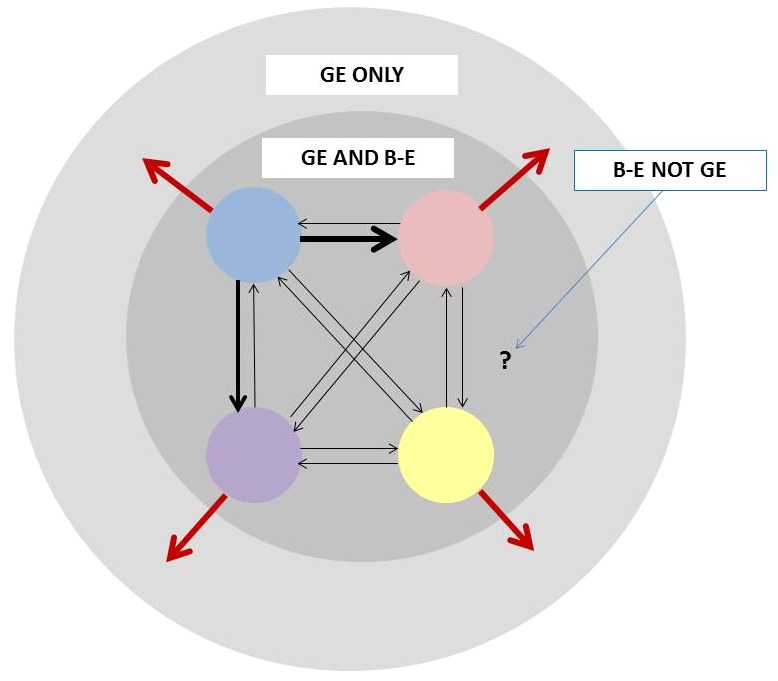
* This was not the only assumption as well as ignoring the Green and MRL. It is possible that some people who turned out for the by-election hadn’t voted in May. More significantly, voters who did turn out for both could have shifted their allegiances in seven months. This diagram indicates the possibilities:


However, I can’t imagine that many May Tories have gone to Labour or Lib Dem. In fact, it seems unlikely that votes would have moved to the Lib Dems in any number from either of the other parties. Hence only the heavy arrows in the diagram,seem to provide a plausible explanation for what happened.

I don't know if the data is available, but it would be very interesting to see the numbers of postal votes, GE and B-E, broken out by party.

26 October 2015

The other road to 2020

I posted here last month about the prospects for Jeremy Corbyn (Labour’s new Leader of the Opposition), out to the 2020 general election by looking at some of the statistics relating to his 13 predecessors in the last 60 years. Of course, not all Prime Ministers begin as Leaders of the Opposition. If a Prime Minister dies or resigns, his or her party chooses a new leader who succeeds to the Prime Ministership. Their challenge is to legitimise themselves by winning the next general election.

Looking back at the 2015 election, apart from the dismal performance of the opinion polls and the prediction machines which fed off them, there were two striking features of the outcome: the rise to dominance of the SNP in the Scottish constituencies and the collapse of the Liberal Democrats, particularly in SW England. But a third aspect of the campaign is likely to become almost as significant. In March during an interview in his constituency home, David Cameron told James Landale, the BBC’s deputy political editor that:
"There definitely comes a time where a fresh pair of eyes and fresh leadership would be good, and the Conservative Party has got some great people coming up - the Theresa Mays, and the George Osbornes, and the Boris Johnsons. 
"You know, there's plenty of talent there. I'm surrounded by very good people." 
He added: "I've said I'll stand for a full second term, but I think after that it will be time for new leadership. "Terms are like Shredded Wheat - two are wonderful but three might just be too many."

Perhaps in years to come we will find out whether there always was a long-term plan to make this intention clear prior to polling day. On the other hand, I do wonder whether Cameron would have been quite so forthcoming if it hadn’t been Landale, a man with the unusual characteristics of being both an Old Etonian like Cameron and being taller than the PM. From personal experience I know that, if you are well above the average male height, the occasional encounter with someone who looks down at you is disconcerting and Cameron I estimate as around 6 feet 1 inch (1.85m).

Anyway, back to the statistics. The table below shows the six PMs who had greatness thrust upon them, rather than having to take on the worst job in British politics first. The data is so sparse that conclusions are even more difficult to draw than in the previous post – apart that is from the Tories seeming better at this particular evolution than Labour.


Looking at the successors to Cameron mentioned above and elsewhere, as far as age is concerned Teresa May could be at a disadvantage and John Major would be a good precedent for George Osborne. On the other hand, President Hillary Clinton and Jeremy Corbyn would both be in their early 70s in May 2020.

As to when the take-over should be, 2018 might be the year to bet on if the Tories maximising their chances of success is the determining factor. But the outcome of the EU referendum might bring things forward to 2017 or even 2016.


29 September 2015

Jeremy Corbyn: Getting to 2020

I met Jeremy Corbyn back in 2003 when I was spending a day being educated on the ways of Parliament, which included discussions with MPs. Three of us, perhaps at the time not appreciating what would eventually become memorable, went for a cup of tea with Corbyn in Portcullis House. Casting about for a non-partisan topic, I asked him about ways to improve electoral turnout (it had been down to 59.4% in the 2001 general election). I remember the question but not the answer, so in retrospect it seems unlikely that anything particularly radical was suggested. Twelve years later Corbyn has emerged from relative obscurity and is Leader of the Labour Party and the Opposition and, although it seems unlikely, could become Prime Minister in 2020.

The commentariat are going flat out with Corbyn prognoses. Even before he was elected, Sebastian Payne asked on Spectator Coffee House
If Jeremy Corbyn is elected Labour leader, how long would he last?
and concluded that, if not challenged immediately,
Corbyn would be challenged a few months/years in his leadership. There is one particular flashpoint next year to watch: 5 May 2016. If Labour fails to win the Mayor of London race, loses Wales and fails to make any progress in Scotland, there will be calls for him to go.
Dan Hodges in the Daily Telegraph thought that the vote on Trident replacement in March 2016 would be a moment of reckoning (though Corbyn later told Andrew Marr that the vote would possibly be in June). On the other hand, John Rentoul in the Independent thought that the Labour Party
is so denuded of talent that it is hard to see where the succession to Corbyn will come from. Part of the reason for his success is the thinness of the field against him, but look beyond them and behold a wasteland.
Andrew Rawnsley in the Observer was full of misgivings:
For the moment, the spectacle of a leader and his top team agreeing to disagree on a host of critical issues at least has the merit of being unusual. It is the price Mr Corbyn is being forced to pay to avoid an immediate civil war with his MPs. It can’t be sustainable. There will be a crunch point between leader and parliamentary party. Then things will get really interesting.
but was not inclined to speculate about timescales:
Earlier foolish talk about a rapid attempt to unseat him has evaporated. The thumping scale of his victory means that his opponents within will have to tread very carefully for the moment. Yet the truth can’t be concealed. This leaves Labour MPs more divided than I have ever known them. Divided between those who are convinced that the Corbyn leadership will be an instant disaster and those who reckon it will be more of a slow-burning catastrophe for their party. Then there are those who candidly confess that they have no idea where their party is now going. “I think I know how this will end,” says one. “But I can’t say when.”
The Guardian made public Peter Mandelson’s private views that it would be “a long haul”:
Nobody will replace him, though, until he demonstrates to the party his unelectability at the polls. In this sense, the public will decide Labour’s future and it would be wrong to try and force this issue from within before the public have moved to a clear verdict.
In the FT Magazine, out just as the Labour party conference started, George Parker and Jim Packard had a long piece, Jeremy Corbyn: how long can he last?, but, not surprisingly, didn’t provide a specific answer. On the one hand:
“We have to give him time to fail and to make it clear to all his supporters that this cannot work,” says one moderate Labour MP. “There can’t be a coup now: we would have blood on our hands.” 
… “It’s going to go wrong,” says another senior Blairite former minister. “We just don’t know when.”
And on the other:
From David Cameron’s point of view, the longer Corbyn stays in the job the better. … “This is proof that God is a Conservative,” says one Cameron ally. The Cameron/Osborne strategy is to hope that Corbyn remains leader as long as possible and that years of leftwing-inspired chaos will cause irreparable damage to the Labour brand. 
… Cameron’s allies ponder whether Corbyn can hack the responsibility, the pressure and the mental strain of his new job and the need for constant accommodation and compromise with his party. “Cameron’s mentally extremely strong and even he can find it tough,” says one friend of the prime minister. “Corbyn’s 66. He’s never faced anything like this.” But Dave Prentis, head of the union Unison, says Corbyn has the stamina to survive the coming months. “He has done 100 rallies this summer. I have seen a man who, wherever he has gone, has shown commitment and fortitude,” he says. “Do I think he has the stamina for this? Yes.” 
On the totalpolitics website, James Skidmore explained Why Jeremy Corbyn will still be Labour leader in 2020, described the three hurdles any challenger would have to clear and concluded, fairly convincingly:
Essentially, the choice facing moderates now is how much rope do they give Corbyn? Until after the 2016 elections or until after 2020? Your correspondent reckons that when they sit down and think through the process they will leave it to 2020.
Given such uncertainty, I thought it might be interesting to look for any statistics which sum up the experiences of past Leaders of the Opposition (Leaders or LoOs hereon). To illuminate Corbyn’s position, comparisons should be made only with those individuals who have sought Leadership as a first step towards possible premiership. This rules out those who have had the office thrust upon them, that is those who have become Prime Minister (PM) by another route and then lost an election, most notably Churchill. Also excluded are interim, if recurrent, Leaders like Harriet Harman.

Initially the selection was confined to the last 80 years, beginning with George Lansbury who became Labour Leader in 1935 and, because of his pacifist views, is seen as having similarities to Corbyn. Over that period there were 14 men and one woman Leaders ab initio, nine Labour and six Conservative. Three of each party went on to win an election so the success rates are 33% for Labour and 50% for the Tories – success being defined as moving from LoO to PM. However, on examination Attlee’s position is exceptional. Lansbury resigned in October 1938, Attlee becoming Labour leader and losing the general election held a month later. Attlee eventually became PM in 1945 but had ceased to be Leader of the Opposition in February 1942 on appointment as Deputy PM in the wartime coalition.

Leader of the Opposition statistics
(notes at the end of the post)
So while it is useful for some purposes, like age on becoming Leader to include Lansbury and Attlee, comparisons with Corbyn for issues like age at the first subsequent general election are more appropriately made looking at the last 60 years. This is the period since Gaitskell became Labour Leader in 1955 and reduces the selection to 12 men and one woman. Seven of these were Labour and six Conservative with two Labour and three Conservative successes, 29% and 50% respectively.

Age 

Age is unarguable and Corbyn is certainly younger starting as LoO at 66 than Michael Foot or George Lansbury but at nearly 71 would be older at the time of the next election (7 May 2020) than any of the 11 of his 13 predecessors who survived to an election. Only two of them were over 60, neither man was successful. (In the last 80 years the only successful LoO older than Corbyn was Churchill at nearly 77 in 1951, but, as an ex-PM, and for other good reasons, there is no comparison).

Time in office

In May 2020, Corbyn would have been Leader longer than any of his predecessors except Heath who was successful. The five successful LoOs were in office slightly longer than the six unsuccessful ones but this masks an interesting difference between the two successful Labour LoOs who were in office for less than three years (2.2 average) and the three Conservatives, all more than four years (4.5 average). One could theorise that the UK media build up Tory LoOs, who thereby benefit from time in office, but conduct a war of attrition against Labour LoOs who do better the sooner they can get to Election day.

Health

Although correlated with age, health is always a matter of speculation. It seems reasonable to assume that if Corbyn has, or has had, any significant medical events and issues, they would have emerged in the media by now. To judge from his appearance, Corbyn does not look particularly young for his age. His not dowsing his hair in dye, like so many other politicians, if anything adds to his “authenticity” – perhaps it will encourage others to stop. He is long-sighted (presbyopia) to judge from the photograph of him looking over the top of his glasses at the TUC audience (below top left), as to be expected at 66. He looks slightly overweight to judge from the St Paul’s photograph of him not singing the National Anthem (below top right) – more than might be expected of a vegetarian, almost teetotal, cyclist. In future it can be assumed that he will be cycling less and making more use of the transport provided for LoOs (below lower) and gain weight.


When he was forming his Shadow cabinet in the House of Commons on 13 September, Corbyn was observed by Darren McCaffrey, Politics Reporter for Sky News:
… at the end of a bookshelf-lined corridor, opening up to the members’ lobby and behind a door grandly named Her Majesty’s Official Opposition Whips’ Office, Jeremy Corbyn was holed up. … And again Jeremy emerged, which he seemed to do once every hour, when a toilet break was needed.
Needing to urinate that frequently suggests that Corbyn has an enlarged prostate pressing on his bladder. If so, that would be a common condition (BPH) in a 66-year old male.

Corbyn is in the unusual position of a man having to give up his hobbies to work at an age when many others have already done the opposite. Should he become PM, he and a future King Charles could at least have that in common. Until now Corbyn has been doing what he enjoys with the salary and continuity of employment of an MP with a safe seat. His interests seem to revolve around the far left of politics and he has been able to spend his time engaged with like-minded people. As an MP answerable to no-one, certainly not his party’s whips, he has been able to avoid the stresses and conflicts of working life which he would have encountered in white collar employment. Men of his age at his salary level in the real world, if they haven’t already quit, will mostly be about to escape from having to meet the unrealistic aspirations of self-serving senior managers while overcoming the reluctance of subordinates to embark on anything but the mildest change.

It seems likely that nothing in Corbyn’s previous experience (apart from two divorces) will approach the stresses that he will encounter in The Worst Job in British Politics. So far he seems to be avoiding confrontation where possible, for example the first PMQs. If an interviewer, and there have been few so far, raises difficult issues, these are being deflected with vague promises of consultative forums and discussions which will arrive at agreements acceptable to all involved. That sort of obfuscation can only go on for so long. For Corbyn the stress of having to compromise sincere beliefs which have hardly ever been challenged, let alone had to be defended could eventually take its physical toll. Oddly enough, the two Labour predecessors to whom he is most often compared, Foot and Lansbury, lived on to the ages of 96 and 81 respectively. However, two Labour LoOs have died in office, Smith and Gaitskell, at 55 and 56.

Conclusion 
Leader of the Opposition
Month of taking office and outcome

As investment funds make clear, past performance is not necessarily indicative of future results – or words to
that effect. This is particularly so when the underlying statistics are so scant. But if Corbyn’s health holds out, and, in the hope that 70 is the new 60 I would not want otherwise, the statistics for previous LoOs in terms of age and time in office are not encouraging for him. Nor is the final table (right) which shows the outcomes for the 13 LoOs depending on their month of taking office, unfortunately September in Corbyn’s case.

On past performance Labour would do well to change Leader about two years before the next election – February 2018 looks a particularly auspicious time for a Corbyn successor, someone in their late 40s, to take office. In the unlikely event that anyone takes previous posts on this blog seriously, it would seem a good idea to select a second-born middle-born who went to Oxford!


Notes
(a) Died in office 12 May 1994
(b) Resigned 6 November 2003
(c) Died in office 18 January 1963


UPDATE 6 DECEMBER 2015

As far as I know, the first media report about Corbyn’s health which has appeared is the one in the Independent on Sunday (IoS) today, Jeremy Corbyn's allies accuse MPs of 'spreading lies' about Labour leader's health, an exclusive by Tom McTague. What I regard as the relevant extracts are below, but the original is easy to access.
Labour’s increasingly bitter civil war has deepened after allies of Jeremy Corbyn accused MPs of “spreading lies” about the 66-year-old’s health in an attempt to destabilise his leadership. Labour’s increasingly bitter civil war has deepened after allies of Jeremy Corbyn accused MPs of “spreading lies” about the 66-year-old’s health in an attempt to destabilise his leadership. … 
Sources close to the Labour leader have revealed that he has been forced to reassure MPs in private that he is not going to quit after being made aware of “smears” circulating Parliament about his fitness for the job – including the “categorically untrue” allegation that he briefly “passed out” under stress in his office last month. … 
One senior Labour source close to Mr Corbyn told The IoS that he had emerged from the past week strengthened – and demanded an end to personal insults and smears about his health. … 
A shadow minister, who did not want to be named, went further – accusing anti-Corbyn MPs of being “prepared to spread lies about Jeremy’s health in order to assist them in their aim” of destroying his leadership. He added: “You can’t get much lower than spreading lies about someone’s health to undermine them and their ideas.


UPDATE 7 FEBRUARY 2016

On 5 February Ken Livingstone appeared for about 15 minutes on RT News Thing. About four minutes in, being pressed as to whether he might become Labour leader after Corbyn, he said:
If Jeremy was pushed under a bus being driven by Boris Johnson, it would all rally behind John McDonnell.
Almost at the end of the session he reinforced the point, but less hypothetically:
I keep telling you, it’ll be John McDonnell. If Jeremy was to have a stroke or something like that, it will not be me.
For comparison with the table above, John McDonnell was born on 8 September 1951 and would be 68.7 on 7 May 2020.