Showing posts with label Ed Miliband. Show all posts

24 June 2017

On age advantage in general elections

There have been 20 elections in the UK since the end of the second world war. A recent post looked at the vote share of the two main parties (Conservative and Labour) in these elections. Another, perhaps less well-grounded, updated the remarkable record of graduates of Oxford university being the winners – now 18 times out of the 20.

Yet another, but not altogether serious, statistic about elections which is easily captured is the age difference between the contenders (Prime Minister and Leader of the Opposition), shown for the post-war period in the chart below.


The green shadow indicates where the election generated a change of governing party. 1945, following the wartime coalition led by Winston Churchill, and 2010, leading to a Conservative/Liberal Democrat coalition led by David Cameron, are assumed to be changes of party. Eight of the 20 elections were then of this kind. In the four elections from 1966 to 1974 the age difference between the contenders was insignificant, Harold Wilson being born in March and Edward Heath in July 1916. For this reason, no conclusions can be drawn about the 1970 and February 1974 changes of government. However, in five of the remaining six elections in which there was a change of party, the successful challenger was younger, on four occasions by 10 years or more. The only older successful challenger was in 1951, when, having failed to displace Clement Attlee in 1950, Churchill returned to the Prime Ministership.

In the 12 continuity elections (ie with no consequent change of governing party), Wilson’s successes against Heath in 1966 and October 1974 are as before insignificant as far as age differences are concerned. Cameron’s success in 2015 against Ed Miliband, who was three years younger, and John Major’s in 1992, when a year and a day older than Neil Kinnock, are probably best regarded as inconclusive as well. In the eight remaining continuity elections, three of the victors had an age advantage of more than 10 years and two were more than five years younger. Three were older, Margaret Thatcher’s defeat of Kinnock in 1987, when more than 15 years older, being easier to understand than Harold Macmillan’s of Hugh Gaitskell in 1959 when more than ten years older.

Is there any underlying significance to all this? It could be that for the electorate to move a party from opposition to government, there has to be an appetite for change and the case for fulfilling it can be made more convincingly by a younger person – Wilson in 1964, Margaret Thatcher in 1979, Tony Blair in 1997, Cameron in 2010.

And what should the two parties’ strategies be for the next election if they were to take age advantage seriously? Labour would, it seems, be more likely to succeed in selling change to the electorate with a much younger leader than Jeremy Corbyn, 68 but now not easily dislodged. It is worth noting that while Cameron at 43 in 2010 was the youngest PM since 1812, Justin Trudeau became Canadian Prime Minister in 2015 at the same age and Emmanuel Macron was elected president of France this year at 39. Labour might well want to wait for the Tories to move first but ought already to be considering that their man or woman should be much more than five years younger than Boris Johnson or Amber Rudd (both currently 53) and significantly younger than Michael Gove (49, going on 60) or Sajid David (47). The Conservatives (on the assumption that Theresa May is no longer PM by then) should aim to nullify any future Labour leader’s age advantage by choosing someone in their early forties. It would also be to the Tory’s advantage to play it long and keep Labour waiting.   Oh, and if they'd been to Oxford ...

Anyone thinking of starting up a new party under, say, David Miliband, should remember that he is 52 next month. How time passes.


Update 27 June 2017 

On 25 June, the Sunday Telegraph carried an article by Ben Riley-Smith, Tory plot to skip 'toxic' generation and install younger face as next leader.
Tory MPs and donors are plotting to “skip a generation” and install a younger MP as their next leader after concluding the front-runners to replace Theresa May are too toxic. A growing number of Conservatives believe that Boris Johnson and David Davis have “had their day” and only younger faces can revive the party’s fortunes.  
… Hopes are now turning to the “golden generation” of Tory MPs first elected in 2010 to win back younger voters who voted for Jeremy Corbyn en masse at the election.  Sajid Javid, the Business Secretary, Dominic Raab, the Eurosceptic justice minister, and Priti Patel, the International Development Secretary, are all being talked up by colleagues.  Other ministers from the 2010 intake such as Jesse Norman, Brandon Lewis and Jo Johnson - the brother of Boris - are also mentioned as possible contenders.  
Supporters of the plan point to how David Cameron, the last Tory to win the party a majority, was barely known when he joined the leadership race in 2005.  
“If and when this happens, we need Year Zero – a real radical revolution,” said one 2010 MP about a leadership switch.  “We need an equivalent to Ruth Davidson [the Scottish Tory leader] – someone completely counter-intuitive. She is a lesbian kick-boxer who doesn’t fit the mould. When she first got elected she didn’t have much cut through. But because they are new and different it will gather stream [sic].” 
One veteran MP warned that “all the front-runners are contaminated in one way or the other". Another younger MP said: “They’ve had their day and it hasn’t worked. For the current lot – Boris and the rest of them – their time is up.

Raab is 43; Patel, 45; Norman, 55; Lewis and Jo Johnson, both 46.


11 June 2017

The Oxford Incumbency continues (just)

It was back in October 2013 that I posted about the very high proportion of elected British Prime Ministers who were Oxford University graduates. The table I produced then is due for an update following the general election on 8 June 2017:


As are some the points which I made:

In 18 of the 20 general elections since 1945, the winning Prime Minister was educated at Oxford.

Of the 11 elected Prime Ministers since 1945, nine went to Oxford; of all 13 PMs since the war, ten went to Oxford.

On only one occasion, 1951, did an Oxford-educated incumbent, Clement Attlee, lose to a non-Oxford person –the “Former Naval Person”, Winston Churchill.

In only one election, 1992, had neither candidate been to Oxford.


Notes 

(1) Harold Macmillan did not graduate from Oxford, his studies having been interrupted by war service.

(2) Known as University College of South Wales and Monmouthshire in Neil Kinnock’s time there.

(3) Cameron, a Conservative, led a coalition from 2010 to 2015.

23 March 2015

It’s the David Miliband wagon again

Just my conjecture of course, but could it have been that it seemed a good idea last Monday. On the Wednesday (18 March) Osborne’s Budget - bribing taxpayers with borrowed money - was bound to go down well and Ed Miliband’s response to go down badly; the YouGov opinion poll to be conducted on 19-20 March was certain to show that the Conservatives had opened up a significant lead over Labour; then on 22 March the poll results could lead on the front page, the Sunday Times magazine having been given over to a cover feature trailed all week: Celebrity big brother How David Miliband conquered New York. Anonymous Labour MPs and shadow cabinet members would provide quotes which evinced a bad attack of the heebie-jeebies, and the ditch Ed bandwagon would be shown to be rolling.

Only it didn’t quite work out like that. The poll showed a two point Labour lead and accordingly was relegated to page 16, leaving Iain Day’s David Milband article, THE OTHER MILIBAND Yo bro, I’m the talk of the town, somewhat high and dry in the magazine, as was the companion puff piece, No 1 Miliband still wants No 10, on page 8 of the main paper. Never mind, it still left some grist for the mill of this blog which has been following the periodic revivals of media interest in David Miliband since last August (and December and January).

So what was different about this one? There was certainly stock material about their Marxist dad, which brother got the first in PPE, and how upset their mum was and how the two younger Mrs Milibands had fallen out when Ed stymied David’s bid for the Labour leadership. But Day’s article seemed to have some new material from New York sources in and around the International Rescue Organization (IRC) where David now works as its president and CEO, at a salary of £300,000 ($450,000 presumably). As always, these things are best taken with a pinch of salt, for instance, early on we are told:
Miliband, astonishingly, has become the toast of the Manhattan elite.
and three sentences later:
… they have become minor celebrities among über-rich New Yorkers.
Not quite the same thing, surely? Anyway, towards the end there is a health warning:
David Miliband refused to be interviewed for this article.
Indeed, so we have:
According to some of his closest confidantes … 
… says one director of the IRC. 
Almost all of the IRC directors I spoke to … 
… a number of the charity’s directors confirmed to me … 
… says one IRC director … (five times)
and bizarrely:
Sir Patrick Stewart, the Star Trek and X-Men actor, is one of Miliband’s closest confidantes in New York, according to IRC sources …
Just how many directors are there? According to the relevant IRC webpage, 28, but the layout is unclear and I could have miscounted. There are also about 75 overseers (some may be directors as well) including, as the article explains, such eminences as Henry Kissinger, Madeleine Albright and Liv Ullman. Some of the overseers and directors are named as sources and their comments should interest anyone who wants to know how Miliband got the job and how he is operating and raising funds through his “relentless charm offensive around New York’s high society”. But this blog has been more interested in whether Miliband would “do a Boris” and return to Westminster politics. There are three passages in the article I thought worth noting:
"He wants to be prime minister," says one director of the IRC. "The typical term for the boss o this organisation is 10 years. He made a commitment to stay for seven, which takes him to 2020, but with, effectively, a break option at five. I don't think it's a coincidence that the dates align with the next election. He does not want to run against his brother. But if his brother gets chucked out I don't think he is at all averse to being the white knight."
and:
Should destiny come calling, Miliband has kept his designer kitchen cabinet of trusted advisers close to him. Madlin Sadler has long been the right hand of David Miliband, serving as his special adviser at the Foreign Office and as his agent in that fateful 2010 Labour leadership contest. The daughter of Labour MP Barry Sheerman, Sadler ditched a well-paid role with the law firm Mishcon de Reya to join her old boss in NewYork. Ravi Gurumurthy, a strategy expert who helped Miliband form British foreign-office policy, has also been hired. Gurumurthy is the brother of the Channel 4 newsreader Krishnan. Then there's Ollie Money, his Westminster public-relations handler, who is now the IRC's communications director. 
“David has a vision and a mission, Maddie [Sadler] just wants to get to Downing Street and to get there fast," says one IRC director. "When he brought her in, he called her his chief of staff, which was a big mistake. She's super-smart, young, really brassy, just killer. He needed that because he didn't have any experience managing big organisations, and there are 6,000 people in this organisation, spread all over the world. She just ripped the shit out of the place. There was a pretty strong reaction to her, but not to David. Being the great politician that he is, he made it good when it went too far."
and:
The IRC insists that Miliband's contract is not limited to just seven years. Yet a number of the charity's directors confirmed to me that Miliband made a commitment to the board to stay for a minimum period after they raised concerns about him being tempted to return home. Should the opportunity emerge to take the helm of Labour, Miliband would be a greyer, wiser, very electable 54 years old in 2020. He would be even better connected internationally. Unlike almost any other politician in Britain, Europe or the US, he would have experience of running something before attempting to lead the country. 
"We have our eyes wide open to the possibility that David could disappear," says one IRC director. "If Labour get trounced and they're looking for a new leader, and it doesn't look like he was the one who threw his brother out, would he consider it? Yes, I suppose. I still think he’d prefer that they threw in someone who would be cannon fodder for a period of time. Then, when there's a problem, David is the white knight. If David could write the script, that's what it looks like."
Day shared the by-line of the story in the main paper with Tim Shipman, who, to judge from this extract, had spent some of Saturday on the phone to his Labour contacts:
Labour MPs who supported David Miliband last night questioned whether he has a realistic chance of returning to replace his brother suggesting that rising stars such as Chuka Umunna, Tristram Hunt, Liz Kendall or even Dan Jarvis are better placed to carry the Blairite standard. A frontbencher who voted for David said: "He should have won the leadership and I think we'd be in better shape if he had. But the modernising wing of the party has moved on. "David's still young but he's part of a different political generation. We need to look forward, not back. There are a lot of talented people like Chuka, Tristram, Liz and even Dan Jarvis now coming through. David's had his time." Another prominent MP said: "If the public rejects one Miliband, the idea that they are going to race to embrace the other is fanciful." A spokesman for Miliband said: "David wants Ed to be prime minister. End of story."
“ … even Dan Jarvis” – an estimable character I always think, and well-equipped to “go on manoeuvres” as the Tories put it. Shipman’s view of politicians in general was revealed in a The Times Red Box email on 22 March while commenting on a Tory candidate currently in a spot of bother:
I am struck, not for the first time, that too many people engaged in frontline British politics believe they are living and working in House of Cards, with its labyrinthine Machiavellian scheming, when in fact they are straight out of The Thick of It, the ultimate modern incarnation of tragedy as farce. Politics attracts the talented and tormented, idealists and ideologues, the principled and the perverse. Most strikingly, it attracts more than its fair share of risk takers, gamblers, and fantasists; the kind of people who live their lives in a divinely ordained parallel universe of their own creation. Vetting can only show what skeletons candidates have in their cupboards. It cannot show the delusions in their own heads.
Interestingly on Monday 23 March, in the Sun (stablemate of the Sunday Times and The Times), Trevor Kavanagh, its veteran political journalist, has authored an opinion piece, Arrogant David is wrong to assume job’s his next time round. So, at least for the moment, the Miliband wagon is not just stalled, one of its wheels has come off. Disappointing for anyone at IRC who was hoping for a new CEO, perhaps one of those:
… long-standing staff members [who] did not take kindly to memos [from Gurumurthy] asking about their financial targets and questioning various projects in terms of cost benefit analyses and return on investment.


19 January 2015

Former Prime Ministers – some statistics


What uncertain times these are. In the Independent on Sunday on 18 January, Iain Dale, political commentator and former Conservative politician, provided his prediction of the outcome of the May general election (his website is the primary source). It was based on a painstaking consideration of the circumstances of each of the 650 constituencies in the UK parliament, after drawing together whatever local knowledge, polling evidence and so on that he could find. This approach had served Dale well “when I got the European election results bang on and made the most accurate predictions in Cameron’s Cabinet reshuffle”. On the same day in the Sunday Times, Peter Kellner, political commentator, president of the pollster YouGov and husband of a Labour politician provided his forecast (now on YouGov). Their data is in the table below, my additions in italics:

Of course, both men may choose to revise their forecasts in the coming weeks and who knows how robust such predictions would be in the event of, say, a terrorist outrage days before the election. But in both neither of the two main parties is expected to achieve an overall majority, which would suggest that some form of coalition is likely. However, according to Kellner, David Cameron will be leader of the largest party whereas Dale implies that  Ed Miliband, the leader of the Labour party, will be Prime Minister and heading the coalition.


So we may have four former Prime Ministers, with Cameron joining John Major, Tony Blair and Gordon Brown. Or perhaps there will still be three at the end of May. This set me thinking about the number of ex-PMs over the years, hence the chart on the left from 1870 to the current day.


It turns out that for most of the last 100 years, the presence of three or four ex-PMs has been the norm. There only being one, as was mostly the case from 1945-55, was unusual. Only in Gladstone’s final administration was there none, for four years following Disraeli’s death in 1881.  Prime Ministers tend to be long-lived – only one born since 1800 died under 70, Bonar Law, who died soon after leaving office in 1923. The only PM to die in office was Campbell-Bannerman in 1908 at the age of 71.


The mean age at death of the 21 deceased PMs born since 1800 has been just over 81 years, but for the five born and deceased since 1900, just over 88. The latter include one woman, Margaret Thatcher, who died at 87, bringing the average down, contrary to actuarial expectation. Presumably to get the job at all requires a good constitution, but comparison should be made with the life expectancy of upper middle class males (mostly) over 40, not males in general at birth.


On average PMs have lived for 14.8 years after leaving office for the last time (Wilson, Churchill, and Baldwin are among those who returned to office). This becomes 17.2 years if Campbell-Bannerman (see above) and Chamberlain and Bonar Law, who both died within six months of leaving office, are excluded. (The arrows are for Major, above Blair, both to the left of Brown, all on-going of course).


The longest lived was Rosebery – more correctly Archibald Primrose, 5th Earl of Rosebery, probably the most interesting PM statistically. At 45 he was the youngest person to become PM until Blair and later Cameron. His period in office was only 15 months and his estate is thought to have been the largest –so far. The younger they enter office, as has increasingly been the case, the younger PMs will be when they leave:


As far as the next election is concerned, there would be nothing surprising about either outcome as PM in terms of the consequent number of ex-PMs.  However, it seems very likely that the number will go up over the decades ahead. As the table below shows, despite the impression of premierships having become longer, over successive three decade periods, there have been about the same number of office-holders:


However, if the leaving PMs are getting younger and they live to about 90, there will, before long – probably the late 2020s, be six or even seven ex-PMs to be invited to lunch or dinner with the sovereign!


NOTES 

1. Dates of birth, death and office are from Wikipedia.
2. The “quick and dirty” method for dates before 1900 in Excel was used.
3. Photograph at top, 1985: PM Thatcher, ex-PMs Callaghan, Douglas Home, Macmillan, Wilson, Heath (left to right).
4. Second photograph, 2012: PM Cameron, ex-PMs Major, Blair, Brown (left to right), Thatcher was too ill to attend.
5.  Any errors will be corrected if provided as comments.


11 January 2015

Could David Miliband do a Boris (part 3)

Following posts last August and last month, even I am getting bored with this subject, so in brief there is an article in the February 2015 Vogue magazine, The Exile - Is David Miliband the most charismatic leader we never had? - a QTWAIN* candidate, if ever there was. Christa D'Souza accompanied DM on one day of “a three-day whirlwind trip” he made to Pakistan in his role as CEO and president of the International Rescue Committee (IRC). Much of what she reports is either stock stuff:
Born in London in 1965 and brought up in Primrose Hill, David Wright Miliband is the elder son of the late Marxist academic Ralph Miliband …
…PPE, the wife, the kids, New York etc, and much else only worth reading if you are interested in the work of the IRC or in Pakistan. However D’Souza didn’t miss the opportunity to enquire about DM’s longer-term aims. Although his answers were in quotes, and therefore presumably verbatim, her sometimes obtuse questions were only implicit in the breathless accompanying text – like this:
David Miliband as the next prime minister? Is that something … that might be on the cards - if not at this election, then the next? He’d get my vote, I sally shamelessly... "Ha ha, well, that's very kind of you to say so," he says, and then deftly extricates himself from answering the question. "Look, it was great that you came out here, so much better than doing the interview in some office... “
… he laughs when, as we pull away from the sprawling Mughal residence, I mention the way Sarwar made a joke about shaking hands with the future British prime minister. So, come on then, he's still young, is he thinking of returning to politics? Both Tony Blair and Peter Mandelson have been quoted as saying they very much hope he is. "Ummm... I don’t know; is the answer. It was obviously a big move to come to the States. I had a very good run. Obviously I still care about the country, but I’ve come here to make a success of this job. Whenever anyone asks me when I decided I wanted to go into politics, I always say: what do vou mean, when did I decide? I still haven't decided! Evidently it's not all written down on a sheet of paper... It feels like I'm in the right place at the right time..."
The question I pose to him is, on a simply human level, doesn't he wince at reading all the dreadful press his brother is getting? Isn't it true, to varying degrees, that it's fine to be appalling about one's own family, but if an outsider weighs in on one's own flesh and blood, beware?     "I can't say anything, because anything I say plays into the whole narrative," he tells me wearily. “And I made an absolute commitment to myself not to play into the story, so I can’t even accept the premise of your question... "It's not good for him and it's not good for me for this to become a story," he says as he gestures for me to switch off the tape recorder, forgoing the chance to make a statement of wholehearted support for his brother that one might reasonably expect.
Nowhere in the article is there any indication as to when this encounter took place. However, according to the Lahore University of Management Sciences (LUMS) website:
On Monday, November 18, 2014, the LUMS Model United Nations Society (LUMUN) hosted a talk by President and CEO of the International Rescue Committee (IRC), David Miliband. He has had a distinguished political career in the United Kingdom over the last 15 years. … This is Mr. Miliband's tenth visit to Pakistan and the fourth to Lahore.
The December post here was triggered by Miliband’s Lunch with the FT encounter which had appeared in the Financial Times on 13 December 2014, so whether that took place before or after the trip to Pakistan isn’t clear. Either way, perhaps at least for the first four months of 2015 David Miliband will decide to go into purdah – an expression remaining in modern British usage as a vestige from the old Indian Empire, appropriately enough.

D’Souza, like other journalists before her, couldn’t resist making unfavourable comparisons between the two brothers:
Looks aside, [DM’s] aura brims with steely, statesman-like charm, unlike his comparatively hapless-seeming brother …. [who] mutates into the twenty-first century's equivalent of Michael Foot …
Intentionally or not, amongst the gush about DM:
I sit next to an extremely beautiful editor from the national newspaper Dawn, who whispers admiringly, "I didn’t realise he was so tall! He's too good-looking not to return to parliament." Unlike his brother, David Miliband has the aura of a statesman, as opposed to that of a politician - and you can feel it right here in this room, the sway he holds over this impromptu gathering of influential, super switched-on elites.
there are some revealing vignettes:
The disquieting thing about David Miliband, aside from the darkening gaze and marionette-like rictus he pulls when someone talks while he's talking, or when the development jargon irritates him (“NFI? I mean, who's going to know what that means?" he all but snaps at an aide), is the fact that he appears such a young 49-year-old, with his plush, badger-streaked hair and football-player body.
and
Despite his generally easy manner, Miliband's patience obviously gets tested by a number of things. Red tape; extraneous noise while he is talking; time-wasting. At a meeting the previous day in Islamabad at the Pakistani Humanitarian Forum, to which the heads of several local NGOs had been invited, he became noticeably fidgety when the host invited each speaker around the table to introduce themselves. "Yes, we've done that already," he said with that icy grimace. "I know everybody's name, I think, and where they are from, I've read all my briefings …".
Well, we’ve all known people like that.


*QTWAIN Questions to Which the Answer is No


15 December 2014

Could David Miliband do a Boris (part 2)

Previously on Western Independent: 

Back in August I pulled together two stories in the UK press to address the question “Could David Miliband do a Boris?”.  Boris Johnson had just announced his intention to stand as Tory candidate in the 2015 election and The Times had run an article on 7 August, Still smiling, but it hides the battle of an alien in New York, about David Miliband which suggested that things weren’t all that they might be over there:
… Despite being in the midst of a complex and difficult reorganisation of a big international charity, as well as the usual problems of settling a family into a foreign city, Mr Miliband still pays close attention to British politics down to the fine details. etc, etc.
A few days later the Observer ran an “exclusive interview” with Miliband, possibly to get the record straight:
"Both Ed and I want the other to succeed," he said. "Strongly, passionately. And we also both work hard to keep personal lines open and private. I'm focused in succeeding in my job … and I want him to succeed in his job. And I'm sure it's the same for him." Yet on the subject of whether the Ed-led Labour party will win next year's election, he was not emphatic: "I think that it's really open. I think we can." Then he hedged. "I never say we will win. Because I'm a protagonist, not a commentator."
On 20 August The Times Red Box came up with another twist:
Labour MPs hoping to bring David Miliband back into the fold have an idea for his brother Ed. They say that Ed should make David British ambassador to Washington if he wins the general election, as reported in The Times Diary this morning.  It would be the ideal way of rehabilitating him, paving the way for a later return to British politics after a spell in the US capital, they say.
Boris Johnson is now the Conservative candidate for the safe seat of Uxbridge and South Ruislip. But four months later, we seem to be going around the same buoy again with Miliband D. The Financial Times has selected the charity he directs (the International rescue Committee) as its charity of the year. (Miliband had told the Observer that it was a $500 million organisation, but no doubt every little extra helps). So its deputy editor, John Thornhill, went to New York for Lunch with the FT with Miliband as guest*, and authored the feature on 13 December. Personally, I find this weekly format a tired and tiresome way to report an interview:
He opted for a simple salad to start while I go for the kale salad. “It’s much more edible than you think. It’s not like chewing cardboard,” he reassures me.
But later:
As I sample my mound of kale, sprinkled with a few roasted nuts [$16.00], I conclude he was wrong about the cardboard.
Never trust a politician! Eventually:
Now that we are on to the red meat, I ask him about the bloody issue of British politics. … I ask him who he thinks is going to win the next election. “I passionately want Labour to win – and Ed to win,” he says. And would his brother make a good prime minister? Without hesitation, he shoots back: “Of course. I would know that better than most.” What are his qualities? “What I would say is that the clarity, the vision, the determination, those are all important qualities. But, equally, I have made it a rule not to insert myself into the political dynamic for two reasons. One, I have got a job that requires me to work with the current government. And, two, I am trying to run a charity, not a political party. My experience is that anything I say gets taken out of context. While it might not be twisted in your hands, it will be twisted in the re-spinology that goes on. So we should probably leave it at that.” 
Miliband drinks a double espresso while I sip on a green tea and ask him whether he could ever envisage a return to UK politics. He says he has made a big commitment to join IRC and is fully dedicated to his job. But, he adds, he does not intend to become an American citizen and spend the rest of his life in the US. Life is unpredictable, he suggests. Two years ago, he had no idea he would now be in New York running the IRC. “You just don’t know, do you?” 
It seems unlikely that someone who has devoted most of his adult life to Westminster would be content to see his political career finished before the age of 50. Perhaps, I venture, it would be a good thing if British politicians had multiple careers — as is so often the case in the US. “Tony Blair and John Major have said that they wish they’d done their post-premiership jobs before they became prime minister,” he says. 
Maybe, I suggest, he is learning from their experience and doing a pre-premiership job outside politics? He guffaws with laughter. “That’s not the way I conceived it.”
Comparing the FT interview with the Observer one, and both are, presumably selections from what was said, albeit one would like to think unvetted, David seems more enthusiastic about Ed than in the summer. There is little point in speculating at length as to why this might be the case. But currently the odds are just about on Ed Miliband as PM. If that were so, putting David in the Washington embassy might offer parallels with Churchill’s despatch of his rival Halifax in 1941. However, in the event of Hilary Clinton, who has a high opinion of David, becoming 45th president in 2016, that might put him in too powerful a position. And would it be appropriate anyway for a former Foreign Secretary to take up an ambassadorial post, even in Washington or Paris?

But what if Ed isn’t PM next May? He might not go, nor may his party want him to. For example, if Labour fail to secure the seats they need because of the rise of the SNP, it would hardly be Ed’s fault. Or if Cameron cobbles together a tottery government with Ulster Unionist and/or UKIP support? On three occasions since 1945 there have been general elections soon followed by another to resolve an unworkable situation: 1950/51, 1964/66, and 1974/74. But if he failed to become PM after a second election Ed would certainly have to go . No wonder David is happy to go on record as thinking life is unpredictable, “You just don’t know, do you?”.

*At the David Burke Kitchen, 23 Grand Street, NY10013.


10 August 2014

Could David Miliband do a Boris?

On Thursday 7 August, The Times gave some of its front page and the whole of page 4 over to a “Boris bombshell” story, Boris Johnson having announced the day before that he wanted to stand for Parliament in the 2015 election. I have doubts as to whether Rupert Murdoch is particularly keen on Johnson. Certainly some of News Corp/News UK’s papers have their reservations. Later that day Simon Nixon posted a very critical piece, Boris Johnson Is Talking Piffle, on WSJ Blogs, and on 9 August in The Times, Matthew Parris, opinion columnist and former MP who has observed Johnson, commented about
… the Boris I’ve observed for years. He has some of the qualities of a great and inspirational leader — a political transcendent — and some of the qualities of a hideous car crash waiting to happen. 
I’m glad he wants to come back. He’ll be fun. He’ll enliven the Tory campaign, help in places, hurt in places, entertain everywhere and make little difference outside London. He’ll be a persistent irritant on the question of the Tory leadership, but he probably won’t ever be leader.
The leadership question had come to the fore in an analysis of Johnson’s strategy by John McTernan the previous day in the Scotsman, Riding to the rescue or a Tory car crash?:
The fact no-one wants to mention is that Boris’ return is predicated on a Tory defeat at the next election. … He can only be the leader if there is a vacancy. There can only be a vacancy if there is a defeat. 
… some argue that Cameron will win a majority, hold a referendum, win it and then gracefully hand over in 2018. If you believe that, do you mind sending me you bank details, your PIN and your mother’s maiden name. 
David Cameron is born to rule, and if he wins a majority next year – the first Tory majority in 23 years – he will enjoy every day of his five years in power. … If he can stay in power he will – whether an understanding with the DUP or supply and confidence with the Liberal Democrats. You will have to prize the code for the No10 flat from his cold, dead hands. 
No, Cameron goes when the Tories lose power. A triumphant Dave – in whatever form – kicks the leadership election beyond 2020, and then Sajid David will have shown us his paces.
But another politician (with grinning selfie) was spread over two pages by The Times on 7 August, David Miliband:


Rather a tale of woe:
Behind the smile, however, is a more fraught reality and fears that, despite moving to New York, Mr Miliband  remains a man at best in limbo, and at worst floundering. 
… Friends concede that it has not been an easy move [to run the International Rescue Committee] for the family. His wife, although American, was less than enthusiastic. 
… A friend adds that the two boys also found it difficult to settle. 
… The family spent the first holiday after the move not exploring the US, but visiting their old home in South Shields, his former constituency in the northeast. 
… Shortly after his arrival it was reported by The New York Times that “the plan is that with his international experience and gold-plated virtual Rolodex, Mr Miliband can bring in new sources of funding as well as raise the group’s profile”. Britain’s former foreign secretary has interpreted this job spec in a way that has increased tensions with some senior staffers at the IRC, his allies admit. 
… A couple of months after he started at the charity in earnest, The New York Times described how “some long-time IRC staff members responded to news of his appointment with a certain wariness, mainly because of Mr Miliband’s foreignness, his celebrity, his lack of experience running non-profit agencies and because they did not know what his management style would be.” 
… The US staff are said to find Mr Miliband aloof and arrogant.
And so on, with his lightweight social and public profile in the US, unlike Boris Johnson! And then:
There is no sign of a full — or even partial — reconciliation. Ed Miliband did not make a detour to see his brother during his trip to Washington last month. David Miliband did not see Ed when he was over in the Britain for a recent IRC conference in Windsor. In fact it is Louise Shackleton who remains the most unforgiving about Ed’s displacement of his brother, her husband. 
… Despite being in the midst of a complex and difficult reorganisation of a big international charity, as well as the usual problems of settling a family into a foreign city, Mr Miliband still pays close attention to British politics down to the fine details. “He knows far too much about canvass returns in Stevenage than he should,” one intimate says. It would be inhuman of Mr Miliband to want his brother to win handsomely, suggests another. In private, he is critical of Ed’s strategy and his narrow lead in the polls. He believes that the lead should be much greater given the collapse in most people’s living standards under the coalition government, and that the gap will inevitably narrow as the election approaches.
The article goes on to say that David Miliband is totally committed to the IRC and to speculate, rather unconvincingly, about how he might benefit from a Clinton victory in 2016.

An attempt was made to counter the “fraught reality” in the Observer on 10 August in an “exclusive interview” granted to Jon Swaine, David Miliband: 'I want Ed to succeed. I'm sure he feels the same about me':
… Miliband likes Italian food. His American wife, the violinist Louise Shackelton, prefers Japanese cuisine. Eating out is one of the best things about their new life, he said, denying rumours that they are not enjoying life in New York much at all. Soon they will be holidaying in Cape Cod. 
… "I'm absolutely convinced this is the right place to be for us," … "I wouldn't be happy if my family wasn't happy. That's a big thing. My kids are OK. Louise is OK." 
… Miliband said he was brought in to make the IRC "think, act, speak, like a $500m organisation, not like the much smaller one it used to be". Asked for a concrete change he'd made, he said: "We have galvanised the organisation to think ambitiously about its strategy for the future." Longer-serving IRC managers, apparently worried about risks to staff on the ground, reportedly fear creeping politicisation under Miliband, adding to the pressure they feel they are under to stay neutral. He denies any such clash. 
… He claimed that he doesn't follow "every twist and turn" of British politics, before saying he had watched the TV debate on Scottish independence the night before [6 August on STV, which would have been at 15:00 EST], and followed criticism of the wreath laid by his brother at a service to mark the centenary of the first world war. 
… In a telephone conversation later, following a report [presumably The Times above] that he privately wants his brother to fail, Miliband was asked [by whom, presumably not Swaine?] whether he thought he would be doing a better job. 
"Both Ed and I want the other to succeed," he said. "Strongly, passionately. And we also both work hard to keep personal lines open and private. I'm focused in succeeding in my job … and I want him to succeed in his job. And I'm sure it's the same for him." 
Yet on the subject of whether the Ed-led Labour party will win next year's election, he was not emphatic: "I think that it's really open. I think we can." Then he hedged. "I never say we will win. Because I'm a protagonist, not a commentator."
That there are parallels between David Miliband’s position and Johnson’s is obvious. If Ed M loses in 2015, and there is a leadership contest, the candidates would have to come from the Labour MPs who will be returned in the 2015 election. It wouldn’t be a much of a surprise to anyone who had read The Times article to hear that David M was looking for a seat (assuming the arcane rules and selection processes of the Labour party don’t make that impossible). And, no doubt one among several, Frank Dobson has just announced that he will be standing down in Holborn and St Pancras where he had a majority of nearly 10,000 in 2010.


UPDATE 20 AUGUST

An innovation at The Times which started this week is a daily political briefing, Red Box, sent by email at about 8 am London time. This morning it included the following:
LABOUR JOSTLING
Send David to Washington, Ed Miliband urged by MPs 
Labour MPs hoping to bring David Miliband back into the fold have an idea for his brother Ed. 
They say that Ed should make David British ambassador to Washington if he wins the general election, as reported in The Times Diary this morning. 
It would be the ideal way of rehabilitating him, paving the way for a later return to British politics after a spell in the US capital, they say. 
The idea of appointing David Miliband to the post was considered, then rejected, by Downing Street after the 2010 election. Sir Peter Westmacott is currently our man in Washington. 
The brother of the Labour leader currently lives in New York, where he heads the International Rescue Committee charity. 
As foreign secretary he forged good personal relations with Hillary Clinton, who is widely expected to run as the Democrat candidate in 2016. He would also be a voice trusted by the Obama administration in its final months. 
"What could be better?" a senior Labour politician told me. "It would be terrific for Ed to have David over in Washington, whoever takes over from Obama. And it would be a route back for David." 
Recently figures in the camps of the two Milibands have pondered how he might be brought back. They agree that if Ed wins the election his decision to stand against his brother in 2010 would be finally vindicated. He would be in a position to offer a role to his brother, and his brother should be prepared to take it.

UPDATE 30 DECEMBER 2014

David Miliband's situation has again been the subject of speculation  after an article appeared in the Financial Times earlier this month - see this post.  Keir Starmer has been selected as Labour candidate for Holborn and St Pancras.


29 May 2014

Doncaster and UKIP

According to the Guardian on 27 May:
Nigel Farage will launch an audacious attempt to steal Labour's clothes by unveiling his manifesto in Ed Miliband's seat of Doncaster and promising answers on the cost-of-living crisis and the NHS. … In a particular warning to Miliband, the MEP said he had chosen Doncaster as the perfect place to launch Ukip's general election manifesto in September 
… "We have already been doing substantial work on the NHS, on defence, on education, on public spending and other areas, and we will unveil our outline manifesto for the next general election, and we will do it in a town called Doncaster," Farage said. "It is a town in which Ed Miliband is the MP, it's a town in which yesterday we topped the polls, and we will have an honest conversation with the British public about the cost-of-living crisis and about how we can make life better and more affordable for ordinary families in this country. Policy will happen in Doncaster in September."
Both the Guardian and Farage were misleading in so far as the town of Doncaster lies within the Metropolitan Borough of Doncaster which has three parliamentary constituencies. Some of its wards form the parliamentary constituency of Doncaster Central. Ed Miliband’s seat is Doncaster North which, as its name suggests, includes some of the town’s northern wards and other wards in the countryside beyond. The Don Valley constituency is similarly arranged to the south of the town. The Doncaster Metropolitan Borough is part of the South Yorkshire Metropolitan County which in turn is part of the Yorkshire and Humberside Region of England.

I thought it might be of interest to pull some relevant electoral statistics together following the 2014 elections for the European Parliament. The results for the Yorkshire and Humberside region are the responsibility of Leeds City Council who have recently provided the following for the Doncaster Metropolitan Borough:


In chart form:


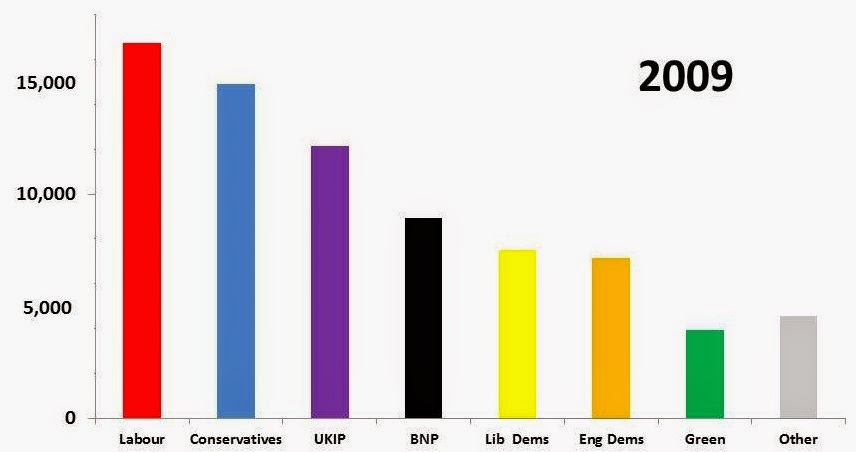
which can be compared with the 2009 Euro election result when there was a slightly larger turnout:


Clearly the votes in 2009 were more widely spread and the two largest parties had only 42% of the vote in contrast with 69% in 2014. At first sight it would seem likely that in 2014 UKIP benefited from the collapse of the BNP and also acquired a large part of the Tory vote. Indeed, in 2009 the combined UKIP and BNP vote had been greater than Labour’s. Labour’s vote in 2014 was increased relative to 2009, matching the decline of all the other contestants apart from UKIP, but particularly that of the Liberal Democrats.

The 2010 Westminster election (combining results across the three parliamentary constituencies; data from the three Doncaster constituency links above) had shown how the smaller parties find it difficult to sustain the number of their voters, let alone their shares of the vote, when the turnout goes up:


The pie charts give a better view of the way the vote share alters. The areas have been adjusted to match the numbers of votes cast in the three elections:


As for the 2015 parliamentary elections? Who knows – some Lib Dems may return to the fold at Labour’s expense and some Ukippers may go back to the Tories. But for UKIP to defeat Miliband, a large proportion of the 2014 non-voters who are expected both to turn out and to vote Labour in the 2015 Westminster election would have to transfer to UKIP.


19 May 2014

El Niño and Ed Miliband

The invaluable Ballots and Bullets Polling Observatory at the University of Nottingham’s School of Politics and International Relations recently produced their 36th summary of opinion polling of voting elections since the last election:


When I posted about their 28th summary last September, I suggested that there were two axes of symmetry. One showed Labour’s poll rise reflecting the Lib Dem’s decline, the other axis the same relationship between UKIP’s rise and the Tories’ decline. This idea now seems to have broken down. The Lib Dems still seem to be stuck on a plateau below 10%. The Tories seem to have done slightly better in the last six months – if that’s because some UKIP supporters have returned home, then UKIP has nonetheless kept its numbers up, perhaps at Labour’s expense.

Once the European Parliament elections are out of the way, UKIP may enter a long decline until 2015. If it does, it will be interesting to see if that benefits the Tories, or Labour or both. And some Lib Dems may return to the fold, mostly at Labour’s expense probably. John McTernan is a centre-left commentator whose opinions are, in my view, always worth considering. (For example, see his piece for the Guardian, John Smith would have led us to a decent world, on the 20th anniversary of the Labour leader’s untimely death). In the Scotsman on 8 May, McTernan concluded that the 2015 election will be hard to call:
The Tories will prosecute an apparently simple argument: the economy is working, don’t let Labour wreck it. … For Labour, the nightmare is economic growth quickening, incomes rising swiftly.
But
The fear of the government will be that events beyond their control will overwhelm them. One of the biggest is an interest rate rise. Former chancellors Norman Lamont and Alistair Darling are both warning that there is the danger of a housing boom. Voices off are one thing, but what if the Bank of England decides to act? So many families are stretched financially that the smallest increase in mortgages could be enough to tip them over the edge. The other is an NHS winter crisis. This is what did for the Tories under Thatcher and Major – patients on trolleys in corridors would be disastrous for Cameron, as they would be the emblem of public service cuts.
And of course, these possibilities are not mutually exclusive. But, as far as the NHS is concerned, the 2014/15 winter seems a long way off on a balmy day in May. This is particularly so when the last winter was so mild. To quote the UK Met Office:
Mean temperatures over the UK were well above the long-term average for all three months {December, January and February] with a mean winter temperature of 5.2 oC which is 1.5 oC above the average and the fifth highest in the series. There was a notable absence of frosts, and the lowest UK temperature of the winter, -7.7 oC at Altnaharra, Sutherland on 17th February was the highest such winter value for at least 50 years.
whereas the year before:
The mean temperature over the UK for winter was 3.3 °C which is 0.4 °C below the long term average. December was equal to the long term average for the month, January was 0.3 °C below, February was 0.9 °C below and at 2.8 °C was the coldest month of the season. Spells of notably mild weather occurred in late December and early January, and notably cold weather in early December, mid to late January, and the latter part of February.
The difference between the two winters comes out in the charts below (blue indicating below and red above average temperatures).

2013/14 (left) 2012/13 (right) Mean Dec Jan Feb temperature anomalies
Health planners are, of course, well aware of the effect of winter conditions on the demand for health services. For example, Public Health England have a Cold Weather Plan for England 2013, Making the case: why long-term strategic planning for cold weather is essential to health and wellbeing. This points out that:
Evidence shows that there is an increase in hospital admissions from cold-related illnesses, as the temperature falls … Admissions for chronic obstructive pulmonary disease increase as temperatures fall, particularly in those most socio-economically deprived. Hospitals and social care commonly face winter pressures. These often result from a high demand for beds and difficulties in discharging patients. This may be compounded by staff shortages due to illness. Cardiovascular, respiratory and infectious diseases with a seasonal increase, as well as weather-related accidents – contribute to raising the number of admissions. Prolonged in-patient episodes can result, either due to medical complications or a delay in discharging patients because of lack of suitable accommodation.
Also
Increased levels of illness due to cold weather can put a strain on local NHS services such as general practices and hospitals. There is evidence that cold weather may prevent people from accessing these services.
It would obviously be helpful for planners to know what the weather will be like next winter. The Met Office (in Exeter, Devon, SW England) has a team of researchers engaged on monthly to decadal prediction with one specialising in the El Niño Southern Oscillation, known as the ENSO. Just how the warming of waters in the tropical Pacific ocean affects weather in the northern hemisphere is complex with other factors to be taken into account, and is certainly a subject for experts. But in 2008 the Met Office did state that:
"We have shown evidence of an active stratospheric role in the transition to cold conditions in northern Europe and mild conditions in southern Europe in late winter during El Niño years".
So it was interesting to see a fairly high probability US consensus forecast for an El Niño event this year:

Not that it means any distinct probability of El N coming to the rescue of Ed M. Better to leave that kind of forecasting to John McTernan who, despite the uncertain start to his article, ended on a more confident note:
But while the big parties fight for tactical advantage, the result of the election will probably be determined by the two minor parties – the Liberal Democrats and Ukip. The Lib Dems’ fate is easily described. In 2010 Clegg sold sincerity to the public. He broke his word on tuition fees and broke his party. They have lost votes irreversibly to Labour and will lose seats to them and the Tories. Ukip is the wild card. It takes votes from the Tories – which is bad enough – but they are also dragging Cameron from the centre ground, which is worse for him. Elections in Britain are always won from the centre, but Nigel Farage has derailed the Tories. 
So, the centre-left is united behind Labour and the centre-right are split between three parties – the Tories, Ukip and the Liberal Democrats. This is a massive advantage for Miliband. Labour is currently on 35-38 per cent in the polls, a historically low level but in 2005 Tony Blair got a 65-seat majority with a similar figure. The reason? Ukip took 2,000 votes from the Tories in every seat. It was enough. No-one doubts Farage will raise that level next year. It’s advantage Miliband.


31 October 2013

CASD, or not CASD

I have posted here from time to time about the UK’s programme to maintain its nuclear deterrent capability by replacing the current Trident submarines. These posts have mostly been about either the implications of a decision next year by Scotland to become independent and non-nuclear, or the consequences for the formation of a Labour/Liberal Democrat coalition after 2015 of the two parties having differing views on the UK deterrent.

Scotland

As far as the first of these is concerned, the current Scottish nationalist line was made less unclear by Alex Salmond when interviewed by Andrew Marr recently (The Marr Show, BBC1, October 20):
ANDREW MARR: What happens to the submarines at Faslane? Are they- do you order them to sail south and do you know where they would sail to? 
ALEX SALMOND: Well they should be safely removed. The time period for the removal once Scotland becomes independent - and after of course people have elected their first government in an independent Scotland - but if it were to be an SNP government, then we would ask the submarines to be removed from Scotland as soon as was safely possible. And the emphasis obviously on the safety because nobody would want to compromise that in any way. But of course a country has the right to say we don’t want to … possess nuclear weapons - either our own or anyone else’s.  
ANDREW MARR: When you talk to defence ministers in London, they say oh well we might have some kind of leaseback arrangement a bit like the base in Cyprus. That is for the birds as far as you’re concerned, isn’t it?  
ALEX SALMOND: Well yes it is for the birds. I think the Ministry of Defence actually briefed quite recently - I know they did - that they were going to annexe Faslane, but that particular ridiculous scare story just lasted overnight before Downing Street tried to … well did dismiss it. So you know I think the reality is that if Scotland becomes an independent country, if they choose the SNP to be the government, then we would want to see Scotland as a non-nuclear country. Part of the NATO Alliance certainly, part of the defence structures, cooperating on defence, but cooperating from the basis of being … a non-nuclear country.
Since any independent Scottish government would be elected in 2016, the removal would be “as soon as was safely possible” after this, presumably. The costs and practicalities of Trident relocation as a consequence were the subject of a post here most recently in July. I am not aware of anything particularly interesting having come up since.

The Liberal Democrats

The evolution of the Liberal Democrat position relevant to any Labour/Lib Dem coalition in 2015 has been more convoluted. The Lib Dems were for some time advocating a system other than Trident as being more appropriate for the UK. For example, in January Danny Alexander gave an exclusive interview to the Guardian which reported:
The Liberal Democrats demanded a review into alternatives to replacing Trident as part of the coalition agreement, and it was initially led by the then armed forces minister, Nick Harvey. When Harvey was moved from the MoD last September, Alexander took charge of the detailed study, which is due to be completed and published by June this year. In his first interview since taking charge of the review, Alexander said nothing he had seen or heard in the last four months had challenged his view that replacing the Trident fleet was unnecessary – and unnecessarily expensive. He said he doubted it would meet the UK's 21st-century defence requirements either, with experts estimating the whole-life costs of replacing Trident could exceed well over £100bn.
The Trident Alternatives Review was published on Tuesday 16 July. Two days earlier, the Independent on Sunday had run a story, Trident fleet may be cut to two submarines in new Lib Dem plan:
Britain’s fleet of four Trident submarines could be cut to two vessels under plans to be put to the Liberal Democrat conference this autumn. Danny Alexander, the Liberal Democrat Chief Treasury Secretary, will set out the proposal on Tuesday after heading a review of the alternative options to the £25bn “like-for-like” successor to Trident fleet favoured by the Conservatives.  
… Mr Alexander has concluded there is no practical alternative to Trident, party sources told The Independent. But he will detail alternatives for downgrading it, making clear the leadership’s preference is for a two-submarine replacement.
However, on 16 July in a speech to the RUSI about the Trident Alternatives Review, Alexander indicated no such preference:
… We can adapt our nuclear deterrence to the threats in the 21st century by ending 24 hour patrols when we don't need them, and buying fewer submarines. … a replacement nuclear deterrent based on the current Trident system is the most cost-effective in the period we are considering.
but
[A] Four-boat successor operating continuous at sea deterrence [CASD} is not the only viable approach available to the UK. … The option of non-continuous deterrence does not threaten current security. And by changing postures we can reduce cost at the same time. For instance, ending CAS-D [sic] and procuring one less Successor submarine would make a savings of about £4 billion pounds over the life of the system.
The Trident Alternatives Review had concluded:
32. The analysis has shown that there are alternatives to Trident that would enable the UK to be capable of inflicting significant damage such that most potential adversaries around the world would be deterred. It also shows that there are alternative non-continuous postures (akin to how we operate conventional military assets) that could be adopted, including by SSBNs, which would aim to be at reduced readiness only when the UK assesses the threat of a no-notice pre-emptive attack to be low. None of these alternative systems and postures offers the same degree of resilience as the current posture of Continuous at Sea Deterrence, nor could they guarantee a prompt response in all circumstances. …
and the analysis of Postures had pointed out that:
3.36  Classified analysis about attempting to maintain continuous at sea deterrence with a 3-boat SSBN option showed that the risk of unplanned breaks relates directly to the number of submarines available for operational deployment, which in turn relates directly to the total number in the fleet. The modelling suggests that, over a 20 year period, a 3-boat fleet would risk multiple unplanned breaks in continuous covert patrolling as well as requiring regular planned breaks for maintenance and/or training. Experience to date with the Resolution-class and Vanguard-class SSBNs is that no such breaks have occurred or been required with a 4-boat fleet.
In a Commons debate on an unrelated defence topic later that day, the then shadow defence minister, Jim Murphy, took the opportunity to point out that:
… what we have learnt today is that the Lib Dem part of the Government has taken two years to review a policy and spent thousands of pounds of taxpayers’ money, only to conclude that the Lib Dems’ past policy was unachievable. Today they appear to have managed to advocate both a Trident-based system and part-time unilateralism simultaneously. That is a real achievement. The British people will marvel at the incompetence of suggesting that we should pay tens of billions of pounds to send boats to sea, while the media are now being briefed that on occasion they will not even carry missiles. That is like someone having a new, expensive burglar alarm at their home with no batteries and a sign above the door saying, “Come on in—no one’s at home”. (Hansard 16 July 2013 : Column 970)
The Commons debated the Trident Alternatives Review on 17 July, with Danny Alexander providing the Lib Dem interpretation of its conclusions. He told the Commons that:
… ending CASD and procuring one fewer successor submarine would make a saving of about £4 billion over the life of the system. (Hansard 17 July 2013 : Column 1225)
which would appear consistent with Chart 1 of the Review (below).


Kevan Jones spoke for Labour in place of Kevin Murphy and, in response to a question from a Conservative, Sir Edward Leigh, confirmed the Labour party’s commitment to CASD, but went on to state that:
If changes in technology make the nuclear submarines more reliable, meaning that we can go down to three, we will consider that. (Column 1227)
Parliament went into recess shortly after the debate. The next articulation of the Lib Dem view of the UK’s nuclear deterrent was in a paper for their Autumn Conference, Defending the Future UK Defence in the 21st Century, Policy Paper 112. This recommended adopting a “Contingency Posture” which among other things would:
• End CASD but exercise the submarine capability regularly to maintain relevant skills, including weapons handling and nuclear command and control.  
• Issue a declaratory policy of going to sea only with unarmed missiles and store a reduced stockpile of warheads at RNAD Coulport for redeployment within a specified timeframe. (6.3.6)
Of the four non-CASD postures identified in the Review: Focused, Sustained, Responsive, and Preserved, the last seems most similar to the Contingency Posture. The Conference passed the Defending the Future policy on 17 September.

On 7 October, Ed Miliband reshuffled the opposition front bench, and Jim Murphy’s move away from defence drew the attention of the commentariat. Gary Gibbon remarked on his Channel 4 News blog:
Ed Miliband is said to rue the decision to continue with continuous at-sea deterrence (CASD) and four Trident submarines, and there’s bound to be suspicion that the removal of Jim Murphy from defence is part of a plan to move the party to a different place on this (even though the commitment to CASD was only signed up to this summer). In the past, Vernon Coaker, the new shadow defence secretary, has voted in favour of Trident renewal, but I wonder where he stands now and whether it came up in the chat in the leader’s office this afternoon.
Polly Toynbee was even sharper in the Guardian the next day:
Removals may say more than promotions. Jim Murphy, smoothly dangerous, evicted from defence, frees up that policy for changes he would have blocked. Suspected of serial disloyalty, turning this war tiger into a peace-loving pussycat at international development is condign punishment that raises a smile among colleagues.
But Dan Hodges in his Daily Telegraph blog knew better:
Vernon Coaker is determined to ensure that there's no backsliding on Trident renewal.
and on 16 October this News item appeared on the website of John Woodcock, Labour MP for Barrow and Furness:
THOUSANDS of submarine design and construction jobs in Barrow will be safe under an incoming Labour administration, the new shadow defence secretary Vernon Coaker MP said this afternoon (Wednesday). Mr Coaker gave the commitment to replace the Vanguard-class nuclear deterrent boats when accompanying John on a visit to BAE Systems' giant submarine-building complex in the town. Labour's pledge will also protect work carried out by supply-chain companies across the UK and maintain the nation's security.  
John said afterwards: "It's so important that the new shadow defence secretary chose Barrow over all the places in the UK to come first. He's been impressed by the capability he's seen today and the clear signal he's given is that Labour will continue with the programme that we started in government - to maintain the continuous at-sea deterrent by replacing the Vanguard submarines. That's absolutely right, but it's really good to hear it on his first outing.”  
Mr Coaker said: "The important thing is we're maintaining our commitment to an independent, nuclear deterrent. We believe that should be a continuous at-sea deterrent and the Main Gate decision for that will be made in 2016. The workers and management I've spoken to here today are reassured by that."  
Around 5,500 BAE Systems personnel are engaged in submarine design and construction at the Barrow yard with thousands more involved in supply-chain manufacturing and services throughout the UK.
So, in October 2013, about 18 months before the election, the Labour and Liberal Democrat positions on the deterrent are no longer differentiated by choices as to the most appropriate delivery system but by the appropriate “posture” for the Trident submarine force and hence the number of Successor submarines required. My view is that the current Lib Dem position can be regarded as quasi-unilateralist and intended to attract a particular left constituency which would otherwise vote Labour (or Green, or not at all). Labour’s position remains one of avoiding any hint of unilateralism, which the Tories would be certain to capitalise on, and also has an eye to the jobs at Barrow and in the supply chain referred to by John Woodcock. Whether Trident CASD would prove to be a “red line” if a Labour/Lib Dem coalition had to be formed remains to be seen, perhaps not until the possibility of one being unavoidable seems likely.


As a reward for anyone who has bothered to read this post to the end, left is Henry Moore’s Atom Piece (Working Model for Nuclear Energy), now on display in Tate Britain. The University of Chicago commissioned Nuclear Energy and the full work was unveiled in 1965 by Moore and Enrico Fermi’s widow, Laura, on the site of the first man-made nuclear reaction . Moore, who was a CND supporter, said that he intended the upper part of the sculpture to resemble the mushroom cloud of an atomic explosion (Roger Berthoud’s The Life of Henry Moore, page 394).


UPDATE 24 NOVEMBER

It is probably worth recording the following exchange at PMQs on 20 November (Hansard Column 1229):

Dr Julian Lewis (New Forest East) (Con): If he will rule out the removal of continuous at-sea nuclear deterrence for as long as he is in office. 
The Prime Minister: As I told my hon. Friend when he last asked about this issue, if we want a proper, functioning deterrent, we need to have the best. That means a permanent, at-sea, submarine-based posture, and that is what a Conservative-only Government after the next election will deliver. 
Dr Lewis: May I reassure my right hon. Friend that that excellent answer will remain on my website for as long as it takes for the pledge to be fulfilled? I notice that he used the words “Conservative-only Government”. Will he reassure the House that never again will Liberal Democrats be allowed to obstruct or delay the signing of the main gate contracts, and will he undertake to sign those contracts at the earliest possible opportunity? 
The Prime Minister: I would say a couple of things to my hon. Friend. First, investment in our nuclear deterrent has not ceased. Actually, we are taking all the necessary steps to make that main gate decision possible. Also, we have had the alternative study, which I do not think came up with a convincing answer. I have to say, however, that I do not feel that I would satisfy him even if I gave him a nuclear submarine to park off the coast of his New Forest constituency. [Laughter].


28 October 2013

The Oxford Incumbency

In the FT Weekend Magazine of 26/27 October, its editor, Simon Kuper, indulges in a trip down memory lane in the form of My return to Oxford, 25 years on, with the theme:
The Oxford I knew – shot through with sexual harassment, racism, dilettantism and sherry – has been replaced by something quite professional and money-conscious.
He tells his readers:
It wasn’t very hard to get into Oxford in my day, as almost all students – whether from private or state schools – were drawn from the small British upper and upper-middle class. Moreover, most were men.
and
Once you’d got in, little effort was expected. … Often an entire week’s workload consisted of writing one shortish essay (good preparation for being a columnist). Some of my essays were so shoddy that when I reread them before my final exams, I almost wrote to my old tutors to apologise. Many tutors didn’t care anyway. … A tutor in my college was known for exposing himself to some students, and trying to recruit others to the intelligence services. Another harassed so many female students that finally action was taken: he was banned from tutoring women one-on-one. Political correctness was not rampant then.
He justifies this remembrance of things past by pointing out that:
All this might seem like ancient history, except that many of today’s British politicians – David Cameron, Ed Miliband, Michael Gove, George Osborne – were Oxford contemporaries or near-contemporaries of mine.
(although not, apparently, Boris Johnson, subject of the cover story on the FT Weekend Magazine a month earlier – but see Note 4 below) despite the fact that:
Oxford had educated Thatcher (and most other recent British prime ministers) and yet it felt apolitical.
The table below supports the statistical element of this remark:


Some interesting points:
  • In 16 of the 18 general elections since 1945, the winning Prime Minister was educated at Oxford.
  • Of the 10 PMs elected since 1945, eight went to Oxford.  Of all 13 PMs since the war, nine went to Oxford. 
  • On only one occasion, 1951, did an Oxford-educated incumbent, Clement Attlee, lose to a non-Oxford person –the “Former Naval Person”, Winston Churchill. 
  • In only one election, 1992, had neither candidate been to Oxford. 
In 2015, it seems highly likely that two Oxford graduates will be in contention for the Prime Ministership: David Cameron as incumbent and Ed Miliband. This has been the case in eight elections since 1945, in six of which the incumbent remained in office (which would be 2015A). The two precedents for Miliband’s becoming PM (2015B) are Edward Heath displacing Harold Wilson in 1970 and Wilson displacing Alec Douglas-Hume in 1964. Miliband’s winning is not impossible, of course, but the second of these precedents is not particularly encouraging, Cameron being a far more credible incumbent than Douglas-Hume.

Notes
(1) Harold Macmillan did not graduate from Oxford, his studies having been interrupted by war service.
(2) Known as University College of South Wales and Monmouthshire in Neil Kinnock’s time there.
(3) Cameron, a Conservative, has been leading a coalition since 2010.
(4) Osborne and Miliband graduated in 1992, Cameron and Gove in 1988 and Johnson in 1987; Kuper circa 1991.


UPDATE 30 OCTOBER

If you found this post interesting, you might like:
Ages at the Audience
and
Top Politicians: Birth Order and Handedness