Showing posts with label Louise Mensch. Show all posts

3 August 2014

By their tweets …

On 31 July the new UK Foreign Secretary, Philip Hammond gave his first newspaper interview to the Sunday Telegraph which reported his remarks on 3 August, concentrating on the situation in Gaza. Notably:
“The British public has a strong sense that the situation of the civilian population in Gaza is intolerable and must be addressed — and we [the UK government] agree with them.”
He was also quoted as saying that:
The British public is “deeply disturbed” by the suffering of the people of Gaza …
Judging by some of the heated remarks on the normally calm parts of Twitter which I follow, he is probably right, and not just the British public. Perhaps people are being led into saying things they normally wouldn’t, or are just being careless about what they are saying. I couldn’t help being struck by this tweet (2 August, 16:02), one of many about Israel and Gaza from Louise Mensch (@LouiseMensch):


Two questions came into my mind reading this. Firstly, why “know” as opposed to “expect” or “suspect” or “wouldn’t be surprised if”? Secondly, why Shin Bet? This, as far as I understand, is Israel’s internal security service, as opposed to Mossad which operates externally.

Given its formidable reputation, I would be surprised if Mossad wasn’t aware of Mensch: a former Conservative MP retaining a keen interest in UK politics, living in New York with a Jewish husband, and writing a column for a Murdoch newspaper would seem to tick quite a few boxes as a person of interest. 

Her tweets often form part of a dialogue with others which can be combative at times. One of those with a different viewpoint from hers currently about Israel and Gaza is Richard Kemp (@COLRICHARDKEMP) who came up with these two among many others (2 August, 18:36 and 18:42):


“So-called” or “self-styled”? No matter. Kemp is a bit of an international man of mystery to judge from his single-page personal website:


but the website of his book, Attack State Red, is more informative and the description it provides would seem to support this particular point during a later exchange with Mensch:
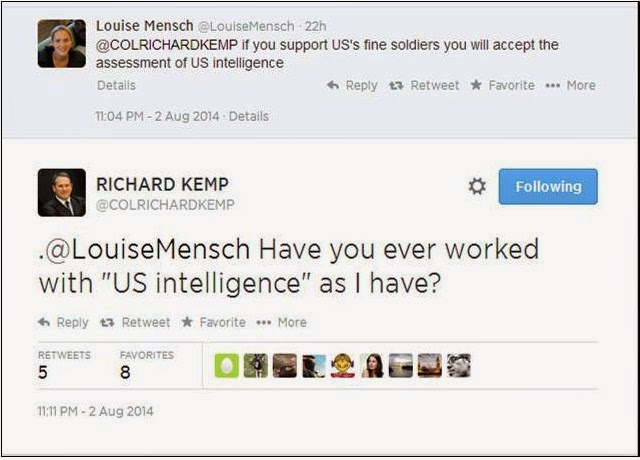

but to be fair to both parties, their dialogue should be read in full.


17 November 2011

Politicians and Twitter – “just like me” or you?

The Telegraph magazine on 12 November carried an article, Too Big to Fly?, by Joe Hagan:
While Twitter struggles to impose order on the 200 million messages a day that cascade through its servers, the battle to make the company profitable has become a race against time.
The article concluded that the potential for profitability exists, but a way has to be found to introduce advertising without turning the tweeters and their readers off the whole thing. Hagan’s article contained a lot of interesting material, some of it particularly so:
To attract and hold the audience, and to attract the talent, Twitter needs the media as its accomplice. In 2008, Twitter hired Chloe Sladden, a former executive at Al Gore’s TV network, Current, to work with news agencies and cable networks. An attractive and animated speed-talker with bright, flashing eyes, Sladden was tasked with convincing old media that Twitter was the handmaiden to their future. … 
The impact of all this hand-holding was not only to help the media but also to help the media help Twitter. To make Twitter seem inevitable, it got people with large organic followings, like newspeople and celebrities, to use it and draw in more users - what social-media investors call ‘viral looping’. Sladden is in charge of schooling these adoptees – television’s talking heads, reality television producers, newspaper columnists - in the ways of Twitter, which is, in essence, about giving followers that ‘magical feeling’ of being inside with the insiders. Sladden’s message is that to build an audience, you have to draw back the curtain on your life, or appear to. In Sladden’s view, this is perfectly in step with broader developments in the culture. ‘We’re changing to this more quote-unquote authentic media experience,’ she says, and everything is caught on tape. And that was a big part of the mission here, making it a two-way experience.
The key to this ‘authenticity’ is the use of the word ‘I’. The first rule of Twitter is that talking about yourself makes the tool work better. The upshot is a narcissism so democratized that users don’t have to feel guilty about it and, in fact, barely notice it.  
In 2007 Twitter hired Adam Sharp, a former aide to Senator Mary Landrieu of Louisiana, to promote Twitter among the political class. Working closely with new-media staffers in the congressional caucuses, Sharp held private events to teach senators and congressmen why and how they should use Twitter, promising that they can ‘build a deep echo chamber to have a continuing dialogue with these people, who then go into their communities and they can say, “I was tweeting with Senator So-and-so last night.”’  Sharp figures three-quarters of Congress have signed on to Twitter. Sharp says, ‘If they can make that connection – “Oh, he’s a family man, he’s just like me,” or “She’s a working mother, just like me” - the candidates realise that the “just like me” is the most effective foundation for engaging in the political conversation.’
So, when we read tweets from British politicians, like Ed Balls’ about his culinary achievements, or Louise Mensch’s on going to Asda, and if we experience a ‘magical feeling’ of being insiders in their lives, we should bear in mind that it’s just possible that they (or their staffers) have had private training in how to build ‘deep echo chambers’. Remember, politicians are by definition not “just like me”, or you, at all.

Hagan’s article, which is well worth reading in full, doesn’t seem to be on telegraph.co.uk, but his similar piece published on 2 October, Tweet Science, is available on the New York magazine’s website.