Showing posts with label George Grosz. Show all posts

13 March 2014

Hannah Höch at the Whitechapel Gallery


Art in Germany between 1919 and 1933 fascinates me and there have been posts here about the Bauhaus, George Grosz, Kurt Schwitters and the German Expressionist pictures in Leicester. So, very better late than never, I was glad to have been able to visit Hannah Höch at the Whitechapel Gallery before their show of over 100 works closes on 23 March.


Höch was born in Gotha in 1889 and escaped from a kleinburgerlicht family to Berlin in 1912 to study the applied arts and textile crafts. By 1919 she had become part of Berlin’s Dada movement, its only woman member, alongside Schwitters, Grosz, László Moholy-Nagy, Paul Citroën and her lover, Raoul Hausmann (left). There are two portraits of Höch by Hausmann in the show, one a 1917 nude, the other a woodcut on a banknote from 1923, the year of the most severe Weimar hyperinflation. However, it was arguably Schwitters who had the more enduring influence, possibly introducing her to collage (as is claimed at the end of the exhibition), and adding an h to Hanna to make her forename palindromic. Grosz and John Heartfield (born Helmut Herzfelde) tried to keep her work out of the First International Dada Fair in 1920, but as a fine riposte to their chauvinism she produced a large collage, Cut with the Dada Kitchen Knife through Germany’s Last Weimar Beer-Belly Cultural Epoch (Schnitt mit dem Küchenmesser Dada durch die letzte Weimarer Bierbauch-Kulturepoche Deutschlands, 1919, not at the Whitechapel, above).  Smaller pieces of sardonic social criticism are Heads of State (Staatshäupter, 1918-20, below top) and High Finance (Hochfinanz, 1923, below bottom). The first shows the Weimar President, Friedrich Ebert, and his defence minister, Gustav Noske, who crushed the Sparticist uprising in 1919.


In the 1920s Höch was working for the publishers Ullstein and had easy access to magazine illustrations and articles addressed to the emerging New Woman. From 1924 to 1930 Hoch worked on a series called From an Ethnographic Museum (Aus einem ethnographischen Museum) combining photographs of contemporary women and non-Western women and sculpture (Untitled, 1930 right). The Whitechapel tells us:
At once beautiful and monstrous, these compositions allow for a complex discussion about the presentation of the female body, of notions of exoticism and of the legacy of colonial aesthetics and politics.
No, I’m not sure either.  Not all of her work was as serious, for example, Marlene 1930 (Dietrich’s legs, doubtless, below left) and the later Made for a Party (Für ein Fest gemacht, 1936, below right).


Höch’s relationship with Hausmann had ended in 1922 and in 1926 she embarked on a nine-year affair with the Dutch female writer Til Brugman. Unlike many artists who fled Germany when the Nazis came into power, Höch (“constantly being watched and demonised”) went into internal self-imposed exile by obscurity in a house on the outskirts of Berlin and in 1938 married Heinz Kurt Matthies, a German businessman, though they would divorce in 1944.

In 1945 she would emerge from what she called “12 years of misery – forced on us by a mad, inhumane, yes, bestial ‘clique’”. The exhibition includes many works after 1945 which show the effects of the expansion of colour printing on her source material and the tendency of her compositions to become either more fantastical and surreal or more abstract than before the war. The exhibition ends with a video which draws on documentary interviews with Höch in the 1960s and her ‘collage of collages’, Life Portrait (Lebensbild, 1972-73, below). Höch died in 1978, probably the last of the Dadaists.  There are few opportunities to see her work in the UK so get to the Whitechapel before it's too late!


(Some reviewers have titled the exhibition as “Hannah Höch: Radical Works from the Woman Behind Collage”, but the shorter the better, I think.)


14 MARCH

Just an afterthought, but I wrote above:
Unlike many artists who fled Germany when the Nazis came into power, Höch (“constantly being watched and demonised”) went into internal self-imposed exile by obscurity in a house on the outskirts of Berlin…
Not an elegant sentence for sure, and I’m wondering also whether it wasn’t quite that simple. Nazi Germany was a police state so it seems a little doubtful that a marked man or woman could avoid attention from the authorities, starting with the local gauleiter, for long. Was it that the Nazis, who thought the proper concerns of women were Kinder und Küche, didn’t want to draw attention to a woman like Höch? It might have undermined the credibility of their attack on Entartete Kunst (Degenerate Art) to make too much of a collage artist, and was she considered best ignored as long as she kept quiet?

I envy those interested in this subject and in New York where the Neue Galerie currently has a show, Degenerate Art: The Attack on Modern Art in Nazi Germany, 1937.


28 November 2013

Paul Klee at Tate Modern


A post here last year about the Bauhaus exhibition at the Barbican Art Gallery mentioned three painters who had spent time in Weimar and Dessau: Paul Citroën, Wassily Kandinsky and Paul Klee. Searching on Google, I can find no evidence of a recent retrospective of Citroën’s non-photographic work but Kandinsky is widely exhibited (eg currently at the Guggenheim in New York), and Klee almost as much (eg earlier this year in Rome). Nonetheless, a full retrospective is always worth seeing for any artist and The EY Exhibition: Paul Klee – Making Visible at Tate Modern is the first large-scale showing for Klee in London for over 10 years.

Klee was born in Bern in 1879 and moved to Munich to study painting when he was 19. He began to establish himself as an artist in his early thirties and the Tate exhibition shows 128 examples of his work from 1912 until his death in 1940. Klee produced and carefully catalogued about 10,000 paintings, drawings and other works. In 1911 Klee met Jawlensky, Marc, Kandinsky and others and joined the Blaue Reiter group (Landscape with Flags 1915, left). In 1914 he travelled to Tunisia and its colour, light and landscape would influence his subsequent work. From 1916 to 1918 Klee served with the German air force. His 1920 Aerial Combat (below left) is in sardonic contrast to Nevinson’s Futurist Spiral Descent 1915, seen recently at Dulwich, while his experience of the chaos of postwar Germany reflected in Memorial to the Kaiser (also 1920, below right) shares the viewpoint of his contemporaries like Grosz. Both these works were produced by the oil-transfer method, tracing over painted paper then transferring onto a blank sheet.


Klee joined the staff of the Bauhaus in 1921 at Weimar, moving in 1926 to Dessau. In 1922 in Berlin he encountered Russian constructivism in the form of works by Malevich, Tatlin and others. Klee’s work in his Bauhaus years involved colour investigation in both constructions and imaginative surreal pieces (Pictorial Architecture Red, Yellow, Blue 1923 and Around the Fish 1926, below left and right). In 1930 his work was exhibited at the Museum of Modern Art in New York and that year he left the Bauhaus to teach in Dusseldorf. In 1933 Hitler became Chancellor of Germany and within a few months the Bauhaus closed. Klee and his family left for Switzerland in December. In poor health after 1935, he died in 1940, the same year as his father.


Brian Sewell in the London Evening Standard liked the Tate’s catalogue but had reservations about both the exhibition and the artist, as did Andrew Lambirth in the Spectator, although of a different kind. Klee described himself as possessed by colour and since reproductions fail to do justice to the subtlety with which he used it, the opportunity to visit The EY Exhibition: Paul Klee – Making Visible and view source works is worth taking. The exhibition continues until 9 March 2014.


20 October 2013

Georg Grosz at Richard Nagy

George Grosz (or Groß, 1893‑1959) was first referred to here almost two years ago, and more recently I mentioned that some of his drawings are at Leicester. There seems to be only one of his paintings in a public collection in the UK, Selbstmörder (Suicide) 1916 owned by the Tate. Last year the Richard Nagy Ltd gallery showed the Silverman Collection of German and Austrian Expressionist art which included Grosz’s Tempo der Strasse (The Tempo of the Street, left). The Nagy gallery has included this picture in a new show of nearly 50 drawings, oils and watercolours, Georg Grosz’s Berlin: Prostitutes, Politicians, Profiteers, which, as they point out, is the first major exhibition in this country dedicated to Grosz since the Royal Academy’s retrospective in 1997.

The coarseness of Grosz’s work is not to everyone’s taste but his harsh satirical view of a ferocious crowded Berlin is a particular reflection of his times: German defeat in World War 1 and the exile of the Kaiser, hyperinflation, conflict between Communists and Nazis and the rise of Hitler. Most of the works are from 1918 to 1928, Grosz leaving Berlin for the US in 1932. He was a founder of Dada but his use of colour, often watercolour on a wetted surface, can be regarded as showing the influence of his Expressionist contemporaries, although he was undoubtedly familiar with Futurism and Cubism as well.


The Nagy exhibition (above) continues until 2 November, and worth seeing for anyone with an interest in inter-war European art.


7 December 2011

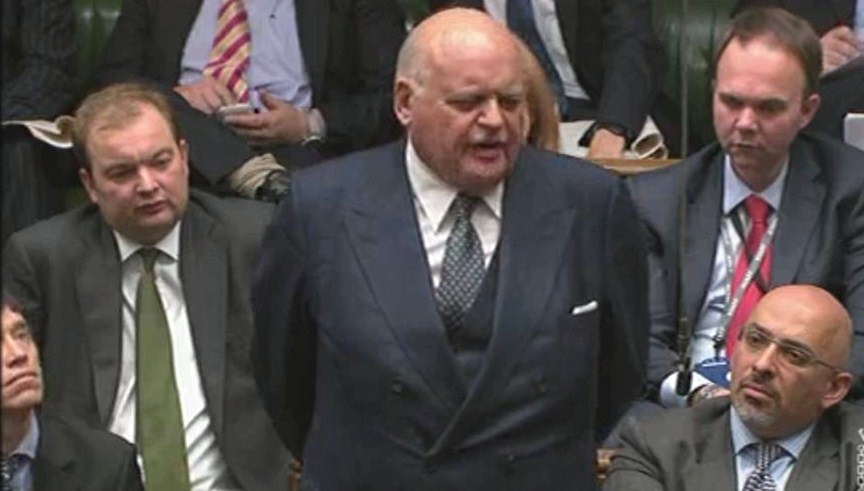
George Grosz at PMQs

Watching PMQs today, perhaps it was David Cameron’s remark:
... Labour would put Britain in such a bad position that the tax changes would be written not by the shadow Chancellor, but by the German Chancellor.
but for some reason an image of the honourable members


suddenly made me think of the art of George Grosz. Most unfair, it must be the poor lighting in the Chamber or I need a new TV.


Grosz (1893-1959) painted in a Dadaist then Expressionist style in Weimar Berlin until he emigrated to the USA in 1933.