4 February 2015

William Blake at the Ashmolean

William Blake Apprentice and Master at the Ashmolean Museum, Oxford aims to provide a chronological account of the life and work of Blake (1757 – 1827), engraver, painter and poet, though, inevitably as an exhibition, it is most informative about the first two of these roles. At the age of 17 Blake entered a seven-year apprenticeship as an engraver after which he studied at the Royal Academy. Zoffany’s painting of the Academy’s Professor of Anatomy, William Hunter MD (c1772 below) indicates the thoroughness of its schooling at the time.


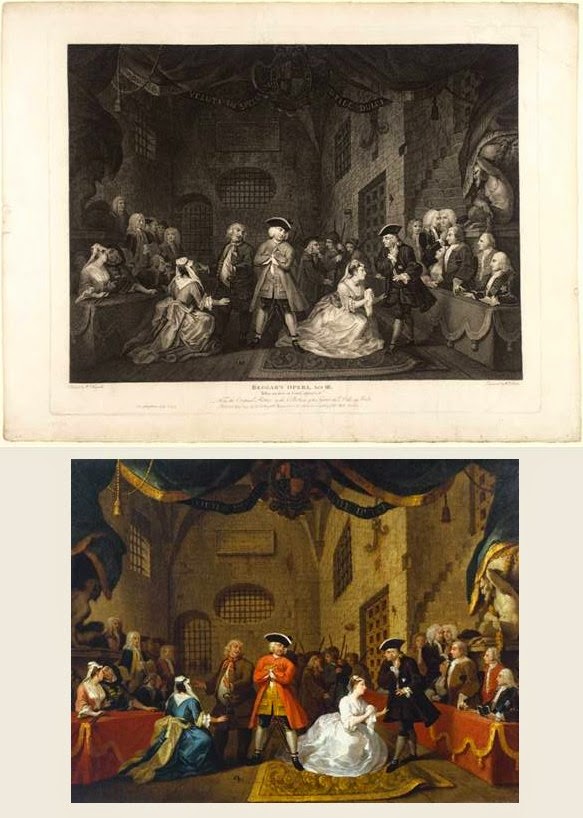
The exhibition is largely chronological and shows how, once developed, Blake’s skill as an engraver brought commercial success, for example his copy, Beggar’s Opera, Act III (1790, below top), of Hogarth’s painting, A Scene from ‘The Beggar’s Opera’ VI (1731, below lower).

The exhibition then moves on to Blake’s innovations in printmaking which allowed the integration of text and illustration, eg Laocoon (1826-7, below):


and in hand-coloured relief etching through which he created such memorable images as Los Howl’d from the First Book of Urizen (1796, poster above), Nebuchadnezzar (c1795–1805, below top) and Newton (1795, below lower):


The interpretation of these and other images and their place in his writings is rather beyond the scope of this blog. Blake’s religiosity, mysticism and political views to be found in his writings are specialist areas in their own right. But I did recall this passage from one of Anthony Powell’s A Dance to the Music of Time novels. Nicholas Jenkins (the novels’ narrator) is attending the Victory service held in St Paul’s Cathedral, London in 1945:
…We rose to sing Jerusalem. 
'Bring me my Bow of burning gold;
Bring me my Arrows of desire; 
Bring me my spear; O Clouds unfold!
Bring me my chariot of fire!'
Was all that about sex too? If so, why were we singing it at the Victory Service? Blake was as impenetrable as Isaiah; in his way, more so. It was not quite such wonderful stuff as the Prophet rendered into Elizabethan English, yet wonderful enough. At the same time, so I always felt, never quite for me. Blake was a genius, but not one for the classical taste. He was too cranky. No doubt that was being ungrateful for undoubted marvels offered and accepted. One often felt ungrateful in literary matters, as in so many others. (The Military Philosophers, page 229)
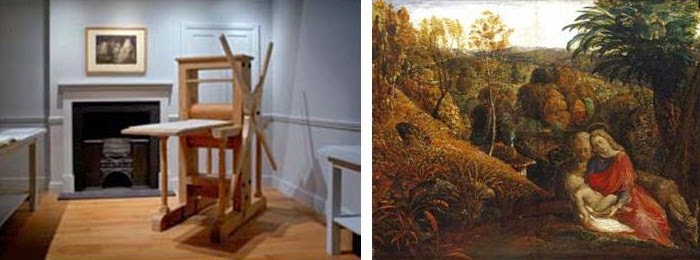
The curator has taken the trouble to recreate the room in Blake’s house in Lambeth (demolished nearly 100 years ago) where he made his prints, complete with a new printing press of the type he used (below left). One imagines that the original would have been well-stained with spilt ink. The show ends with works by some of the younger artists who had become his followers at the end of his life, for example Samuel Palmer’s Landscape with the Repose of the Holy Family (1824–1825, below right).

William Blake Apprentice and Master ends on 1 March 2015.


2 February 2015

JC Chandor’s ‘A Most Violent Year’

A Most Violent Year is set in 1981 in New York where Abel Morales (Oscar Isaac) is an emerging presence in the cutthroat business of distributing heating oil. Just as he is about to close on a real estate deal for a riverside tank facility which would turn him into a major player, his rivals close in. His employees are intimidated, his family are threatened and an ambitious young assistant District Attorney (David Oyelowo) puts him under investigation. Abel’s wife, Anna (Jessica Chastain), keeps the business’s books in the less than rigorous fashion of the time and sector and, coming from a mafia family, has her own views on how to handle the situation. Abel sets out to do better than that, believing that a man “must take the path that is most right” and being totally confident in his ability to do so and in his own powers of leadership. The film is the story of how, rather against the odds, he succeeds and is revealed to be cut out to be much more than a dealer in kerosene. I would be surprised if Chandor doesn’t return before long to the story of Abel Morales .

Abel’s fastidiousness and ambition gives Isaac a chance to reveal his considerable dramatic range, quite a different characterisation from those of Rydal in The Two Faces of January and (Inside) Llewyn Davis. Chastain, notable in Zero Dark Thirty, has a couple of good scenes but the film is primarily about Anna’s husband.

Chandor’s first feature, Margin Call, which he also wrote and directed, was primarily about investment banking at the time of the crash, Wall Street and New York providing the background. This film, his third, is down on the streets and audiences outside the US may not always appreciate the nuances of a scenario firmly embedded in a particular American city (even if they realise that in the US a DA has to run for office). By far the most helpful and informative review of A Most Violent Year which I have read was, perhaps not surprisingly, that in the New Yorker by their David Denby who has been a film reviewer in New York since the 1970s.

Chandor has now started on Deepwater Horizon, a story about the offshore drilling rig disaster in 2010 which had such dire consequences for the UK oil major, BP. It will be interesting to see what line he takes and consequently what British critics decide to make of it.